
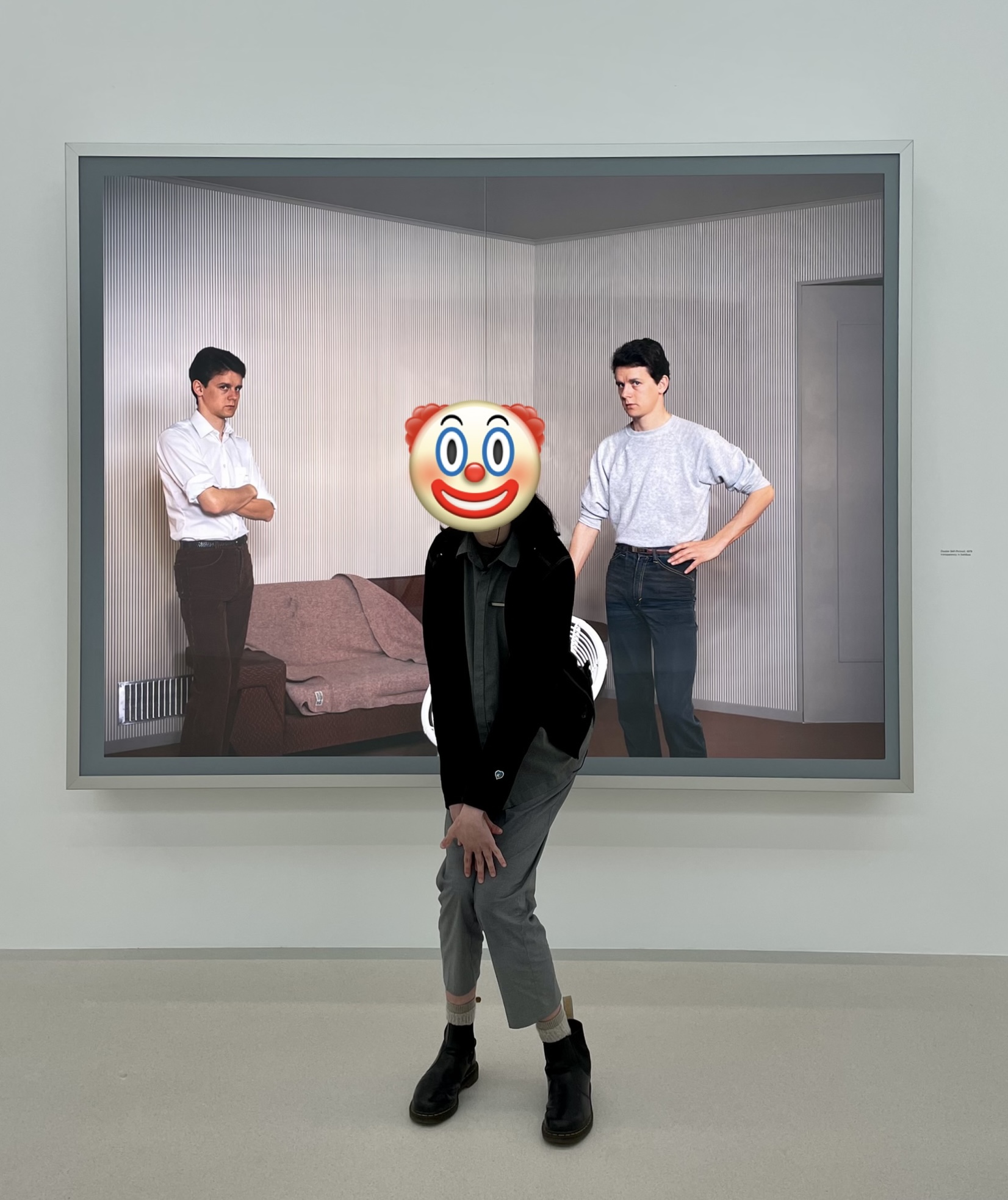
(The author and Jeff Wall’s Double Self-Portrait, 1979. The flooring in this image: terrazzo.)
Concrete
Most of the walls are made from concrete, pre-cast into panels and weathered outdoors in North Carolina. The floors of only two rooms are made of concrete: one exhibit room and the main loading dock. The loading dock is where we’d gather to hear the featured artists speak, our employee status granting exclusive access to the secrets of their practice. The sound would bounce off the walls and concrete floor so much that I had to strain to understand. The head curator once introduced us guides to a visiting artist as “walking, talking wall labels.” I’ll never forget the rage I felt in that moment.
6/10. Not especially comfortable nor remarkable.
Argillite gravel
Only used in one quasi-outdoor exhibit. Outdoors in that there is no roof, indoors in that there are four walls. Outdoors in that you can see planes following the Potomac River overhead, close enough to guess the airline, indoors in that photos are prohibited. The gravel surrounds a sixteen-foot-deep pit full of carefully welded and rusted steel. Because of the safety hazard, one guide always watches while the other gives a tour. When I would watch, I would shuffle some gravel into a little mountain for my left foot to stand on, making up for the difference in the length of my legs. There is little shade in this room on hot summer days, and the argillite helps to amplify the heat. One guide jokingly called the room “the fires of hell” on an especially sweltering day. Our manager complained that we were too demanding regarding the Gatorade they’d promised. We weren’t allowed water bottles on the museum floor. Two guides passed out from heat stroke in 2021.
7.5/10. Crunchy, not too bad on the knees. Generates red dust that visitors track into the museum.
Terrazzo
The material used throughout most of the larger building. Smooth and cool to the touch. Hard and unforgiving. On the day in June right after Roe v. Wade was overturned, I broke down crying because I couldn’t handle telling each visitor who came through about how the work was all about the obliteration of the self that accompanies rape. When I told my manager that our team was stretched thin, she replied that I couldn’t know that because I only knew my own feelings at any given time. I was projecting my exhaustion onto others, never mind that my coworkers told me, with their own voices, that the job was too demanding. I sank to my knees, and my hands met the unyielding terrazzo.
3/10. Standing on terrazzo for hours left me with shoulder pain. Beautiful, but bad for acoustics.
Limestone
Blissfully cold on hot days. Used in the smaller gallery which gets fewer visitors. I was always excited to be assigned there, because it was easy to gauge exactly how many visitors were in the building, so I knew when I could sit without consequences. Splaying out on the cool stone was always relaxing, and sometimes I’d even get some stretching in. I never felt the need to stretch until I started this job, but now every day brought a new kind of spinal pain. The main gallery floored with limestone has large windows and a great view of the founders’ home. On some days they had the blinds up and I could see them drifting about their kitchen.
6.5/10. Like concrete, gray and unremarkable.
Douglas Fir
The oldest guide on our team is probably the kindest woman I’ve ever met. Some days her husband would come to the museum just to say hello to her. She’d tell us younger guides that we would bring the change in the workplace that older generations can’t even imagine asking for. She told me that once, after hours of standing on the Douglas Fir parquet, her feet hurt so badly that that evening she had to crawl to her car.
1/10. The hardest material I’ve ever stood on. You can feel your knees lock up immediately. Looks delicious, like a Smith Island cake. Visitors love the unique pattern.
Maple
Makes up the flooring and walls of the arrival hall. A long maple bench lines the far wall—one of the museum’s few places to sit. When large groups came through, I would sometimes stand on the bench to make myself more easily seen and heard when giving visitors the long introduction to the museum’s many rules. It was the opening weekend of the large exhibit all informed by trauma—the exhibit I later broke down crying in—the exhibit that pushed me to quit—and I had just started giving all visitors I spoke to a verbal content warning for that room, one that I had put together myself because curatorial had done no such thing. The material deals with sensitive topics such as sexual assault, gun violence, and loss of a loved one. There are no written warnings and the meaning of the art isn’t immediately apparent so I’m telling you now. A woman approached me after I addressed her group, and asked which room it was on the map so she could avoid it.
9/10. Easily the most comfortable to stand on. Soft and springy, warm and bright when hit by afternoon sunlight.
 Unruly Bodies
God, this is so poignant and pungent and so well-written. Reads like poetry, the kind that makes you sad and angry at the same time. When I think of awful places to work, I have to admit that an art museum isn’t on the list, but I suppose it comes down to the people, not the place. That bit about the older guide and her hope for younger generations is so bittersweet and so damning – How many years has she spent standing on that fir? How/why has she put up with it for so long?
I honestly do think there’s a generational difference here. Whenever I complain to my parents or relatives about my work experiences, I’m always told that it’s like that everywhere. And whenever I say the same to people my age (early 20s-ish) they agree that what’s happening is awful. Maybe it’s because we haven’t had the chance yet to be jaded by decades in the workforce? Or maybe because we were never there to see capitalism succeed, for the most part and this is with a million caveats, to create a stable middle class?
I LOVE this. (It reminds me, in the best way, of John Green’s “The Anthropocene Reviewed” — if you ever need a good cry, listen to the episode called “Auld Lang Syne.”) The curator’s comment about you being “walking, talking wall labels” perfectly captures the dehumanization of laborers. And the fact that you cried on the floor is the perfect transgression of that dehumanization. For better or for worse, crying in front of people forces them to see you as a human. In a weird way, I think it’s kinda empowering? Like, not in a fun way, but in an unruly way.
So GUESS WHAT this is absolutely inspired by the Anthropocene Reviewed (“Googling Strangers” is my personal favorite gut-punch). And you’re right, crying in that moment somehow felt terrible and great at the same time. Sometimes, when customers and employers see workers as subhuman, it can be liberating to act as human, as flawed, as ungovernable as possible.