
Race controls society no matter how you think about things. Recently I have been talking about race a lot with my friend who is mixed. It made me think of how society and cultures will make you choice a race if you are mixed. Society seeing you be too black or not black enough , too white or not white enough , too asian or not asian enough, etc. When you think race do you just see color or do you see features? Do you see mannerisms , clothings, lifestyle living? I knew I was my race because thats what society told me and they made sure I fit the description of what my race should be I grew into it and embodied it. When people are mixed they either feel the need to choose or society makes the choice for them of the race they embody. I think of how people that are mixed might feel pressure and discount from their communities that should be embracing them. A conversation I had was how can we as a society or community can embrace and make sure these individuals feel accepted and loved.
Read more: Is my body my own or is it my race?social construction
Can Society Truely Change?
Are any of the phenomena that society has built their understanding of the world around truly changeable, or are humans just flawed to always fall victim to them? I have struggled with conceptualizing if changing how society has built and its understanding of people can actually become a reality, because people will always be flawed if the society they live in was built wrong. I am not saying humans cannot change and we cannot redefine the phenomena that have built societies deep-rooted issues with sexism, racism, homophobia, and more. I truly believe individual people can change, can grow, and can become educated on things that they were not before; and learn from the past. Sexism, racism, homophobia, ableism, and so much more were institutionalized into how our society was built though. If they are built into something, how does it get removed; without completely rebuilding the flawed creation of society? These are not little issues that can be worked around, like sometime happens when something is built wrong, these are fundamental and structural flaws on what was built. Fundamental and structural flaws will often lead to destruction or demise, and that is why many things with fundamental and structural flaws are completely redone. This leads me to struggle with the idea of how to redo society without completely rebuilding it and completely redoing it would be tearing down and stating over without these fundamental structural flaws. Yes, the world is becoming more accessible, adaptable, accommodating, and people can change, but can those fundamental structural flaws/issues ever truly go away or will there always be a struggle for equality because they are built into the world so deeply?
Truly Unruly Body (Medical Trauma)
Phenomenology this is the theory is the study of structures of consciousness as experienced from the first-person point of view. The central structure of an experience is its intentionality, its being directed toward something, as it is an experience of or about some object. In simple terms is each person can experience the same thing but due to their past have a completely different view of this experience. For me this help me better understand my own unruly body, I personally have been sick since birth I had rare disease that caused my main vein to my liver to fail as a baby in turn cause me to need a liver transplant at only 2 years old, due to this I was often sick and in and out of the hospital for many different things. With this being stated I have a lot of medical trauma that yes what they did was for the best but as a child you do not completely understand why they are doing the things to your body that hurt or our uncomfortable. This trauma I never really thought was there until I started to go to therapy and learn more about the body and mind through going back to school.
Sex a very common thing for most couples to engage in I personally have been with someone for many years but have never taken that step even though there is a desire to do so. Why? Well through this concept of Phenomenology and going to therapy it has helped me see that because of my medical trauma my body react to physical touch very negatively. I will tense up from head to toe and shut down internally this occurs suddenly and is completely out my control my body take control. I used to tense up if anyone tried to hug me as a child through teenage years due to this trauma I have been able to work through that but still struggle with physical touch outside of a hug. It is very frustrated has caused friction between me and my partner, but they have stayed by myside through this. I hope that in future we can take the next step in our relationship, and my body can learn to accept and trust physical touch again.
Work and Worth: A Journey
As a college student, I’m constantly juggling classes, assignments, and part-time jobs, and I often feel like I’m being pulled in a million directions. It’s exhausting, and I sometimes find it hard to keep up with everything. Beyond my studies, I want to be there for my friends and family, but it often feels like I’m barely keeping my head above water. Lately, I’ve been thinking a lot about how work and health are connected, especially as I prepare to step into the workforce. The transition to independence is daunting, and one of the biggest challenges I face is figuring out how to take care of myself amid all the chaos. Unfortunately, essential topics like nutrition, stress management, and work-life balance are rarely taught, leaving me to navigate them on my own.Reflecting on the history of labor in the United States, I realize that the fight for workers rights has been long and difficult. Over the years, labor movements have battled for fair wages, reasonable hours, and safer working conditions, paving the way for healthier workplaces today. But after reading “Made by the Work: A Century of Laboring Bodies in the United States” by Ed Slavishak, my perspective on the human cost of labor has shifted profoundly. Slavishak dives deep into the harrowing experiences of early 20th-century workers. It’s hard to fathom that laborers in steel mills and coal mines faced daily dangers and grueling conditions, with their bodies treated like mere tools for productivity. One statistic that struck me was that over 25,000 workers died every year from workplace accidents. That number is staggering and heartbreaking. It hits close to home for me because it makes me think about how easy it is to overlook the sacrifices of those who came before us, who were seen as expendable and pushed to their physical limits until they broke.
Sitting in my cozy dorm room, surrounded by textbooks and my laptop, I feel a mix of privilege and guilt. I belong to a generation that, for the most part, doesn’t have to face such dire conditions. It’s easy to take that for granted, especially when I’m so consumed with my own struggles. While my working environment is much safer, I can’t help but feel frustrated by how companies historically handled safety or neglected it entirely. They placed the burden of safety on workers, insisting that “the best safety device was a careful worker” (p. 152). That mindset is infuriating because it shifts the blame onto the very people who had little control over their situations.As Slavishak points out, corporate safety campaigns “shifted responsibility to avoid the costs of updating machinery or improving ventilation” (p. 152). This is maddening. It reminds me of the pressures I face in college. I often feel that I’m expected to power through exhaustion or even illness just to meet deadlines. I think about how many workers today might still feel that same pressure to sacrifice their well-being for the sake of productivity.Learning about unions and workers’ compensation laws has given me a profound respect for those who fought for workers’ rights. They understood that workers deserved to be valued for more than just their output, advocating for crucial things like life insurance and compensation for injuries. Slavishak notes how the insurance department of the Amalgamated Association of Iron, Steel, and Tin Workers directly asked its members, “What are your chances of living twenty more years? Can you afford to tempt fate?” (p. 153). That question resonates with me. It makes me think about the importance of community and looking out for one another in college. We’re not just isolated individuals scrambling to succeed; we’re part of a network that can uplift and advocate for one another. As I navigate my college journey and prepare for the future, I’m reminded that the fight for dignity in the workplace is far from over. It’s not just about securing a job; it’s about creating a work culture that values us as whole people, not just for our productivity. Reflecting on the struggles of past workers fills me with a sense of responsibility to carry their lessons into my own life. Balancing everything can feel overwhelming at times, but I know that by supporting each other, we can work toward a future where every worker is treated with respect not just for their labor, but for their humanity.
Excerpts from my investigation into disability on campus
The following is a series of excerpts for an article that I wrote for The Retriever that was published on Wednesday. (Below is from my original draft, some changes have been made in the final version for newspaper formatting.) If these tidbits interest you, you can find the whole article in print on campus now!
UMBC, I have a challenge for you.
Administration, Student Disability Services, and Facilities all tout the campus accessible routes map as the end-all, be-all solution for disabled students navigating campus. My challenge for you is this:
Make your way to the stadium lot, and then walk to the Fine Arts Building using only routes labeled as accessible. You are not allowed to use stairs, though you may use the short cuts available through buildings via elevators. (The elevator short cuts are labeled on the map below.) For extra credit, start at the top of the hill near the Walker Apartments and go to the library.
I have marked the destinations for you below. The full map is available here: https://about.umbc.edu/files/2021/09/2021-UMBC-accessible-routes-map.pdf
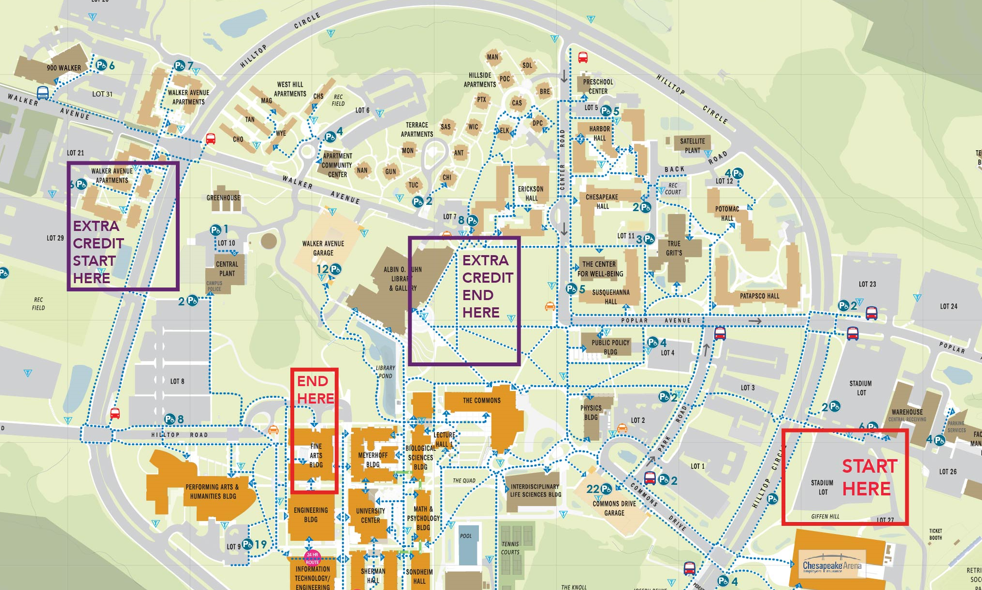
While you are walking, focus in on your body. Ask yourself: What would this walk be like if my calves were screaming in pain? What if I struggled with balance and were prone to tripping on uneven surfaces and could fall? What if I were using a walker right now? What about a non-motorized wheelchair?
What about crutches, or a lower-limb cast? When you arrive at your destination, take a note of the time. How long did it take you compared to using the stairs? Did you have to use a new route compared to your ordinary routine?
It was disclosed to me by several students that after they met all of the (stringent and privilege-laden) requirements to receive an accommodation appointment with SDS, they are told they will be unable to get the accommodations they need. In addition, it has also been reported to me that these meetings are often negative in nature with the student seeking accommodations being met with derision and/or hostility for their accommodation requests. One student, who wishes to remain anonymous, reported being “refused note-taking assistance because they needed to ‘learn how to take notes themselves,’” as well as being refused alternative text formatting as that is up to the teacher and “they cannot do anything about it.” The student accurately pointed out that both of these accommodations are among the published list on the SDS website. Another anonymous student trying to receive accommodations was told, “I know migraines can hurt sometimes but that doesn’t mean you can miss class.”
Many of the interactions that were shared with me have a common thread that is heard all too often by the disabled community: “You’re just not trying hard enough” or “It can’t be that bad”. The implications that we are lazy, that we haven’t developed strategies to succeed in our classes, or that we are somehow exaggerating our health problems are not only outdated ways of thinking about disability but are also extremely harmful. The reality of our lives is that it frequently is “that bad,” and that we wouldn’t be asking UMBC for help if we hadn’t already exhausted all of the resources available to us as individuals. To hear these words from the people put in place to help us succeed is equivalent to lifting us up only to kick us back down. UMBC is not the only institution in Maryland struggling with this problem, as this article (https://www.jhunewsletter.com/article/2021/08/disability-isnt-taken-seriously- at-hopkins) written by a graduate student at Johns Hopkins details out. Laurel Maury was awarded accommodations by JHU but found that her professors refused to use them (even under threat of legal action) and some went as far as to bully her for having them. Maury’s struggle echoes many of the sentiments that have been expressed to me by current UMBC students.
To my fellow disabled students: You are not alone, you have a voice, and your voice deserves to be heard.
When Accommodation is the Bare Minimum, What Next?
First, let me just say that TikTok is a great platform for people to speak out on what seems like small moments in their lives but are ultimately extremely impactful: few other platforms expect you to produce 60-second vignettes of information with little further context, but TikTok allows and almost requires the person behind the camera to get to the point very quickly.
To summarize the video that does not have captions (not all creators in all countries have access to that feature yet): This person is deaf and was raised in a hearing community. They started a new job, and were surprised and overwhelmed when they walked in on their first day and everyone in the office was wearing clear, see-through masks, meaning they would be able to lip read. Their first reaction was to feel gratitude for what felt like a gesture of kindness and welcome, and that they feel seen as a person.
I want to take what this person almost said and bring it a step further. This creator felt gratitude, felt welcomed, and felt seen, and they felt these things because their workplace had done what could be argued they are legally required to do in order for them to be functional in their job. While clear masks may not be spelled out as an accommodation in the ADA, it definitely became necessary during COVID-19 for the deaf community in order for them to be safe, but also to participate in society. Providing clear masks to what is presumably an office would not be considered undue hardship as it would be only slightly more expensive than providing ordinary masks to the workforce. An office with a mask mandate is most likely providing their employees with masks, so an office with a mask mandate and a deaf employee would then be legally required to provide clear masks to their workforce.
I will reiterate: This person felt gratitude because their employer did what they were legally required to do to accommodate their disability and did it promptly so the accommodation was in place when they started their first day of work.
As a member of the disabled community this tells me that the bar is on the ground. It may even be buried, and we are then overwhelmingly grateful when someone unburies the bar and hands it to us. It may still be covered in dirt and we may have a new worm friend but it’s been so long since some of us have seen the bar that we accept it as-is.
Can we even conceptualize what it would look like if every disabled person was given their accommodations on their first day of work? What would it look like if in an interview we could just hand a list to our potential employer and it wasn’t a factor in the hiring decision but simply part of their resume? What if everyone was required to submit a list of accommodations and workplace preferences as a part of their application, and it was simply accepted as standard and a best practice in hiring? What if these were accepted as necessary and automatic requirements as long as they fell under ADA guidelines and did not cause undue hardship to the employer, and thus every employer automatically provided them?
Let’s take this thought experiment one step further. What comes next? What does disability acceptance look like in a world where each individual’s needs were met to the furthest extent possible?
This may take some creative thinking on our part, but I think it’s possible to imagine. I personally can imagine an office where wheelchairs were equally as common as chairs. I can imagine that one person may be at a treadmill desk (there’s always at least one fitness enthusiast in an office) and another desk may be empty most of the time, as its owner largely worked from home. I can imagine that transcription of recorded virtual meetings would be as automatic as meeting notes, and that it would be an expectation that the office would rotate through who took on that job just like we do note-takers. I can imagine that this office would throw out traditional concepts of what a work day would look like, and what work production would look like, and that each individual would be allowed to work and produce work in a way that best suited their personality, lifestyle, neurodivergences and sleep schedules.
These ideas, though, still linger within the realm of accommodation. Is it possible to get even more outlandish in our conceptualization of disability in the workplace?
I can imagine a workplace where a disabled person has been promoted several times. I can imagine a workplace where when someone schedules a happy hour, they take into consideration locations that would be functional and welcoming for every member of the team, which may mean having drinks at a quiet restaurant instead of a loud, difficult-to-navigate bar. I can imagine that at the desk of the person who works from home, there is a prank hidden in the drawer for that person to find from a coworker who is thinking of them whether they’re physically there or not, and doesn’t care how long it takes them to find it. (Who doesn’t enjoy the long game?) I can imagine a scenario where every team member is appreciated for their social contributions to the team, and that for some people that may mean not eating lunch in the cafeteria, but may look like them tracking everyone’s birthdays and sending out celebratory emails to everyone. I can imagine that people with disabilities are treated like people and are accepted in all contexts of the word and are welcomed not only on the surface of being able to do their work adequately, but are welcomed as a human being joining a collective enterprise.
When the bar for disability accommodation is buried underground, acceptance and equity for disability is buried along with it.
Queer Brokenness: Intersection with Mental Illness
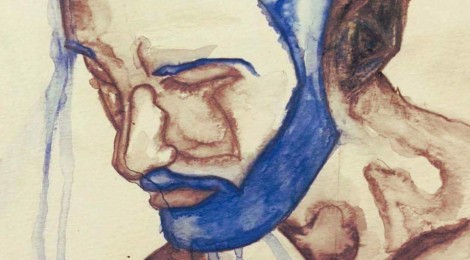
Image Source: http://trauma.blog.yorku.ca/2015/12/south-asian-queer-community-lacks-visibility/ (Artist – Jinesh Patel)
(Content and Trigger Warning: Self Harm, Suicide, Substance Abuse, Emotional Abuse, Intimate Partner Violence, Bullying)
.
.
I often find that mental illness and queerness aren’t addressed properly or constructively when talked about together. So often the public at large would have us believe that queerness is a result of mental illness or that mental illness is the result of queerness exclusively. With this in mind, the queer community will often push back on society’s behavior by talking about the two exclusively from each other, frequently ignoring all the ways mental illness intersect. That’s does not go to say that queerness is the result of mental illness or vice versa at all, but rather it shouldn’t be ignored that many people in the queer community go through both because of the way society has constructed and reacted towards queerness. For example, queerness has often been perceived as a deviant thing, it has historically been punished and worked against in a variety of ways. Continue reading
The Most Common Augmentation
While attempting to define what a cyborg is in class, I was struck with inspiration for a discussion topic on the blog. Fast forward two weeks and I had completely forgotten it, racking my brain for what I wanted to write on. I knew I wanted to write on cyborgs and how people don’t realize how common they are, but I couldn’t remember the specifi-It was memory!

Mental Illness, an existence defined by potential futures and progress
Warning: This blog contains around 1250 words. It could very well be an article in a journal.
In the previous part, I discussed that mental health is constructed by both individuals and society.
Then, what makes a certain state of mental health undesirable? What power is there in claiming a weakened state? Finally, what makes a “normal life”?
In order to understand these questions, it would be important to state the concept of “future”. It is, according to Wikipedia , what will happen in the time after the present, an inevitable event. I will add onto that definition, that future is also a nebulous concept that has not yet been determined. This has political power, in that one can create a variety of potential realities that could come into being as a result of [event].
On the ‘trans race’ argument people use to try to invalidate transgender identities
Before anything I’m going to start of by pointing out that I’m trans but I’m white. So my space in talking about this will come largely from the fact that I’ve had many people including my father try to invalidate transgender identities by saying “well if trans race identities aren’t a thing then I’m sorry transgender identities can’t be either.” So this is mostly coming from a place of defending my own identity but also calling out racism. But since I don’t actually experience racism or understand all of the complexities of this topic I invite this to be a discussion and something people can add to via comments.
So often I hear this argument that tries to invalidate transgender people, and a large response in retort to this attitude is “well you just can’t compare them because they’re different things.” I totally agree with this and it is in fact the reason. Unfortunately, for some, it’s not enough to understand. So in order to justify my identity and also keep people from muddling race and gender, I’ve thought about it a lot and decided to share my reasoning so far in explaining why we can’t simply equate the two. Continue reading


