A Modicum of Power, Respect, and Autonomy

Within the strictly imposed, purposeful, and artificially manufactured hierarchy of our society, the term ‘power’ consists of numerous meanings. The first definition that most think of is how, in many settings, power is about dominance, control, authority, and oppression. It is a matter of commanding people how to act, what to look like, and where to place one’s body. This is presumably the type of power that most incites the oppressor or the privileged to fear any semblance of gain from oppressed groups, as one’s acquisition of power is identified as something that only happens at the detriment of another’s. It is as though some are terrified that they will be unable to impart shame, terror, disdain, or indifference if those they subject to such tools of oppression and control have enough power to refute their efforts. When someone places themselves wherever they choose, exists in a body that defies social norms, or performs actions that are implicitly or explicitly forbidden without politely carrying the emotional or cognitive burdens for others’ comfort, the power dynamic experiences a significant shift.

Perhaps this view of power, as if it is a finite resource, is why our society so carefully enforces arbitrary rules and prioritizes those who can embody them. One can see this when Roxanne Gay is shouted at by a stranger who feels entitled to comment on her body, when civil rights protesters are subjected to horrific violence for challenging atrocious laws and attitudes, when the demands of disabled protestors to attend the activities of everyday life are ignored, and when incarcerated people are forced into appalling conditions. The same message applies: if we cannot control every aspect of your physical being, we will at least attempt to control our view or knowledge of your presence. 

In parallel, power can be regained by the supposedly powerless in many ways, such as when one reclaims one’s autonomy and refuses to accept, either internally or externally, the disrespect one has been bestowed. What is power, if not the presence of respect? What is power, if not autonomy over oneself, and even over others? Power is in the ability to go on with one’s day without being harassed and criticized; it is in the circumstances that allow one to move about the world freely, without social or physical barriers; and it is wholly anchored in the presumedly simple concept of peacefully living one’s life however one chooses. Why should one not have the opportunity and ability to determine one’s own life as much as possible in one’s circumstances, with as few barriers as possible? One should further ask oneself, why is seeking oppressive power over others normative and incentivized, yet the simple request of wanting to be seen and treated as human is consistently dismissed as grossly idealistic?
Did the Parents of Our Hominin Ancestors Proclaim Clothing to be Unnatural?

Throughout various abhorrent efforts to dehumanize any given particular group, the question of what is deemed ‘natural’ has often been present. The concept of ‘naturalness’ is made to be synonymous with ‘goodness,’ ‘correctness,’ and any term that denotes a certain level of social acceptability or praise. Yet, the definition of ‘natural’ does not indicate some infallible or permanently held state of being. Rather, it is an ever-changing term, constantly adjusting to new norms and technologies as our society changes.

Continue Reading

Mental Illness, an existence defined by potential futures and progress

Warning: This blog contains around 1250 words. It could very well be an article in a journal.

In the previous part, I discussed that mental health is constructed by both individuals and society.

Then, what makes a certain state of mental health undesirable? What power is there in claiming a weakened state? Finally, what makes a “normal life”?

In order to understand these questions, it would be important to state the concept of “future”. It is, according to Wikipedia , what will happen in the time after the present, an inevitable event. I will add onto that definition, that future is also a nebulous concept that has not yet been determined. This has political power, in that one can create a variety of potential realities that could come into being as a result of [event].

Continue reading

On the ‘trans race’ argument people use to try to invalidate transgender identities

Before  anything I’m going to start of by pointing out that I’m trans but I’m white. So my space in talking about this will come largely from the fact that I’ve had many people including my father try to invalidate transgender identities by saying “well if trans race identities aren’t a thing then I’m sorry transgender identities can’t be either.” So this is mostly coming from a place of defending my own identity but also calling out racism. But since I don’t actually experience racism or understand all of the complexities of this topic I invite this to be a discussion and something people can add to via comments.

So often I hear this argument that tries to invalidate transgender people, and a large response in retort to this attitude is “well you just can’t compare them because they’re different things.” I totally agree with this and it is in fact the reason. Unfortunately, for some, it’s not enough to understand. So in order to justify my identity and also keep people from muddling race and gender, I’ve thought about it a lot and decided to share my reasoning so far in explaining why we can’t simply equate the two. Continue reading

crap I have a left hand

Being right handed is the best. Why we even have a a left hand is a mystery to me? Of course I am being sarcastic but in most cultures being right handed is preferred. I mean preferred to the point that I have seen children get scolded for using their left hand instead of their right. My older cousin should be a lefty but her father decided that he would beat every impulse to right with her left hand. Today she can write with either hand. So why the preference? Here are some fun facts about left handed people;

  • see more easily under water
  •  excel in tennis, baseball, fencing and swimming
  • generally more intelligent, better looking, imaginative, and more talented
  • children having basic problems using the wrong tools so most often times considered slow. (Maybe if we make more left handed tools it wouldn’t take them forever to figure out how to use a right handed scissors.)
  • They seem to make exceptional leaders, inventors, artists, musicians and murderers!
  • more eloquent

Even with these generally good aspects that come from being left handed we are pushed to be right handed. There is a particular Nigerian food called Eba or Pounded Yam and uses one hand to eat it. Well one time I saw one family friend sitting in the corner and eating her food. I asked her why she was basically was hiding in the corner. And she replied that she was eating her food with her left hand. It was strange to me that she felt weird eating in front of people because she was using her left hand. When you type you use both hands to do so (well unless you are my mom then you use on finger) but were did this preference for right had come from? What are some things that you do better with your left hand then you right?

Pin-up boys?

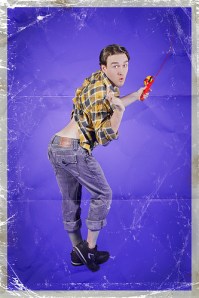
A friend sent me this series of men photographed in traditional “pin-up” girl poses. They sure capture the pin-up girl vibe: Look at those arched backs, pursed lips, and inviting gazes!

Yet the difference is obvious: these “pin-up boys” wear jeans and camo and are depicted with traditionally masculine props such as dumbbells and a wrench. What do these recognizable poses on different bodies do for us viewers?

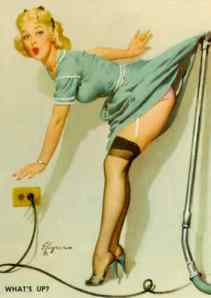
I love these pictures because they subvert the pin-up girl image. Seeing male bodies in pin-up poses takes apart what we’re used to seeing, and for me expose the silliness of pin-up girls while questioning their supposed sexiness. These guys do look silly! We’re used to seeing women with their backs arched and chests thrust out, even in the midst of their regular activities (like vacuuming, apparently). Seeing men in the sam poses while doing their regular activities (fishing? Skateboarding? Talk about the sexual division of labor!) exposes its artificiality; exposes the pin-up girl as the fantasy she is.

Do these men look sexy to you? I think they look funny, which reminds me that “sexy” means different things on different bodies. In U.S. culture, one kind of sexy = slender white women doing chores with their underwear exposed. Does it work in reverse? Do these men look sexy, or goofy and posed?