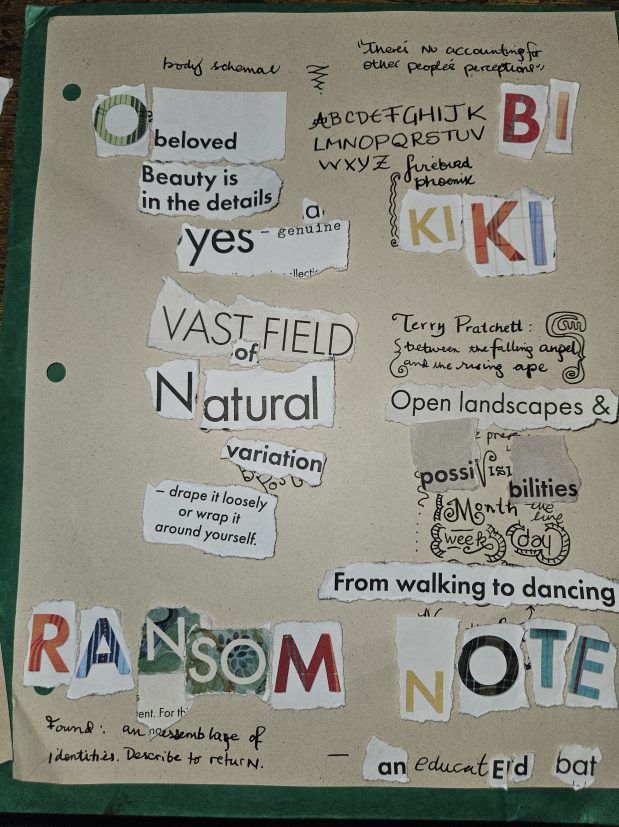
Each person lies within the spectrum of natural human variation, both unique and within a widely-diverse continuum of bodyminds. As this is the case, nothing seemed more appropriate for discussing body schema and the intersection of identities than a literal assemblage piece — layered and gathered letters, words, and phrases. All of the magazine lettering was torn from a single fashion catalog and was completed in one sitting, laid over the handwritten notes I had so far taken for this post.*
I would love for this to be all I wrote about it, but as it’s academic work and also because alt-text is access, there will be unpacking.
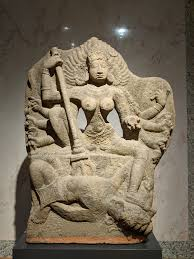
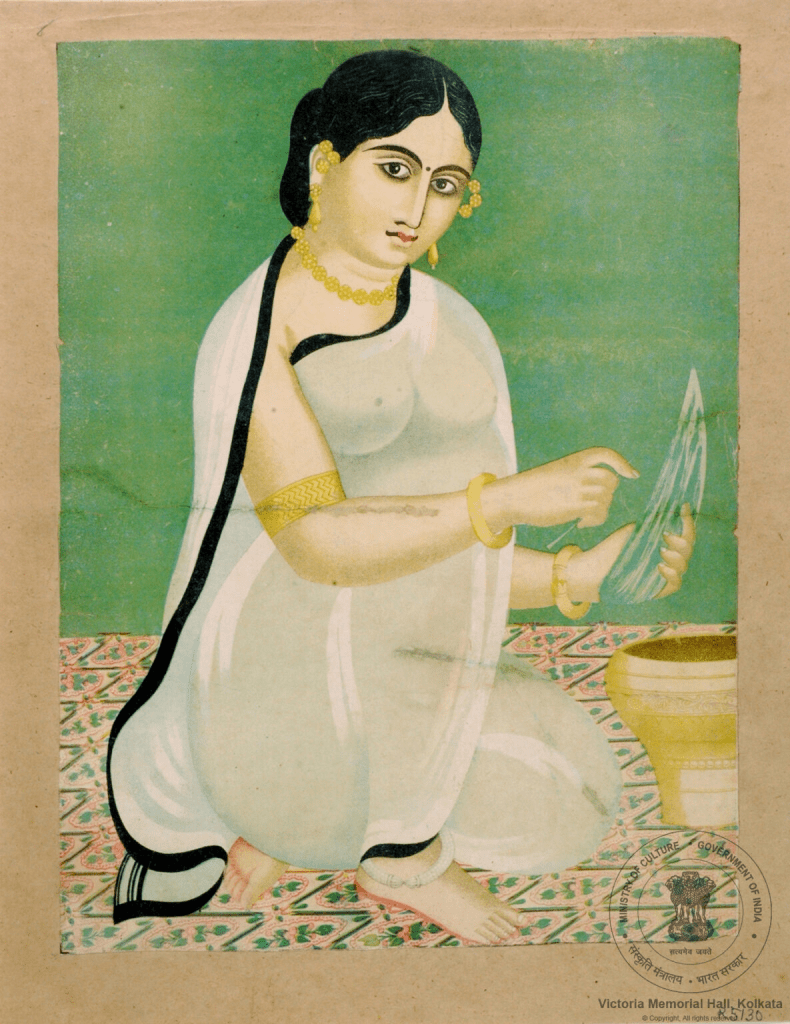
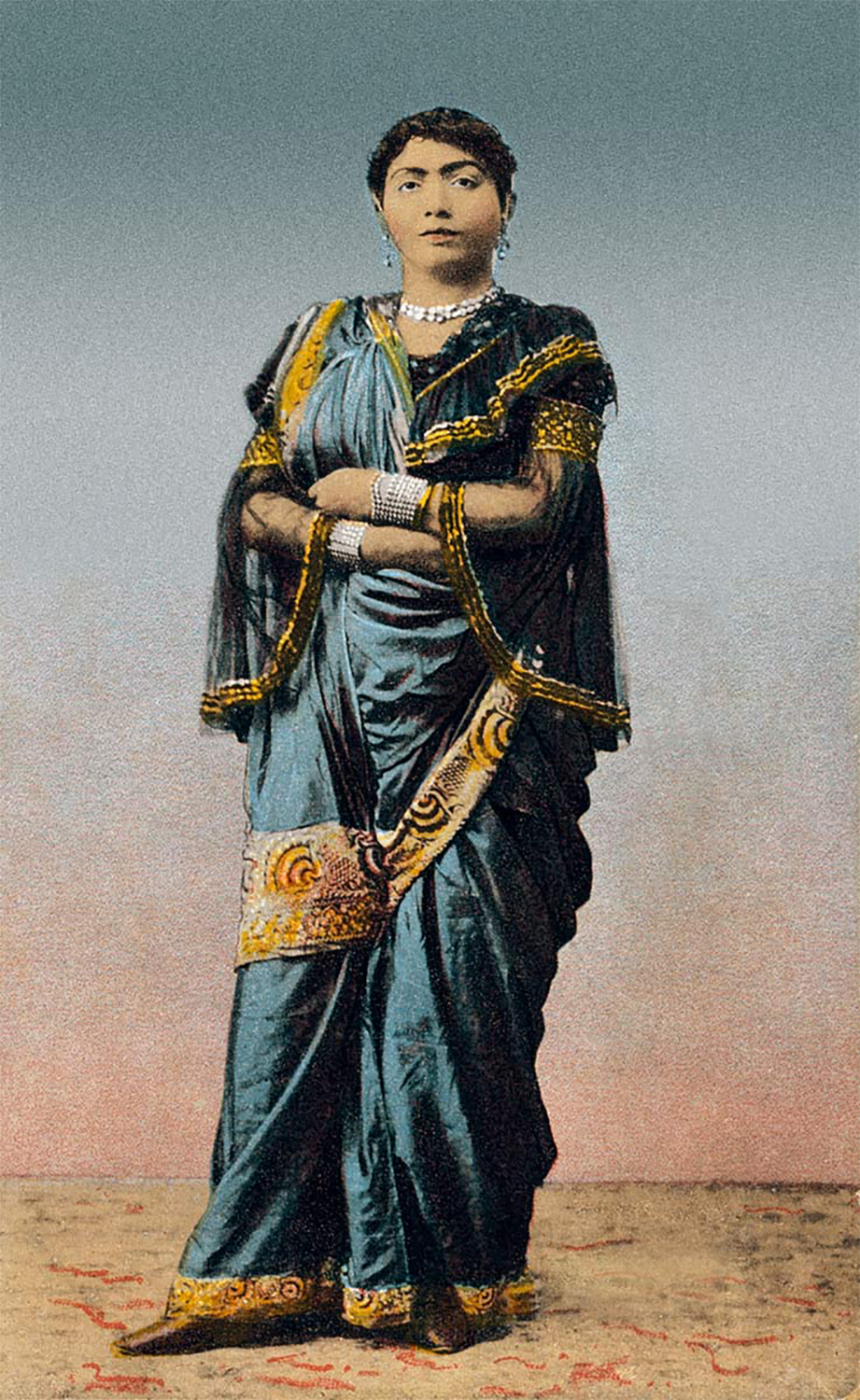
Growing up Baptist, I was always told that my body was to be hidden, especially the breasts. I always wondered why that is. AFAB people have breasts, consisting of tissue and mammary glands to give life, to feed their young. Why is that sexual? As a lesbian, I understand the appeal, but once again, why is there such a deep seated sexualization of these two orbs of tissue? An example of the sexualization of breasts is seen in the change of saree styles pre and post British rule in India. Before the western influence, sarees were often worn without a blouse under it, simply consisting of a long piece of cloth draped around the body. With the British rule came the western ideals of modesty, leading to sarees being worn almost exclusively with blouses in the modern day, ensuring there is no breast visible. I remember being 15, babysitting for an Indian family that taught me this. The mother who is now a dear friend of mine showed me historical portraits of Hindu deities, many of which had breasts visible, specifically the goddess Durga. She is a warrior goddess, seen as a symbol of feminine strength, depicted in ancient sculptures with breasts uncovered, the breasts being a part of symbolizing feminine strength. In this sculpture, she is seen slaying a buffalo-headed beast called Mahisha. (See photo.) Durga was a fierce warrior while simultaneously being a symbol for motherhood and maternal love. She is the Hindu maternal protector of the universe itself.
The first photo is a painting of a woman wearing a saree in the 19th century. The second photo is of a woman wearing a saree in 1910.
Breasts themselves are not sexual, rather they a reflection of the broader societal issues regarding women’s bodies. Sexualizing breasts gives men power over them by making women uncomfortable with them being visible or sexualised, leading to a change in women’s behavior, in this case, covering the breasts. If men are ogling something about your body, you will feel pressured to hide it, therefore the men have the power over what of the body is shown. It all goes back to the patriarchy.
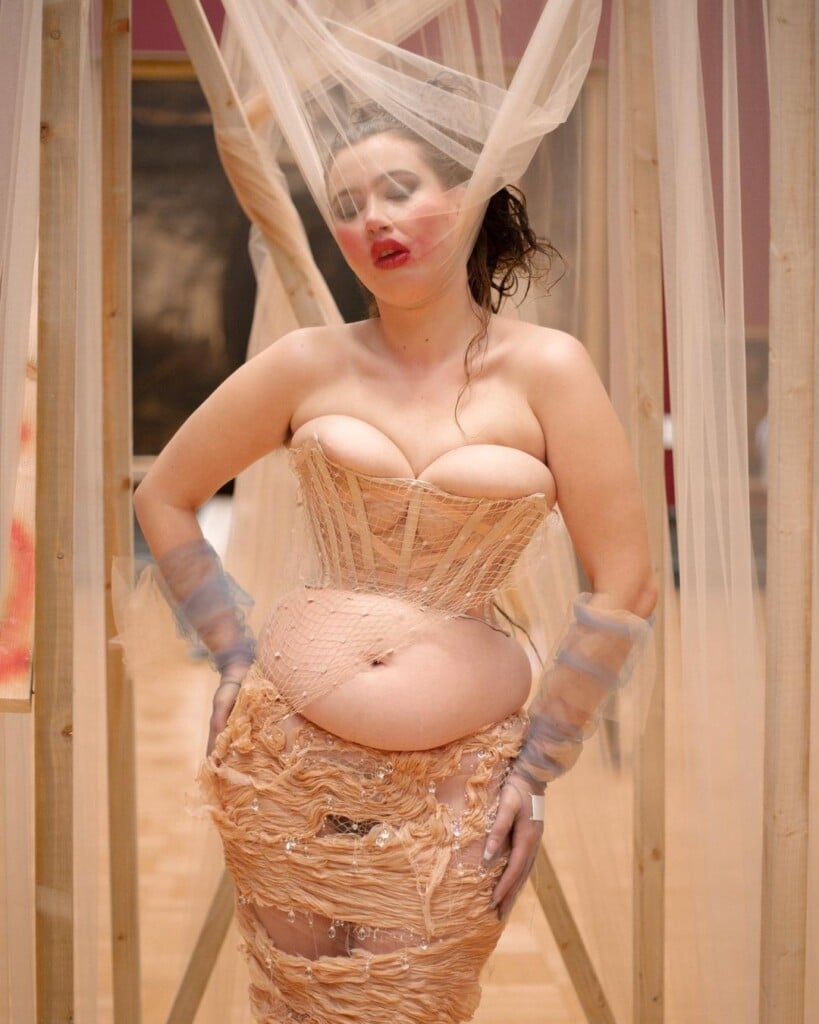
The image above features Michaela Stark on display at the Milan Fashion Week in 2024. Michaela is an Australian “body-morphing” artist currently located in London, who has made several headlines for her ‘Panty’ clothing line, which consists of lingerie and undergarments geared for “all bodies.” She perfectly captures the ways in which our clothing shapes and defines us, and never the other way around. I found Michaela in a sea full of Instagram models, body dysphoric rhetoric, and promotions of every possible procedure to fix every possible flaw of the body, media we consume every single second. Her work was eye-catching, shocking, and…normal.
What is possibly normal about contouring the body in such outrageous ways only to be put on display? Exactly. And yet it has been normalized in every other context by labels. The thin bodies we have shoved down our throats (while completely dismissing our own) are fit to be morphed and changed however need be, whether that be through soft shapewear or restricting corsets. Thin bodies are the ideal, and they must be accompanied by hairless and flawless skin. There mustn’t be a blemish in sight, a wrinkle to see, a stretch mark to grieve. Michaela Stark does this same thing, but we know it’s different. Except we know it’s not different but media has told us it is and so it must be. We all share the burden of having a “broken” body, the only difference is whether your body was born “broken” or conditioned into being “broken.” We all have something we must be desperately fixing at any moment.
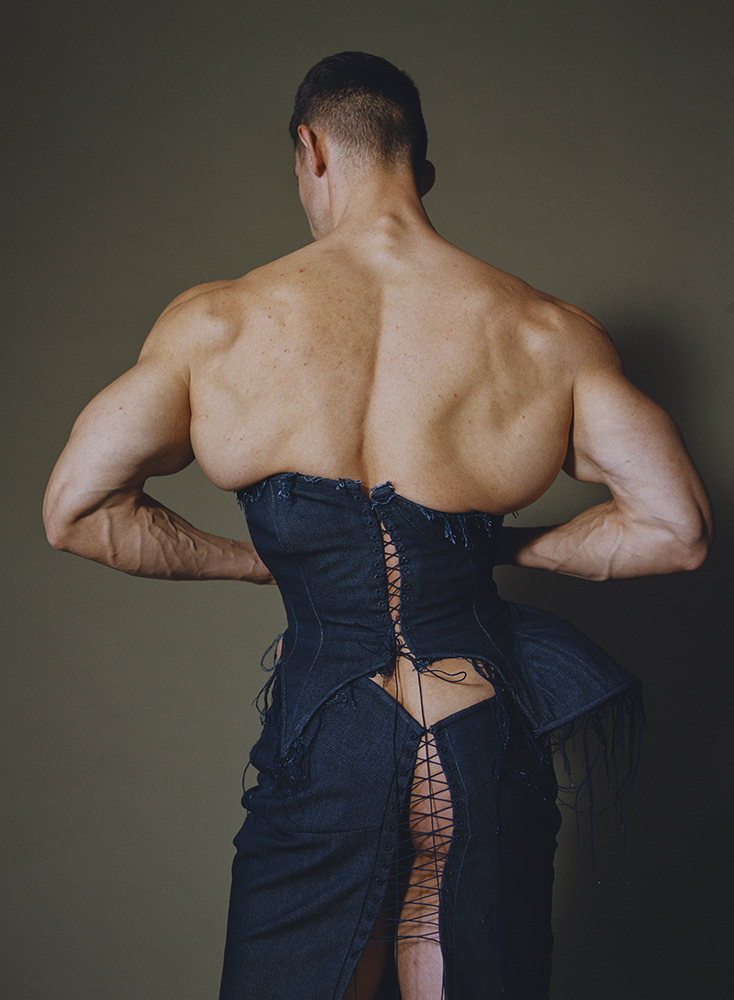
And even through political, social, and public statements that individuals like Michaela Stark make (whether that be through voice or body) where is the representation for men? Society holds tight to how a woman should be, and perhaps we are given some lenience because our bodies are meant to change (not by much though, don’t get ahead of yourself) through the natural processes of pregnancy and birth (yes, I know how demoralizing that is to women anyway), but men don’t get this recognition because it’s socialized to us that they don’t need it. A man’s body should only change for the better: gaining muscle, growing taller, being smarter, stoic. Women are the clay that is never left untouched, always malleable in another person’s hands. Men are the statues, the pyramids, never to fall or be broken down. And a statue should NEVER change. Who knows what waits for you when you don’t identify as either of those things.
My point is that labels are damning, the same way our bodies are socialized and conditioned to be damned. Whether you learn this through the words of Stryker’s My Words to Frankenstein, the sociological concepts of Patricia Collins, or the memoirs in Duane and Rajunov’s Nonbinary, we need no explanation for how this affects us. Through personal experience, we already know. The next step is how we break down these labels that separate us from our bodies, and innovators like Michaela Stark are a perfect example of such. It’s also critical we nip this body-dysphoric-rhetoric in the bud, right at the source: by teaching our children to evolve and grow for their own personal empowerment and not to fit social code. Our girls must know courage and strength the same way our boys receive it. Our boys must know emotion and compassion the way our girls receive it. Most importantly, I think, is instilling these traits as good qualities of a person, rather than subjecting them to a gender binary that supports no one.
Michaela Stark represents a movement of bodies, and in that name we must assume this includes EVERY BODY. If we wish to combat the social construct of the body as its ingrained in our everyday reality, let us begin with abstract thinking.
To be a muse is to be worthy. To be a muse is to be beautiful and talented, chosen and seen. To be a muse is to be exhilarated and exhausted, honored and objectified, proud and pornified. There cannot be one state of being without the other, so long as there is one being to perceive and one being to be perceived.
In some societies, perhaps, it is possible for a muse to exist without the constant fear and awareness of their own and another’s presence. In patriarchal and sexist cultures, however, the muse faces an internal and external threat of surveillance, and therefore sexualization. “(Patriarchal and sexist) society defines woman as object, as a mere body, and… are in fact frequently regarded by others as objects and mere bodies” (Young, I. “Throwing Like a Girl: A Phenomenology of Feminine Body Comportment Motility and Spatiality,” p. 153-154). For feminine muses, they “learn to live out (their) existence in accordance with the definition that patriarchal culture assigns to (them, and) are physically inhibited, confined, positioned, and objectified” (152). The definition becomes internalized, which then manipulates and forces women into being more feminine- more submissive, docile, small, quiet. “Women often approach a physical engagement with things with timidity, uncertainty, and hesitancy… (They) lack an entire trust in (their) bodies to carry (them to their) aims. There is… a double hesitation here. On the one hand, (women) lack confidence that (they) have the capacity to do what must be done… The other side of this tentativeness is… a fear of getting hurt… (They) often experience (their) bodies as a fragile encumbrance, rather than the medium for the enactment of (their) aims” (143-144). The subordination of feminine beings is at the root of patriarchy, and it grows as more minds and bodies accept the notion that feminine and masculine categories cannot intermingle. The stronger the patriarchy becomes, the more ‘natural’ it seems that feminine bodies are weaker than masculine bodies. In reality, women “have more of a tendency than men to greatly underestimate our bodily capacity,” as well as the relentless pressure of being perceived as a muse, which results in under-performance.
Growing up, we saw physically disabled people as the odd ones out. I could take responsibility for viewing disabled people that way, but that was how everybody around me viewed them. I had no chance of “knowing better,” at least in that environment and age. That was the case until I was introduced to this class and had a fair share of friends who were open-minded. These people changed my thinking in both positive and negative ways, but the point that they taught me that people are different; not everyone is going to look and act the same as everybody else, and that is okay. I know the previous statement can come out as a very “duhh” statement for most of yall; however, I didn’t use to think like that. It was more of “you are weird! something is wrong with you.” And of course, like most adolescents who are just discovering sex and how it works, I wondered what sex must have been like for people with spinal cord injuries and other disabilities like that. I asked myself, “Do they feel anything down there?” or questions like, “can women who are paralyzed from the waist down give birth?” Most of these questions came from mostly ignorance and a bit of curiosity.
Sexuality and Disability: The Missing Discourse of Pleasure by Mitchell Tepper opened my eyes to this issue regarding disabled people and sex. An article like Tepper’s is exactly what people like me missed back in junior high. From reading the article, I learned that sex is more than just borrowing some friction from a partner, and there are more ways to derive sexual pleasure that does not involve the privates. I found it heartbreaking that some disabled individuals give up on their sex lives because they believe that there is no point in trying, “nothing will be the same.” And that is when Mitchell Tepper steps-up and encourages people with SCI that their “sexuality is their responsibility.” These people learned more about the spinal cord-injured bodies and embraced their disability. Evidently, disabled people in wheelchairs tend to have a more difficult time finding a sexual partner than abled individuals; most of this is due to the stigma around disability and sex and partially due to self rejecting before they can even try. Self rejection is a problem that we need to tackle. We (teachers and professors) need to teach about pleasure and sexuality in order to shine a light on this topic of sex and disability and hopefully reduce the stigma and misinformation around disability and sex.
For the entirety of my life up until college I was living with the view that how society saw me didn’t matter, that I could reach my goals by acting and looking however I wanted. I was naturally skinny and with my tall build I looked like a noodle. My social skills were severely underdeveloped, I wore clothes that didn’t help my appearance, I only showered when I felt like it; for a time my hair looked like I went to the barber and asked for the lamest looking cut they could think of. My first semester living on campus I decided to change that. I started going to the gym. I made a friend there, and we started going to the RAC everyday at 7:00 in the morning. I liked the progress that I saw from working out, and my newfound confidence helped me make friends in my dorm. We went shopping together to buy clothes that weren’t hand-me-downs and three sizes too big on me, and eventually I found that my lame old self that I pitied was gone.
This drastic change in my life has altered the way I view society. Society today has taught us that we don’t need to change ourselves because we are perfect the way we are, but that is simply untrue. Unless you are your best self you should always be changing and bettering yourself in everyway possible; that is evolution. Now whenever I see someone defend their lazy actions it irritates me that they believe that they think the choices they are making are correct. “Oh, I have a fast metabolism, I can’t gain weight!” – eat more, “I don’t have enough time to workout.” – cut out the time wasters from your day; these are statements from people that I regularly see do the absolute minimum to take care of themselves, and prioritize indulging in media instead of being productive. They’re unenergized, they’re not social, and they wonder why they are depressed. They remind me of who I used to be before I started working out, and I truly believe that everyone would be an infinitely better version of themselves if they started to “Go Jim”.
The words were almost convincing after seeing a commercial of a woman applying cream to her face and miraculously turning many shades lighter. Her brown skin had been edited to a pale white and suddenly she was beautiful. Suddenly, she was fair and lovely.
I was only a child when I saw the ‘Fair and Lovely’ cosmetic product advertised on South Asian TV channels and plastered on the walls of South Asian grocery stores. The product claims to lighten your skin and in turn, enhance your beauty. Of course, anyone with common sense knows it’s impossible to rid yourself of the melanin in your skin with a fragrant cream. But after all these years, the product continues to be purchased. As an adult I never thought I’d be classified beautiful just for the color of my skin—and the idea disgusts me completely.
I have recently been spending my spare time sitting on my couch, waiting in anticipation for the new “Resident Evil” survival-horror video game to release. I played the demo of the game last week, and it was great! I was tense for many hours after, but it was worth it. I love a good scare, and in video games there is the sweet feeling of starting over again even after failure, so there is usually a feeling of relief. After playing it though, I started thinking about video game characters throughout time, and how they kind of always typically find a way to make everything look good. Continue reading →
Every day I question my appearance. I ask myself, what makes me ……. me? If I lose a part of me will I still be me? These questions may not make sense to you but these are some things that I ask myself. Continue reading →

 Every day I question my appearance. I ask myself, what makes me ……. me? If I lose a part of me will I still be me? These questions may not make sense to you but these are some things that I ask myself.
