Success is something that can’t happen within a day. It takes weeks, months, years even to get where you want to be. But once you hit that accomplishment, then what? Success is something that only you can accomplish, no one’s else can do it for you. It could mean doing things you love or setting a big goal for yourself. My success could be so different from your success. Success can often feel like having a particular time to accomplish something, but in life that’s not always the case. Sometimes life has its own way of showing us that time doesn’t stop for anyone. So, take that jump and let things slowly fall into place.
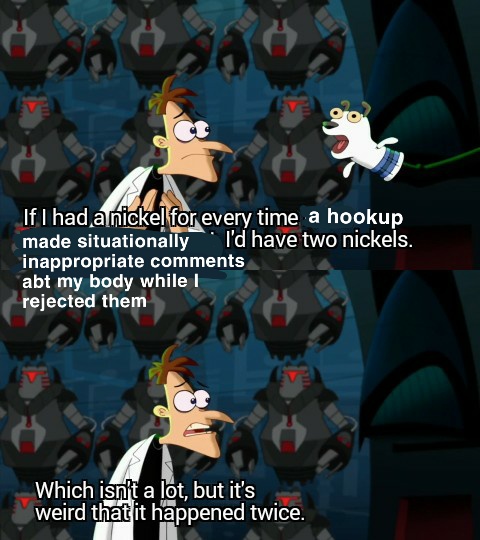
The Phineas & Ferb Dr Doofenshmirtz “two nickels” meme. The text has been altered to say “If I had a nickel for every time a hookup made situationally inappropriate comments about my body while I rejected them, I’d have two nickels. Which isn’t a lot but it’s weird that it happened twice.”
Okay, so this isn’t actually about the hookup itself. Sorry about the clickbait, but I promise nothing too terribly interesting happened anyway. It’s about what happened after– not immediately after the act, but the part where I reject them and find a nice neutral way to say “yeah the sex was fine, I’m not super interested in continuing tho” and move on with my life. I would have titled this the worst breakup but it wasn’t really a breakup, it was just uncomfortable.
Anyway, last November I hooked up with a person, we had a short lived friends with benefits arrangement (what a stupid term, friend with benefits… but I digress) and then I accidentally-on-purpose ghosted them because they got clingy and I was not interested in a relationship with them. (I usually communicate with people clearly instead of ghosting, we ARE trying to heal after all. This situation was unique, I said I needed time/space and then I honestly forgot that something needed to be said. Oops.) Well, by the time I actually talked to them again, they asked if I was ready to date yet and I finally just said I wasn’t interested, at which point they found it appropriate to say “fucked around and caught feelings…p*ssy too bomb! haha” and a few more vague references to the hooking up throughout the conversation WHILE I was actively rejecting them (i cannot make this up, if i still had the screenshots i’d post them here.) I don’t remember the specifics of the conversation but that one line is BURNED into my brain because. Wow. I cannot believe it needs to be said but don’t talk about my body while I’m rejecting you?
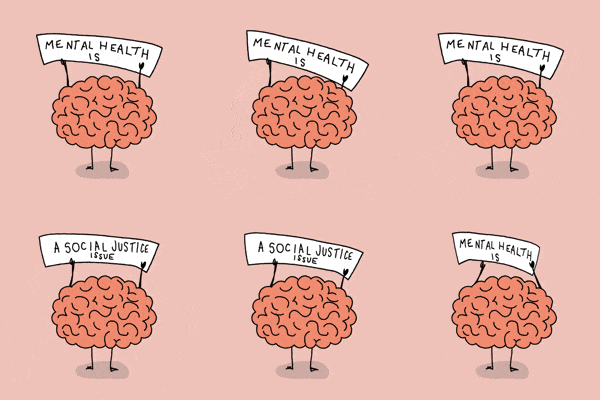
Mental and physical health are looked at very differently in western societies. Mental health is difficult because asking for it means you’re unstable. Physical health is much easier for the ideal person, because for some reason your body is more important than your mind. Insurance also plays a key role in healthcare. The difference between these two types of healing and asking for help is astounding. Insurance can make asking for help harder and more confusing.
Getting help with mental illness makes people think you’re unstable because of the stigma behind it. Going to a therapist is like walking into a mental hospital in some areas. Western ideals of medicine think of hard sciences as the only legitimate types of science, which is unfortunate because it leaves out more than half of the human experience. The mind-body split shows heavily when speaking about mental health. People think that when your body is healthy your mind must be as well, but that is untrue and someone’s mental health can affect their physical health greatly.
For example, my coworker told me that he was “crazy too,” when I told him I had a psychiatrist appointment that day. This sounds like a joke, but when you look at it, he’s saying that we have to be mentally unstable to see a professional about it. When your body is ailing, do people tell you that you’re crazy to go see a medical doctor? Then why is mental health any different?
Physical health has its own challenges, but can be much easier with ideal people. When you mix other identities and factors into the person in question, physical health help can become much harder to attain and maintain. For example, a cis white man can get through a doctor’s appointment very easily, yet a trans woman has to answer many more questions and the doctor can create much more commotion because someone doesn’t fit the “proper type” of person.
Health is such an important part of living, yet many people that need mental help cannot find it, and those who are not binary can get discriminated against for existing. The key piece to healthcare in America is private insurance. Insurance is a leech on resources and does NOT help people get better healthcare. Insurance itself is EVIL!
The fact that we have to pay for a life-saving service out of pocket because someone we pay to pay our bills doesn’t cover a particular surgery or time in a rehabilitation center is absolutely atrocious.
This conversation can be linked to so many things, whether it’s free healthcare, racial justice, LGBT rights, or even basic human needs/rights. These are just a few of the things that physical and mental health can lead to, especially when combined with insurance. People have a right to take care of their bodies and thrive instead of survive, but insurance, mental, and physical health are all factors in someone’s quality of life.
You see, it’s because Cardi B just recently accidentally leaked a nude of herself on Instagram and the title of her album is called Invasion of Privacy, which this blog post is about. This is the part where you chuckle and applaud me for my cleverness…
NOTE: Before I dig into the topic at hand, I would like to preface my blog post by asserting that in no way am I a celebrity sympathizer. I am very much critical of the concept of celebrity within itself; the vicious cult-like idol worship, the hoarding of disgusting amounts of wealth, and the arrogance and lack of self-awareness it breeds (see: the absolutely tone deaf – both literally and figuratively – COVID-19 Imagine cover) is truly no joke. However, celebrities are still People Like Us™ at the end of the day (some of which, depending on their identities, are more vulnerable to and disproportionately impacted by the ills of celebrity than others) and the ways in which we Average Joes engage with them should be critiqued because it says a lot about how we engage with each other as actors in society as a whole. So now that I’ve gotten that out of the way, without further ado…
For as long as I can remember, there has been an odd fixation with seeing the naked bodies of celebrities that I could never wrap my head around to this day. One of my earliest recollections of this is the mass hysteria around the ever infamous Y2K pop culture event that was the “leak” of Ray J and Kim Kardashian’s sex tape, which catapulted the latter out of Paris Hilton’s (who also had a leaked sex tape) shoe closet and into stardom – and we unfortunately haven’t been able to rid ourselves of her and her Klan since. Succeeding 2007’s Kim Kardashian, Superstar we’ve experienced rapid technological advancements like the invention of easily hackable iCloud storage and real time social media like Twitter and Instagram. Now it’s become even easier to obtain, leak, and circulate celebrity sex media at neck break speeds to the point that it happens so often and to so many people that I can’t keep up with who has been a victim! Vanessa Hudgens, Rihanna, Justin Bieber, Chris Evans, Scarlett Johansson, “The Fappening”/”Celebgate”…seriously, look up the many lists of celebrities this has happened to and I guarantee at some point you’ll think, “Them? When?!“
My main question is: Why are we so Mariah Carey – Obsessed.mp3 with seeing the nude bodies of celebrities in sexual contexts, and even more alarmingly, without their consent?
We could look at this from a few lenses, like how generally speaking since celebrities are individuals who are (for whatever reason *eyeroll*) positioned higher in society and perceived as more exclusive than the rest of us, we’re thirsty to see them in a vulnerable, subordinate state and have access to their bodies in the most dehumanizing manner possible when we want. This goes even more so for celebrities who are of marginalized identities, particularly women. It’s not enough to just simply consume Cardi B’s music and videos that she has sexed up at her own volition, we have to take advantage of her mistaken leak of nipples and bully her about how laaaaarge her areolas are for it to mean something. We have to think about how this obsession with leaks often makes us abandon our morals – that is, if we ever had them to begin with. Like how people actively sought out Lil Nas X’s nudes upon his rise to fame knowing that he was a minor in those pictures, thus, definitely making it child pornography. Or how when women who typically rally on the timeline against sexual objectification culture conveniently and expeditiously abandoned this energy when a video came out that was purported to be DaBaby, when in actuality it was that of a porn star (might I add, it’s quite ironic that people immediately lost interest in the video upon this discovery despite the fact that the porn star willingly filmed this video – as that is his job – and most likely did not receive any type of compensation in the form of money or notoriety for the mass reproduction of his work. The disrespect of sex workers and their labor is a whole ‘nother conversation.)
So, before we stampede to Twitter like the wildebeest colony from Lion King to ogle at the latest penis or set of nipples attached to a famous person, pick it apart and create a spectacle only to unceremoniously discard it, and moan then about which leak we’re looking forward to next, I’d like for people to think about these things first and reflect upon why we do it and why we think it’s okay. This is especially important with the rise of deepfake technology, which allows people’s likenesses to be fabricated in…less than desirable situations. Just sit in it. Marinade if you will.
About a few weeks ago, I came across an informative Twitter post. This Twitter post was informing the general public on incarcerated firefighters in California and how these same firefighters are paid little to nothing AND are not allowed to acquire firefighter jobs upon release. My first thought was, “how can this make any sense? And why are we still promoting slavery of people in the name of incarceration?”. So, I’m going to start by being completely honest… I’m a HUGE advocate for prison reform. This is for two reasons: although incarcerated people are deemed criminals, they still deserve basic humans right and the way in which incarceration completely ruins people’s lives, it’s not morally right… at all and no matter what.
Honestly, incarcerated people deserve their basic rights. To me, it doesn’t really matter who a person is or what they have done, everyone deserves basic decency, such as being paid/compensated a sufficient enough amount to sustain themselves. In one article, (link listed below) by a non-profit news source “High Country News”, author Maanvi Singh writes, “in exchange for extremely dangerous work, prisoners earn time off their sentences and are paid between $2 and $5 a day, plus $1 per hour when they are on a fire. Because incarcerated firefighters are paid so little, the program saves the state of California $90 million to $100 million a year”. What I took away from this data is that my argument was further supported. Let’s put this into context. The average minimum wage for firefighters in California is $21/hour, but prisoner firefighters can only receive, at most, $5 a day… Now, I know incarcerated people are housed, fed and not having to worry about bills, but how in the world is this fair? These prisoners literally risk their lives for $5 a day? Then, on top of that, they save the state of California $90 to $100 BILLION dollars a year, through their labor, it’s not morally right, any way you look at it. I don’t even want to go down a rabbit hole with the taking off time from their sentences. I’ll just leave it at that’s not right.
Second, incarcerated firefighters aren’t allowed to apply or acquire firefighter jobs once they have completed their sentences. Of all things, I find this the most absurd. I say this because these incarcerated firefighters literally took on the role of non-incarcerated firefighters. Also, with how prison completely ruins a person’s record; I think the least society can do is allow them to pursue a career after they have served their time. I feel incarceration completely disables people from allowing them to move on and better their lives. Instead, prison only sets its victims up to fail again. #PRISONREFORM!
My mother started a new Weight Watchers program recently and it’s been bringing up a lot of feelings for me. To start, it’s always weird when you see exactly where some of your problem behaviors come from. My mother has been dieting, cleansing, counting calories for the ultimate goal of losing weight my whole life. Naturally I picked up on these behaviors and attitudes towards fatness as a child and carried them with me only until I started learning about fatphobia and toxic diet culture on social media in the past few years. Watching my mother never be satisfied or proud of her body instilled in me deep beliefs that gaining weight and being fat are the worst things that can happen to you and you should avoid it at all costs. Throughout middle and high school, I also was obsessed with dieting and would feel guilty when I ate “too much” food or food that was “unhealthy”. I congratulated myself for making it through the day only eating two meals. If I ever did lose weight, my mother would tell me I looked good. She always told me about her diets and asked if I wanted to do them with her. She would never ask my younger sisters who have always been thin. To this day, I struggle with feeling embarrassed about being the only non-thin sibling. I wonder if my family ever feels ashamed of me or if other people notice when they see us all together and wonder what went wrong with me.
Even though I’m used to my mother dieting and obsessing over losing weight, it’s been especially triggering for me to hear her talk about Weight Watchers now that I’m educated about fatphobia/diet culture and while I’m working on unlearning my disordered eating behaviors. It makes me sad to see her at 46 years old still thinking she needs to fix her weight. It’s hard to hear her decide between “one point” and “two point” foods. It makes me extremely uncomfortable when she praises herself for restricting her eating. Throughout my journey of learning to accept my body at all sizes, I’ve learned that food is not only something that is necessary for your survival, but is also supposed to be a source of pleasure. You should eat what your body tells you it needs. You should eat what you actually enjoy and makes you feel good. It’s draining to hear her reinforce the ideas I’m working so hard to unlearn. I want better for her, but I still have discomfort talking about eating and dieting so I don’t know how to have the conversation with her about it. I usually don’t respond when she talks about it because I don’t want to encourage or reinforce it. Eating alone or in secret is still a behavior I resort to much more often than I think is good for me, so at the beginning of quarantine I even found myself scared to eat around my parents. The messages about eating and gaining weight I internalized from them made me feel like they were judging me or disgusted by me. It makes me wonder if my mother ever feels that way. Listening to her try to talk to me about Weight Watchers also makes me wonder if she’s subtly trying to suggest that I start it. But also that could be me projecting…
It’s wild to think about how something as simple and essentially human as eating can be turned into a basis for making moral judgements about others. We decide who is good or bad based on how much they eat, what they eat, and what size their body is. We do this so much that people actually pay money to have their eating policed. It’s my opinion that diet programs, especially with names like Weight Watchers, are capitalist ventures that train people to develop eating disorders. I’m frustrated that my relationship to eating has always been so troubling, when it should be so simple. I think one thing I’m becoming more aware of in this class is how my perception of my body shapes almost all my behaviors. I remember going to college dining halls and being anxious to put the foods I really wanted on my plate because I thought everyone was looking at me disgusted, thinking “This is why they’re fat.” Sometimes I notice the ways I try to physically shrink myself when I’m around other people, especially people that are smaller than me. Standing next to someone smaller than me has always made me very anxious and still does. But I’ve also just recently started to realize that my body was never actually as big as I thought it was and the way body dysmorphia has really just been playing with me my whole life. And also that my body dysmorphia most likely originated from the fatphobia my mother passed down to me and grew from there. It’s interesting to think about how our bodies are forms of communication, too. We assume that people’s bodies tell us certain things about them. I assume that my body tells people I lack self control and don’t care about myself. But I’m learning that eating is caring for yourself and policing your eating is not.
For as long as I can remember, I’ve always used pads when I had my period. I was NEVER able to get a tampon in– it was uncomfortable, hard to insert because of the shape of my vagina, and just–not something I was socialized to use, I guess. When I was 11 and had my first period, I was traumatized and in so much pain. I never knew really before then about hygiene related to periods. My Mom told me I wasn’t old enough to use tampons yet–so she bought me pads and explained how to use them, how often to change them, etc. I remember asking when I could use a tampon, but I don’t remember the response.
Now at 23, I’ve never used tampons regularly. Only if it was an emergency, and that was a whole process in the bathroom! But, whew, there have been times where I felt so shamed and weird when others would say, “OH. MY. GOD. You still use pads?” I remember my face getting hot and just being like, “Yeah…?” People would question my choice on how to keep myself “clean” when I menstruate saying, “Oh, are you too tight? Haha, tampons are better, and cleaner. You’re just not putting it in right.” Over time, I’ve just ignored that rhetoric about what people think I should be using because of the shame associated with their words, and lack of understanding. Some hold the stereotype that pads are juvenile, and tampons are for ‘grown women.’ But it still gets to me sometimes. This past summer, I went to the beach with my friend (who has always used tampons). I started my period and I wanted to be able to swim, so I reluctantly asked her at the age of 23 to help me put it in. She spent a good amount of time with me in the bathroom, literally watching me put it in–she even attempted to insert it for me. But, there was no luck. In the end she was like, “Wow, I see what you mean now. I’m sorry this doesn’t work for you.”
Out of all ways people with uteruses have been controlled related to their reproductive organs and health, this is another way I feel the patriarchal system has perpetuated how we should respond to menstruation and uteruses–the use of tampons. The idea of a phallic object being put in a vagina to control and catch bleeding doesn’t sit right with me, especially it being designed by a male doctor (Dr. Earl Haas in 1860). When the topic of reproductive labor was brought up, and I was reminded of my own shame surrounding my uterus, menstruation, and vagina. Especially with the aspect of men using women’s bodies for scientific purposes, and shaping the way we experience them through what they prescribe for people with uteruses.
People with periods should be able to use whatever they want if/when they menstruate. That includes using pads, tampons, diva cups, and doing free bleeding without a negative stereotype being attached to whatever method they choose. One’s reproductive organs are personal, and the what people decided to do with them and their health surrounding that is a personal experience and choice! Hopefully, one day we can stop shaming one another for what hygiene product they use for periods, and other choices related to reproductive autonomy and experiences.
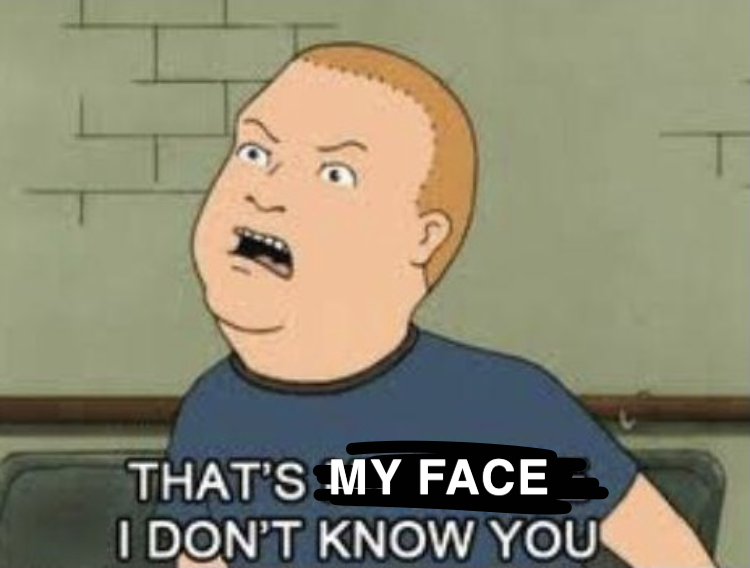
This is (another) photo of Bobby Hill where, instead of saying “That’s my purse, I don’t know you!”, I edited it so he’s saying “That’s my face, I don’t know you!” because I am worried about the alienation people could/can feel when they see their face without makeup as unrecognizable.
I am prefacing this post by saying I barely wear makeup (is slapping glitter on your face “real makeup”?, the next presidential debate topic), I don’t know how to do makeup, but I really think we underestimate the power and psychological issues/potential trauma makeup can create. Granted, makeup can be and is gorgeous/fun because you can accent your favorite features or you can coordinate it with a cool look (i.e. special effects makeup or just a really bold neon green eyeliner), but at what point is it too much? Is it at the point where you have put on a full face for a beach trip? Is it when you have to put on a full face for a gym session? Is it when you’re incapable of seeing yourself/allowing yourself to be seen without makeup, so much so that it dictates how, when, and if you’re even going to be seen in public that day? Or when seeing your bare face strikes actual fear and depression into you? I do not think the idea of seeing your bare face exposed or exposing your bare face to the world, rendering you depressed, disturbed, or even disgusted is given enough space in talking about dismantling body dysmorphia. The alienation experienced at the disconnect of seeing your bare face and not registering it as your own because it has no makeup on it sounds like a trauma response to me. The gym comment is from a conversation I had with a friend. She legitimately could not go to the gym with me (or outside for that matter) without applying at least five different products and I remember pointing out, “dude you’re gonna sweat that off 5 minutes into rowing” and she told me she “wouldn’t allow” herself to go outside without it.
When you think of Kpop, you think of the energetic music, the vibrant music videos, and the adorned idols. But did you know that Kpop became popular due to the South Korean government?
I came across an article in The New York Times which talked about how the pandemic is forcing families to raise their children without help from other family members or outside resources. This sparked the thought of how specifically this situation impacts us and for the future; what are some other, less apparent and personal to me, impacts of the pandemic.