Binder Blues

My ribs hurt as I am typing this blog post. Don’t worry, I’m fine, my current binder is just a bit too small for me. I try to only wear it two times a week, generally, and for less than six hours or so at a time. It’s not ideal, but I’m making it work until I am able to get a new one.

Now, why haven’t I gotten a new one yet? Well, let me introduce you to what it is like buying a binder as a mid-to-plus-sized disabled person.

Continue reading

Transsexual Gender Euphoria

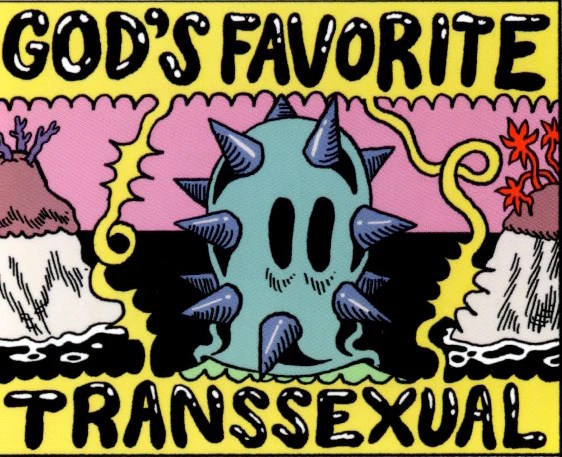
(image description: an illustration of a person with a teal, cactus-like spiky head between two islands on a black ocean against a pink sky. the border, framed in wavy spiked lines, says “GOD’S FAVORITE TRANSSEXUAL” in black bubbly text on a yellow background.
this art belongs to Leo Fox, from his trans comic series Boy Island! you can get this image as a sticker at https://store.silversprocket.net/products/gods-favorite-transexual-by-leo-fox :] )

Since before I started medical transition over a year and a half ago, gaining testosterone-linked physical traits through HRT has been a goal of mine. And recently having the ability to “pass” as cisgender has been such a wild ride in a very gender-affirming way (though I still haven’t gotten used to times when I am perceived and treated as cis male in a social context, such as getting pulled in for a strong dap up after finishing a group project). 

One thing that I have always been excited about was my “passability” opening up new avenues for me to explore queering my gender presentation. There was always something appealing to me about presenting physically masculine with more body hair and a deeper voice while having the freedom to wear whatever I wanted, like skirts with boots, and feeling confident wearing tight shirts without getting dysphoric about my chest. The physical traits I display are also helpful with decoding patterns of comportment and taking up space that I grew up socialized into as a “girl,” because now instead of fearing gender dysphoria from expressing emotions and being particular about the way my body moves, I feel like I am actively participating in throwing off binary norms, rather than taking up as much space as possible and acting closed off and invulnerable as embodied “masculine” stereotypes often go. 

I recognize of course that presenting my gender the queer way I do is something that I have a privilege to do, as I am able to safely be out as transmasculine; I believe not every single trans person should be required to revolutionize trans embodiment and destroy gender norms whenever they can possibly be perceived. No one should be held to that standard, and critiquing those who can find safety within the gender binary is unproductive to the goal of universally embracing trans embodiments.

I believe my medical transition and performed gender, and the euphoria I experience in my trans body, demonstrate Susan Stone’s theory on the transsexual body’s ability to “generate new and unpredictable dissonances which implicate entire spectra of desire” (“The ‘Empire’ Strikes Back”). Her and Judith Butler’s description of the erotic dissonance of the butch lesbian is something I find strong connection to, especially after coming back around to identifying as a lesbian in how inherently queer and “everyone-but-cis-masculinities” my sexuality has been throughout my 8 years of being out. Butch identity and my transmasculine body just feel like they go hand in hand now, and doing what I call “coming home to lesbianism” has been such a euphoric experience for me recently, one that I feel comfortable describing as transsexual gender euphoria.

Not Your Poster Child

CONTENT WARNING: THIS POST CONTAINS DETAIED DESCRIPTIONS OF INTERNALIZED TRANSPHOBIA & INTENTIONAL MISGENDERING

“Transsexual embodiment, like the embodiment of the monster, places its subject in an unassimilable, antagonistic, queer relationship to a Nature in which it must nevertheless exist.”  – Susan Stryker

A human is born
A life has begun
Is it a boy or a girl?
You must pick one

“It’s a girl!” they exclaim,
Teeming with joy.
But what if that human
Is really a boy?

“Sit like a lady” they say,
Your knees must touch;
“Just put on the dress” they said,
“Stop making a fuss.”

Tomboy! Tomboy! Tomboy!
It’s all she hears.
Losing her femininity
Is something she fears.

Fear of losing the attention,
The praise and the love,
So she puts on clothes
That fit her like a glove.

She grows her hair out
Year after year,
Because deep inside her
Is the fear

That one day they’ll call her
A tomboy again,
And she’ll lose her femininity
Before she really can

Grapple with the fact
That she’s not a girl,
And that this gender façade
Makes her want to hurl.

Until age fifteen,
She puts on an act,
Until she knows
For a fact

That this act
No longer works.
Inside her,
This feeling lurks.

But he knows his body
Will never conform
To social ideals
And so he’s torn.

Does he put in the effort
To be seen?
(And what does that
Even mean?)

It means he struggles
Day in and out,
And his mind
Is filled with doubt.

Transness is beautiful,
Transness is great;
But as a trans man,
I’m filled with hate.

I’m tired of keeping quiet
With nowhere to speak up,
I’ve hereby decided
I don’t give a fuck.

Political correctness
Gets you nowhere in life;
I’m not a poster child,
I don’t determine what’s right.

I’m allowed to be human,
I’m allowed to make mistakes.
I’m now living my life,
And I refuse to wait.

Thinking about Transmasculine Feminism

Last semester in my Theories of Feminism class I read “The Transfeminist Manifesto” by Emi Koyama. This text spoke out to me as a trans person, and it introduced me to Koyama’s additional work on disability, sex work and intersex advocacy that has greatly increased my knowledge of other parts of the field. However, one thing I noticed throughout the text was the focus specifically on trans women and minimal reference to the experiences of trans men, apart from a couple of paragraphs in the gender-based violence section along the lines of “trans men also have something like this problem, we should also advocate for them.” Koyama herself at the end of the paper points out that while she did have the intention of transfeminine focus due to a higher visibility of injustice within transfeminine experiences, there is more information she could have covered on trans men’s experiences, and invites the reader to think more on the topics she did not discuss (e.g. intersectional analysis, trans men).

I did some Google scholar and library archival research after reading this paper and found out there is indeed not very much overlapping scholarship on feminism and transmasculinity, specifically discussing how feminism applies to – and can be done by – transmasculine folk across the gender and sex spectrums. In response to this deficit I thought, “they should make a transmasculine feminism,” and then remembered that I am in fact someone who has a say in that!

What comes to mind (at least from my perspective) as an avenue to explore transmasculine feminism is the idea of recontextualizing our lived experiences from embodied “feminine,” non-hegemonic-male experiences that feminism applies to. Examples I’ve thought of include socialization growing up, the treatment of our sexed bodies in the medical sphere (spaces commonly designated as “women’s” care), and ongoing experiences with how we are treated based on the gender others perceive us as.

I admit that while some may be comfortable discussing the controversial point of socialization, not all transgender folk may be as willing to critically discuss their socialized experiences in their assigned gender growing up, which could be due to dysphoria that could come from this recollection. While there are perfectly valid reasons for avoiding exploring this vulnerable topic in depth, I would argue that in the process of developing my transmasculine feminist thought thinking about my own girlhood, my medical encounters with my own biology, and how I have been gendered based on appearance, I have become more in tune with how I live gender than I ever have before. This might just be me growing up, but I think embracing the gendered aspects of earlier parts of my life is genuinely so constructive to thinking on how I wish to improve as a person, and more relevantly, as a feminist and activist.

So, from thinking about Koyama’s call to action to include more transmasculine thought on feminism, my personal goal in my GWST academics is to formulate something along the lines of a “Transmasculine Feminist Manifesto.” It feels like a very big task to come up with a personal Big Word for an Academic Thing and then justify to Big Academia why you think that should be a Thing, so I am quite daunted by that, especially considering I’ve been experiencing some intense burnout and for whatever reason have been having more and more of a difficult time putting words to my thoughts. But in the case of arguing for this from an embodied, phenomenological perspective, I suddenly have a lot more faith in my words than I have before, and I am very excited to get into putting research together and synthesizing that with my own life as a transmasculine person.