TW: Mentions of body shaming, eating disorders and rape/SA.
“Have you tried losing weight?” “Maybe you should get on a diet.” “The pain would go away if you were smaller.” These are all poor excuses that people When going to the doctor as a bigger person, there is almost a preparation internally that is done to face the same two statements.
Being born female has always felt like a curse to me. Although I do love presenting femininely, girlhood, and feminism, femininity always felt like an objective that I could never, ever reach. Growing up, I was surrounded by ideals of what a “real woman” should look like and act like, but none of them ever felt like me.
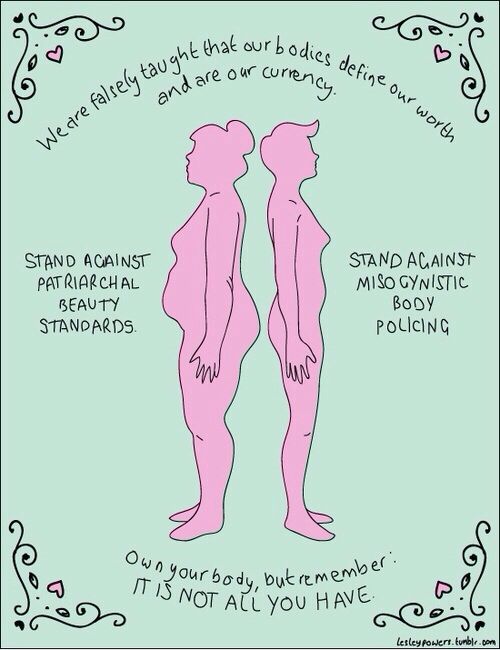
Too often, women & afab people of color, specifically black and brown people, are hyper masculinized by society. Many of us experience gender dysphoria at a young age without even realizing it. In a porn-sick, pedophilic world, we are often told to shave our legs or that we won’t be desirable if we are not petite. We are groomed into believing that compliance with these unrealistic and patriarchal beauty standards is the only way we can be loved or accepted.
This alienation often made me feel like I was a monster, much like how Stryker compares the trans body to Frankenstein’s monster, where both are labeled as “unnatural” creations rejected by society. Even the most natural and feminine part of myself, body hair, was turned into something to be erased. Body hair, a normal sign of maturity, was made to seem masculine, ugly, and unnatural. That made me feel both “not feminine enough” and “not masculine enough,” even as I came to understand myself as genderfluid. I found myself trapped between two conflicting thoughts: one that punished me for lacking male traits, and another that shamed me for not performing femininity “correctly.”
These beauty standards also erase intersectionality, especially when it comes to South Asian bodies. Generations of colonial trauma, famine, and labor have shaped our bodies in ways that defy Eurocentric ideals. Yet we are still told that our features, our curves, our body hair, and our skin are flaws to be fixed. Our oppressors wound us and then teach us to hate the scars it leaves behind.
For me, reclaiming my gender and my body means rejecting those expectations. Like Stryker’s “transgender rage”, I’ve learned that my frustration can become powerful, where I refuse to be molded by standards that were never made for me. My gender exists in the space between what I was told to be and what I choose to become.

To be a muse is to be worthy. To be a muse is to be beautiful and talented, chosen and seen. To be a muse is to be exhilarated and exhausted, honored and objectified, proud and pornified. There cannot be one state of being without the other, so long as there is one being to perceive and one being to be perceived.
In some societies, perhaps, it is possible for a muse to exist without the constant fear and awareness of their own and another’s presence. In patriarchal and sexist cultures, however, the muse faces an internal and external threat of surveillance, and therefore sexualization. “(Patriarchal and sexist) society defines woman as object, as a mere body, and… are in fact frequently regarded by others as objects and mere bodies” (Young, I. “Throwing Like a Girl: A Phenomenology of Feminine Body Comportment Motility and Spatiality,” p. 153-154). For feminine muses, they “learn to live out (their) existence in accordance with the definition that patriarchal culture assigns to (them, and) are physically inhibited, confined, positioned, and objectified” (152). The definition becomes internalized, which then manipulates and forces women into being more feminine- more submissive, docile, small, quiet. “Women often approach a physical engagement with things with timidity, uncertainty, and hesitancy… (They) lack an entire trust in (their) bodies to carry (them to their) aims. There is… a double hesitation here. On the one hand, (women) lack confidence that (they) have the capacity to do what must be done… The other side of this tentativeness is… a fear of getting hurt… (They) often experience (their) bodies as a fragile encumbrance, rather than the medium for the enactment of (their) aims” (143-144). The subordination of feminine beings is at the root of patriarchy, and it grows as more minds and bodies accept the notion that feminine and masculine categories cannot intermingle. The stronger the patriarchy becomes, the more ‘natural’ it seems that feminine bodies are weaker than masculine bodies. In reality, women “have more of a tendency than men to greatly underestimate our bodily capacity,” as well as the relentless pressure of being perceived as a muse, which results in under-performance.
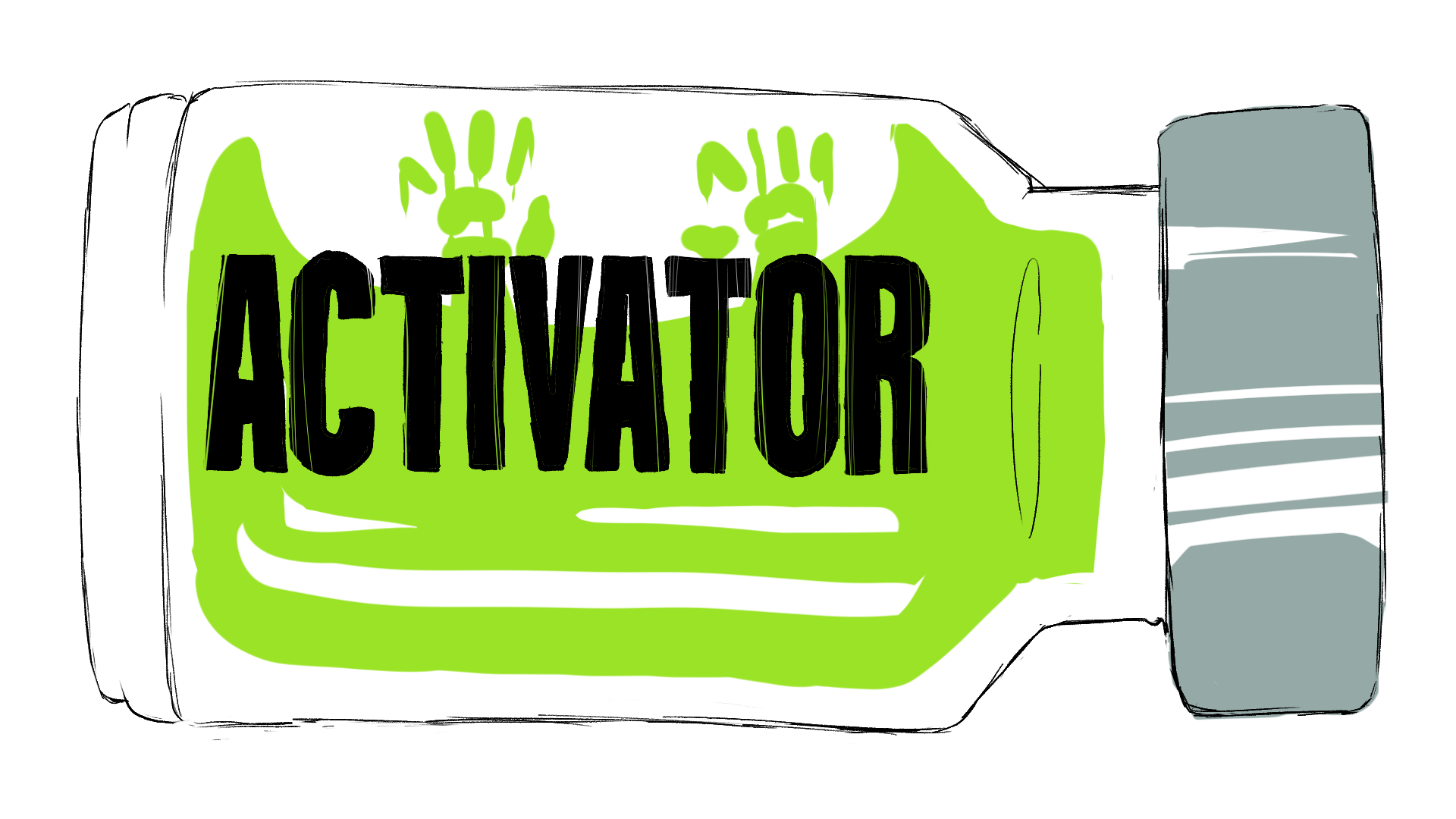
Illustration by me of a vial of “Activator” from the film The Substance with small green hand prints.
The Substance is easily my favorite horror film to come out this year, and probably my favorite film regardless of genre to come out of 2024. It executes common horror tropes beautifully while offering a combination of fresh new ideas that haven’t felt explored in the specific way Coralie Fargeat, the director, addresses them. The film’s plot and general message are also incredibly relevant to politics of Desire and how physical attractiveness is measured among different groups of people.
Who am I? I, I’m my thoughts, My dreams, My aspirations. I’m my name, My looks, My imagination. That’s what I see, When I stare, Into my reflection.
My reflection, Ripples in the river of life, The shallow, Shallow river of life. To the world, I am my reflection: I am only what the world sees, Only what the world decides I am. My body is but a vessel; Why must the world ignore me, But acknowledge the vessel?!
Books, merely objects Are still judged By only their covers, So who am I to demand They not judge me By only what they can see. The inside of a book Is where the value lies But most people don’t bother; It’s easier to judge From the outside
My body is a part of me, It embodies my soul My personality, But it is not all I am. I am not my scars, My disability, I am me, A completely separate entity. I, Me, Not just what you see
Keto, Maybe that’ll help Paleo, Couldn’t hurt to try So many failed attempts To lower her BMI How can I tell her, That a number It doesn’t define her!
The scale, the scale What does it say? FAT, it says But in numbers, It judges. Why must we care What a metal box Has to say?! Why do we care About the numbers At the end of the day?! The world says Those numbers matter The world says Those numbers decide They have more say Than we do, In our own lives
It shatters my heart The look on her face As we snack on chocolates While she eats ice chips Sugar-free, Fat-free, And low-carb That’s her life
My BMI, That number It’s way too high UGH How can I tell her That number is futile Tell me now, Does the BMI know Of the babies You’ve born?! Does the BMI know Of the PPD You’ve overthrown?!
A number cannot measure beauty So why, Why does it bring tears to your eyes? A number cannot measure beauty So why, Why must the matter Overwhelm your mind? I tell you you’re perfect; But my words They are fruitless, It is only numbers That get through to you, The same numbers, That judge you
trigger warnings: body dysmorphia, suicide, mentions of disordered eating, illness
If you remember what your body looks like, I think you’re one of the lucky ones. If you don’t, then I’m not so glad this is what we have in common. Coming from an older West Indian family, my body was always a discussion. No matter how many soccer practices I showed up to, salads I ate, nor how well I did in P.E. class, whenever an aunt approached me it was always “You’ve gotten bigger!” Even throughout my adulthood my body has gotten bigger. I know I’m big, but I wish they knew that I didn’t need to be reminded every second of my life.
I think it’s important to note that I wasn’t always fat, but I still struggled with food and dieting at a young age. Having to deal with cholesterol issues during elementary school was the start of my long, relentless relationship with food. I remember sitting in the doctor’s office with my uncle, his eyes glazed over, listening to every word my pediatrician said. My relationship with food not only originates in this moment, but also with my family’s history of heart disease, diabetes, and many other debilitating diseases. By the time I reached high school, my uncle had a coronary angioplasty, stent insertion, triple bypass heart surgery, and several other surgeries for various kinds of cancer. He never wanted me to suffer like he did.
For as long as I can remember, my uncle micro-managed everything that graced my plate. There were even times we fought at the dinner table so he could see whatever takeout I’d brought home. The stress of bringing home any form of food that he would scrutinize started to transfer into other aspects of my life. In middle school I discovered how uncomfortable it made me feel to eat in public spaces. In high school I even went as far as to become the library aide so I could escape the daunting task of consuming food in the adolescent-filled cafeteria and tried my best to retreat back to the library every lunch break. The library was my safe haven, a place of structure for the moments where I felt the most vulnerable. This is still a habit I have today, I always look for security.
It wasn’t until my senior year of high school that I started my first romantic relationship. He was beautiful, smart, and even had a piercing on one ear that was the jackpot of my teenage girl fantasies. Being with him was the first time someone told me I was pretty. For someone that had only dreamed of having a boyfriend, that meant the world to me. I naively thought that feeling would last forever. As the pandemic raged on, and quarantine forced us into our isolated nests, there became an evident strain on our relationship. Still, we continued to stay with each other. I never noticed when his demeanor changed or that I couldn’t fit into half of my jeans anymore, or even that I was getting bigger than him. I made a huge mistake. You know that horrible mistake people make when they get lost in a relationship because they already have constant bodily validation? Yeah, that one. I gained the “happy weight”, I let myself go. People hate happy weight because being fat makes you feel empty and alone after a relationship. Nobody thinks that you’re attractive anymore and it feels like now there’s this huge responsibility that you have to get back to when you were skinnier. I fucked up.
Coming out of that relationship I became extremely depressed. I moved back in with my family, back to a space I never felt secure in. Endless nights spent scrolling through Tinder, a space where your body is always being perceived, felt completely invalidating. I was a completely different person. And I didn’t feel that way because I had loved and learned valuable lessons about navigating relationships, but it was because I was fat. Everytime I looked into the mirror, a devil appeared on my shoulder pointing out every flaw on my now monstrous body. It’s like my ego had turned against me.
I didn’t want to live in my body anymore. I thought I was nothing without the comfort of another person telling me I was good enough. I can’t say that I never feel that way today, but I’ve worked on it. I’m not about to go on a spiel about how much it matters to love yourself, nor about how self-love is a journey and not a destination… but would love really be worth it if it meant that I had to be skinny, athletic, or fit any of the aesthetic qualities guys on dating apps wanted? Probably not. But I want to be better, because I know that the moments in between these feelings of doubt and despair are much more important than these superficial views of my body. Though, how I never saw myself changing is still a phenomena to me.
In the end, I’m still trying to upward spiral out of this feeling called body dysmorphia.
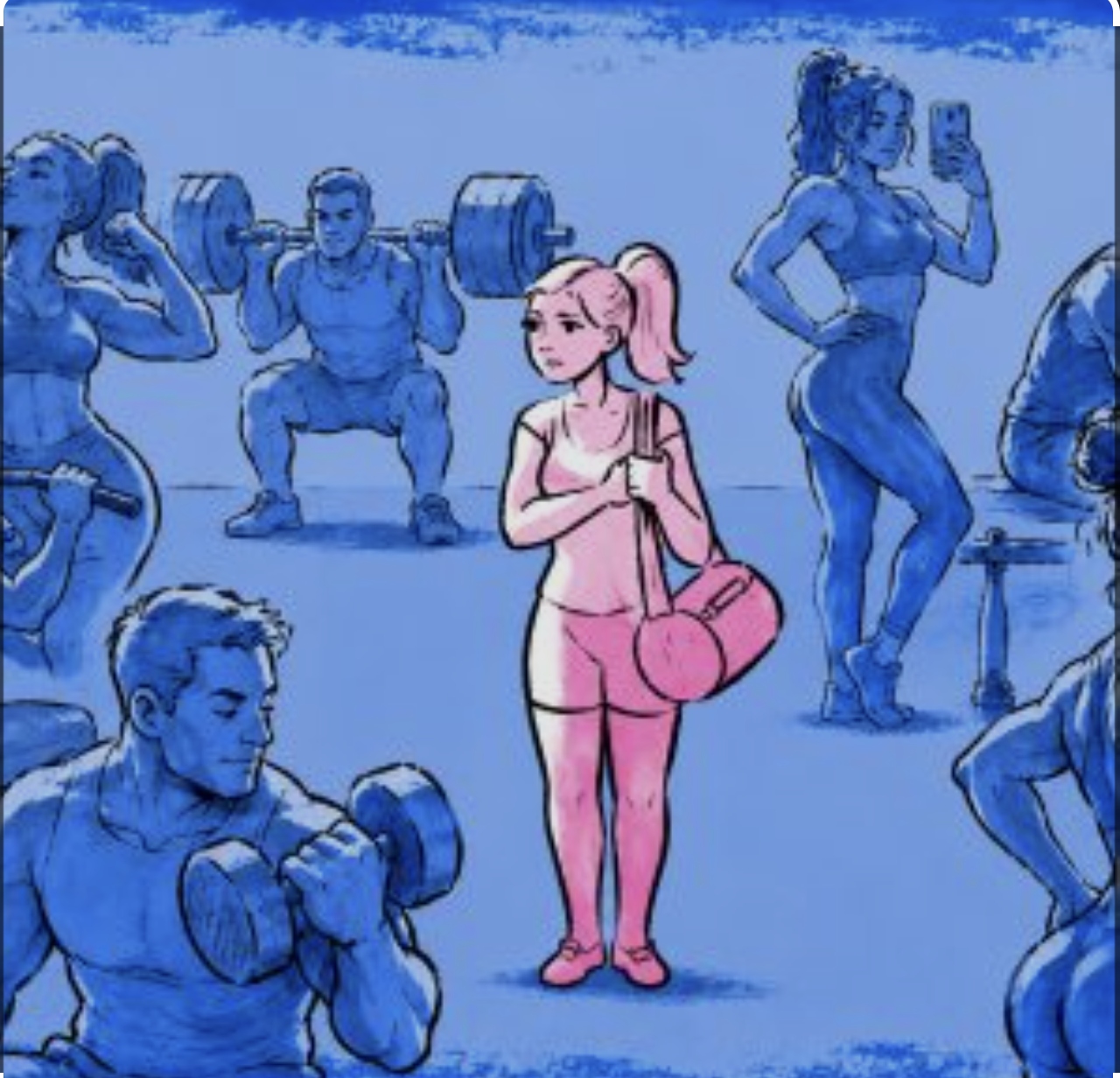
When thinking about the beauty standards of today it’s hard to ignore that bodies within magazines and television are rarely realistic goals for the general public. With bodies that range from what some may consider skinny to what others may consider thick, it’s important that we acknowledge all bodies contain a life within them. Looking at myself in the mirror can be difficult sometimes as I don’t believe my body is what society deems as attractive. Attractiveness is different for each gender as what is subscribed for males and females are different though this is changing it still holds today that men should be muscular and that women should be small and hairless. Focusing on the physical aspect of the
If you spend time sifting through the hundreds of shitposting meme pages that have monopolized Facebook content, you may be able to find the occasional gem. Facebook groups have established online communities that often foster emotional support, validation, and advice from online strangers and internet friends. Many of these groups have “secret” security settings, meaning the group can only be accessed if one is personally invited, allowing for a sense of trust and community among its members. These groups exist in many different forms that fulfill a variety of purposes, one group being a place for members to share photos and stories that all pertain to their bodies.Continue reading →