
Solitary Confinement & Anti-Suicide Rooms

TW: sh, suicide

The Strike examines how solitary confinement in California prisons strips people of basic humanity by removing stimulation, color, sound, and, most importantly, meaningful connection. The documentary shows how incarcerated men organized a hunger strike after years, and sometimes decades, of being trapped in small, bare cells where even a moment of conversation became a form of survival. Many describe how isolation pushed them deeper into despair rather than keeping them “safe,” and how the lack of basic human rights made their mental state deteriorate.

Read more: Solitary Confinement & Anti-Suicide Rooms

While watching The Strike, I was struck by how closely some of those experiences mirrored something I went through this past September. I was placed in an anti-suicide room for six hours completely empty, colorless, and silent. There was no stimulation, no clock, no comfort item, nothing grounding at all. I remember crying and begging the nurses just to talk to me for even a few seconds, and no one responded. I had to use a makeshift toilet, and the combination of isolation and humiliation ended up making me feel worse, not safer. Similar to what people in the documentary describe, my thoughts spiraled in that environment, and I began thinking of ways I could harm myself using the room around me.

The documentary helped me understand that what I felt was not “overreacting”. It was a human reaction to a dehumanizing environment. No one should have to die in order to have basic human rights, and it’s appalling that someone did in order for the government to take the incarcerated people seriously.

When My Body Wasn’t My Own

TW: mentions of SA, dissociation

Growing up in a conservative household, I was constantly told to cover up because of men’s “wandering eyes”. I was taught that if I were to be sexually assaulted, it would have been my fault, instead of the person who sexually assaulted me. Out of fear, I obliged, wearing modest clothes throughout my childhood, convinced that I could never be safe. My mother also told me to speak properly, to never talk back to elders or men, and to hold my tounge if I was uncomfortable. In Throwing Like a Girl, Iris Marion Young describes how women move with “inhibited intentionality”, we know we can act, but we feel like we shouldn’t. That was my childhood: constantly silencing and covering myself to make myself more palatable for men. These habits became ingrained in me, because for so long, they were all I knew to do.

Continue reading

What Were You Wearing

“I was seven,
Wearing play clothes,
When he decided,
I was his experiment
I was seven,
Playing in my home,
When he decided to
Claim my innocence”

“I was eight,
Wearing a black shirt,
And pj pants with pink stars
When it all started
I was eight,
In the trusting lap
Of my uncle,
Too young to question,
Too young to debate”

“I was three,
Or possibly five,
When it became,
A monthly encounter,
I think I was three,
Sometimes in a sundress,
Others in pajamas,
When he decided
He had the right to me”

This poem was inspired by an exhibit called What Were You Wearing. The title of the exhibit is a question commonly asked to victims of rape/sexual assault, implying that what happened to them was somehow their own fault. The exhibit proves that clothing is irrelevant when it comes to sexual assault, and that we should stop victim-blaming by asking this question. 

A monstrous matryoshka

As I had read Susan Stryker’s article on trans rage and the comparison of Victor Frankenstein’s unfortunate monster, I found myself following each word closely. I had so rarely seen anyone talk so openly about the pains and sorrows that are hidden about transgender identity. The discussion in class presented an extremely important point on who is allowed to show and vocalize strong negative emotions like rage and pain. As a person of color, as a queer and transgender individual, my permission of showing these emotions has been quite small, but looking further inward I know that there are other reasons I am not one to show these emotions. For my last post I call upon Stryker’s voice of these negative emotions and a monstrous identity, but not for my transgender identity, but one I am coming to terms with existing within me. I open up the physical patchwork body of mine to see inwards, within the darkness I see a cage chained to the ground. Moving closer I can hear the rattling of anger, I peer inside the cage to see a gnarled and patched up figure, teeth unnaturally pointed and sharp objects partially embedded in its body. I instinctively know these objects were brandished weapons with the purpose of subduing and killing this figure, but they have failed. This figure was human once and I can’t help the sadness I feel seeing what has become of them.

“What happened to you?” I ask cautiously.

The pause feels deafening.

“I’d think you’d recognize us, not many come back from the war of trauma unscathed.”

It’s said that what doesn’t kill you makes you stronger, but no one should be forced to be this strong to the point of being caged in fear.

As an echo to the original article, my comparison of monstrous identity in regards to trauma is not one to be used against all who have trauma. This is my sole reclamation of my past and should never be used against individuals who do not wish to do the same. This post will include raw calls to mental health happenings in response to traumatic experiences. Though there will be no details of happenings, there are insinuations of abuse on varying levels.

Continue reading

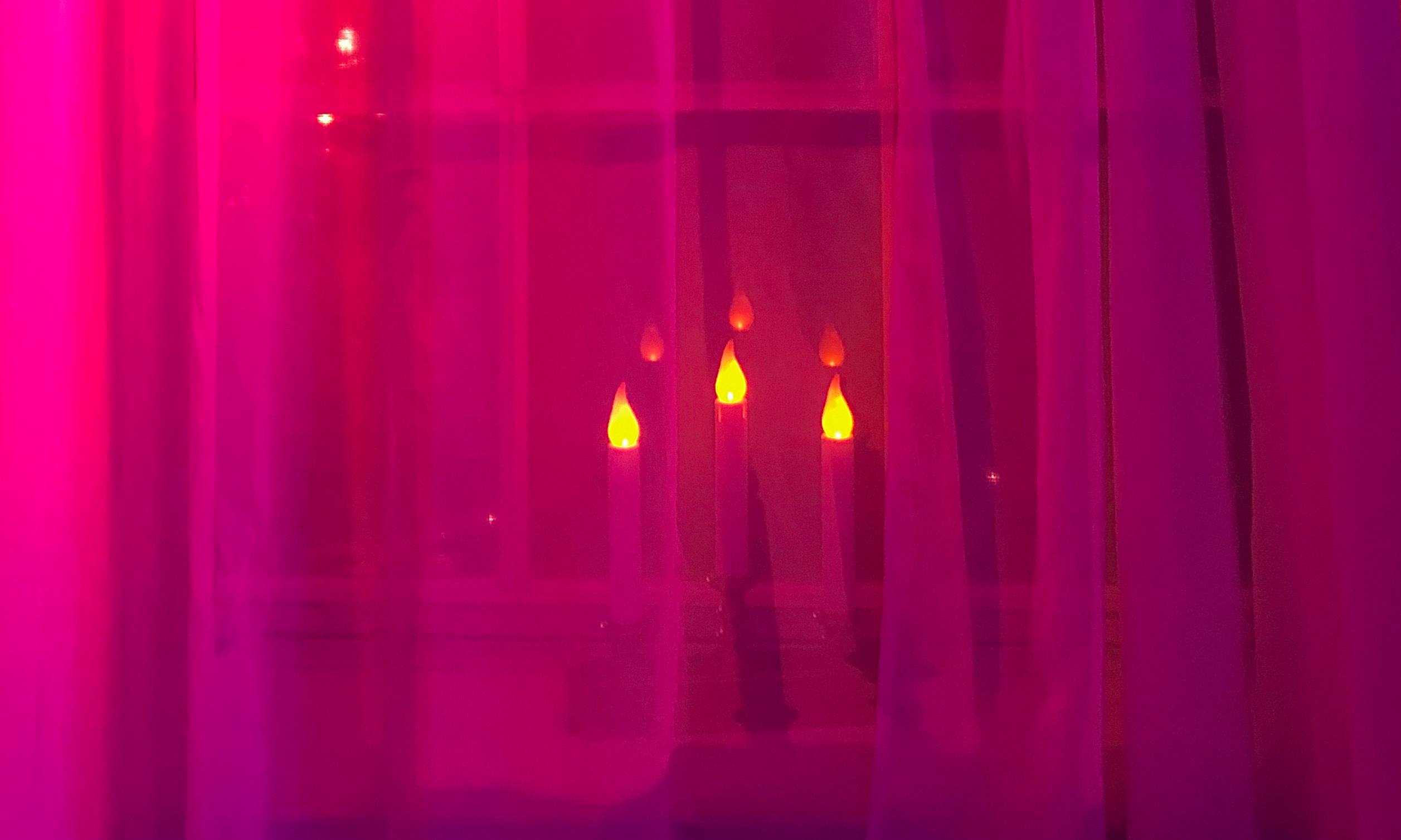
Bedroom.

A view from my bed [ID: Hazy photograph of a window illuminated by vibrant red and purple lighting. In the center there is an electric candelabra sitting on the window sill, slightly obscured by sheer curtains.]

2011 was the year I began distancing. By which I mean, I began a life lived from my twin bed, fueled by goldfish crackers and electrolyte drinks, seldom able to access the outside world. It wasn’t mine to call home anymore.

I was drowning in conditions that these doctors hardly knew about. I had no choice but to become my own doctor, nurse, and historian. More than anything, I became my own community.

The outside world was stolen from me by sickness, uncertainty, and administrative violence – this world was never built for my survival. Such predicaments were met with constant calls to push through – go into the world anyways, risk it all for a “normal” life. They said adapting to it would make me better. It wrecked my body and my mind. Being bedridden was extraordinarily taxing and painful in a way that cannot be understood by those who have not been fully immersed in it in this way, yet. But I am inseparable from my bedroom life, I am made of soft pillows and the world I built among them. 

Continue reading

They Say I Have Her Eyes, Did I Also Inherit His Pain

CW: This post deals with trauma and the resulting mental repercussions and includes mentions of sexual assault and the holocaust.


Ever since I was a baby, people have compared me to my parents. When I was younger, my parents would often be told I resembled my father. As I grew older, the comments changed. I was now told I look almost exactly like my mother. I got my mother’s acute sense of smell and taste. It’s easy to point out the observable traits I inherited from my mother, but I may have gotten even more than that. According to recent scientific studies, my mental health may have been affected by my mother’s trauma. Continue reading