questioning faith/questions of faith

Understand and explain how different forms of embodiment are produced and shaped by narratives. That’s the course learning objective for this unit. The further explanation notes how oral history is produced by selves and produce selves in their telling.

While I was reflecting on how my topic was going to connect to the course objective, I reflected on my recent experience watching the production of “Call Me By Any Other Name…Just As Sweet”. The piece was very impactful, and while I watched the production I was struck with the familiar thought when I am witness to an impactful piece of art- ‘I wish everyone I’d ever loved or know was here next to me to see this too’. Thinking about it more, I think its a thing of I see my human experiences mirrored back to me in media/art and I crave that visibility in my loved ones. Like.. I wish I was understood in THIS way. It’s like when you watch an impactful movie with your family or friend and you want them to get it in the same way you did.

That’s what ‘Questions of Faith’ from Nonbinary: Memoirs of Gender Identity felt like for me. Like I wished people in my life would read and understand my feelings about it. It’s a memoir produced by selves and it produces selves (recognition and validation of my own experience).

  1. Complicated hometown church/small town feelings. Growing up in a small town, being active in church activities, being known as one image of a person and feeling very different. I avoid spaces where I might be known in my hometown to avoid seeing people that know my family, or dress differently in my church to uphold the image. I am very selective with who I’m out to, and to which family friends and people know I am dating my girlfriend.
  2. The feeling of looking for faith communities that fit me. Beyond the feeling of ‘fun’, I struggle with connecting with individuals in faith communities when I leave big parts of me at the door. I have felt like individuals in faith spaces I have been in the past lack a lot of nuance and say a lot of things that make me cringe internally.
  3. Having faith questioned in queer spaces. This one is like when queer spaces are exclusive of religion because of their experience of church hurt/other reasons. Being ridiculed by queer people for being religious. ‘You are still brainwashed and an idiot if you are queer and religious’.
  4. The biggest factor to drive me away from religion is the intense pressure from Christians to conform to a very specific image of a religious person. My family, Christians that I know and Christians in politics drive me away from being religious more than the world/ or sin does.
  5. Cycles of faith. Practicing faith because I was forced to but continuing to practice even though I don’t need to anymore. Leaving and coming back to faith, feeling anchored and simultaneously held down and restricted by it.
Embodiment in the Digital Age

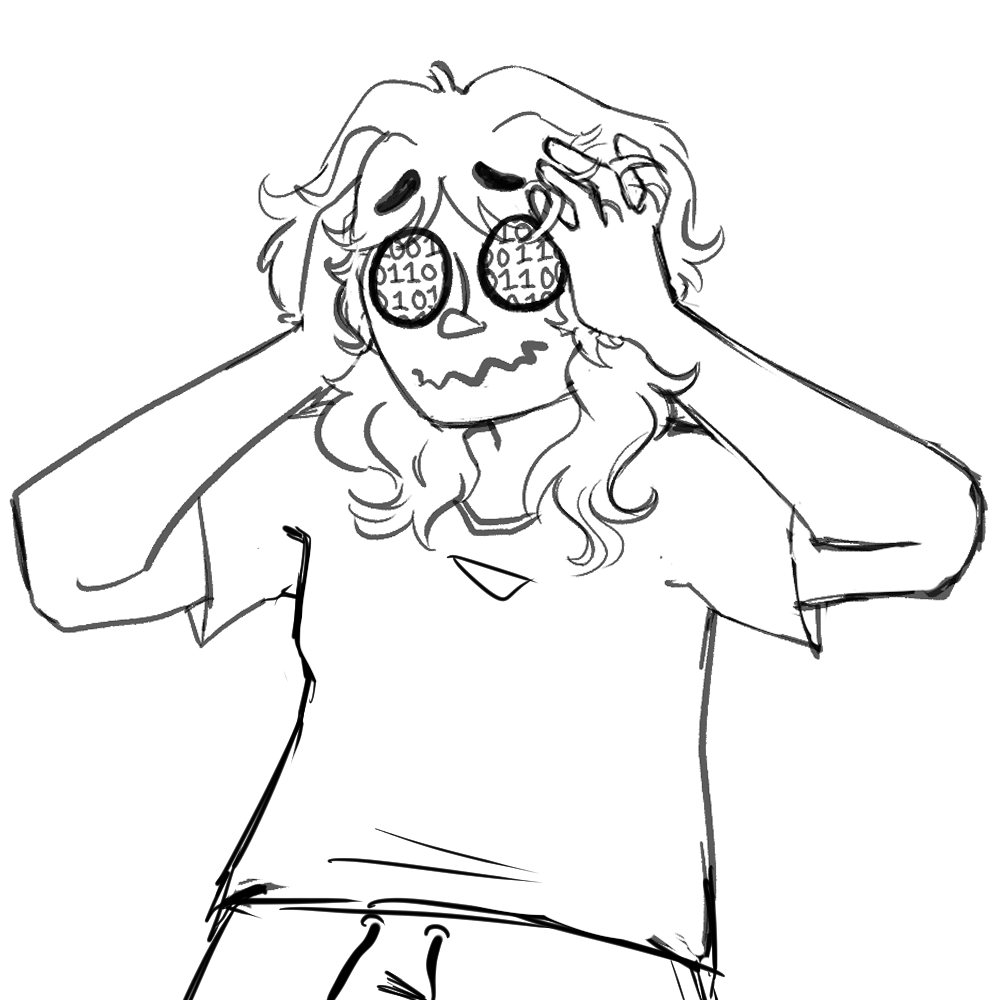
A quick self-portrait doodle I did today that describes my feelings regarding the ever-increasing presence tech has in our lives.

A nih.gov article from 2013 states that an ideal amount of screen time for the average adult should be no more than 2 hours per day. That figure just 11 years later feels completely impossible to achieve, almost like a funny joke. I could hit those 2 hours, 4 times over just working on one school assignment. I have a much more robust and stable social circle online compared to any friendships I’ve managed to foster in real life. My new car’s speedometer and tacometer are both on a digital screen. I can’t even lower my daily screen time when I’m driving. Something about that is kind of terrifying to me.

Continue reading

Job Prospects & Embodiment

I grew up with a very laid back mom.

Read more: Job Prospects & Embodiment

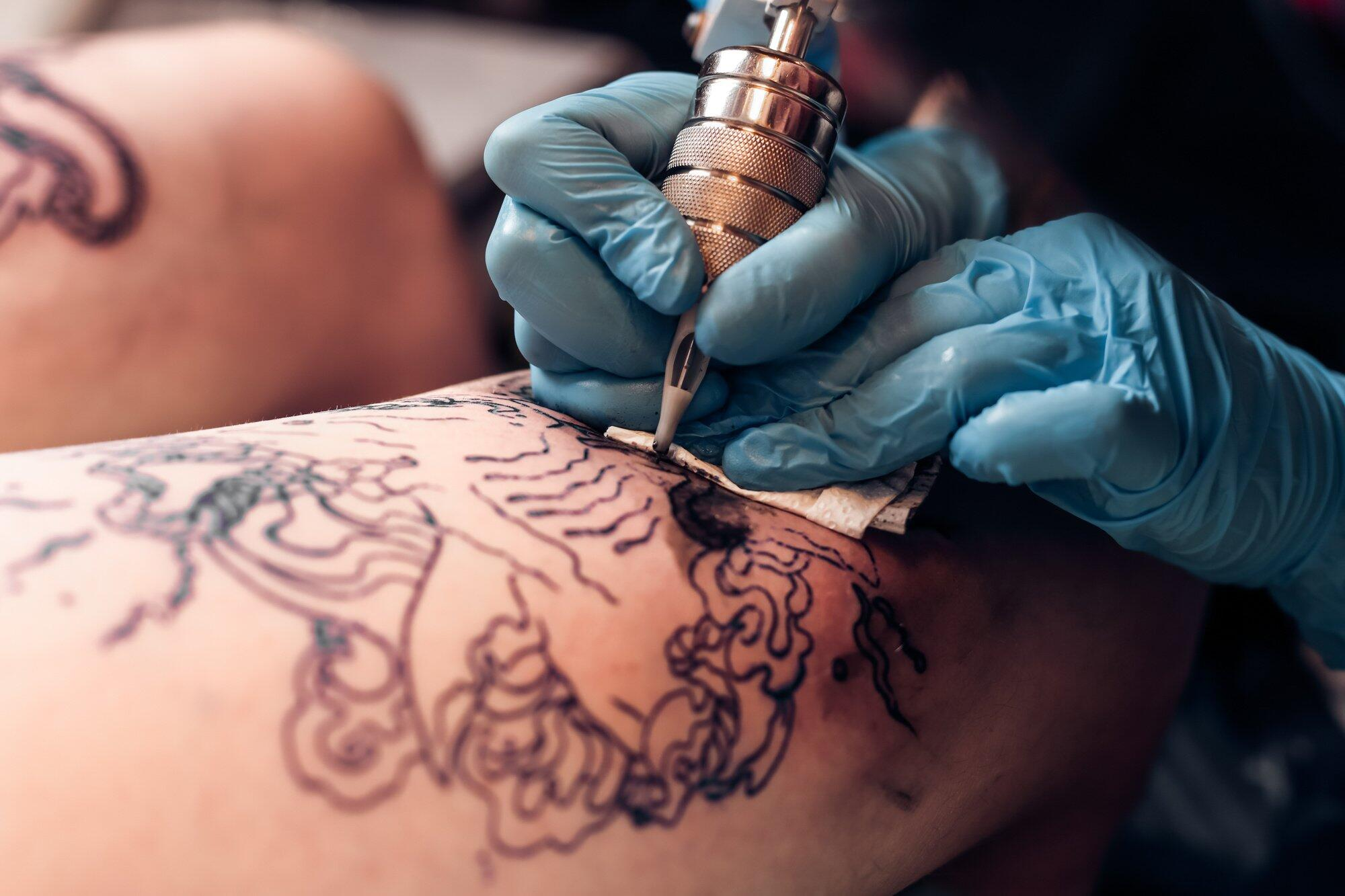
She allowed me to gauge my ears in middle school, and I got my first tattoo, a large forearm piece, in high school (which I do sometimes regret). To this day, I still seek out that thrill of body modifications. It was yesterday that I stretched my ears to the next size up, 9/16″, just a few away from my goal of 3/4″. I have a helix and some facial piercings, and I only plan on getting more. The same can be said for tattoos. I have a list of ones I want, and my following list on Instagram is filled with artists who I want flash pieces from.

Some people ask about things like professionalism and job prospects with my visible tattoos and stretched ears, but at the end of the day, it’s all me. I don’t want to let some corporate entity control how I feel most at home with myself. I’m realizing more and more as I grow into myself that there are so many things that are inherent to me as a person, and tattoos and piercings are some of those things. They’re a part of my identity at this point. They’re how I embody myself.

All of that is to say, I think there is an art of making yourself your own. Creating your body and molding it how you please is a part of the human experience. It isn’t just our limbs that are extensions of ourselves – hair, mobility aids, tattoos, piercings, surgical scars – they’re all extensions of who we are. Piercings and tattoos are how I express myself, and my gender as a trans person. I am reclaiming a body that, as an AFAB individual, has been claimed by society.

There are a lot of ways people make their bodies their own. I think it’s very human, and very beautiful (regardless of job prospects).

Addressing misconceptions of tattoo culture and tattoos as art today

In recent years the tattoo industry has grown significantly; social influence has deconstructed a lot of the stigma around tattoos, and outdated conceptions of tattooing have been dispelled. As an artist, tattoo culture is truly fascinating… It is such a democratic form of art and the commonality and accessibility of tattooing as an art form makes it an interesting subject. 

The permanence of tattooing is integral to its nature, and the permanence of art which is so personal to an individual is a unique phenomenon. There has long been discourse about addressing tattooing as a form of art- this goes along with misconceptions that tattoos are “unprofessional” or “delinquent”. 

However, today, tattooing is much more appropriately addressed as a very impressive and particular form of art. The relationship between art, artist, and customer here is much more complicated than with traditional types of art. Tattoos demand that the consumer accepts this art as a part of them, and there is a unique trust in this process. There is also then the idea of the impermanence of the art for the artist. Their “canvas” per say is coincidentally impermanent to them. It is, conversely, entirely permanent to the consumer. This then leads to the discussion of how tattoos impact or alter one’s individual embodiment. Tattoos to many people are an outward expression of parts of their identity often not visible to the public. To me this is such a beautiful intersection of freedom, identity, and art.

 I think that some stigma that still remains regarding tattoos is their permanence and meaning- there is a general sentiment that now, okay, tattoos are acceptable, but they should be regarded with importance and meaning and hold particular value. I think that this is still a misconception and hinders that freedom of expression previously mentioned. 

To me, tattoos can hold meaning and tell a story, but they also express simple beauty and art. There doesn’t need to be some significant life event or meaning to warrant someone wanting a beautiful piece of art immortalized on their skin. 

To me, my tattoos tell my story, and I will continue building that story as I grow older. I also love collecting tattoos from different artists, and I hope to do this on a larger scale as I go on and travel and have more unique experiences. I love that each of my tattoos holds a memory of a particular artist and a unique interaction and experience. I love collecting other people’s art on my body and using it as a means for my own expression and self confidence. I think it’s a beautiful exchange of expression and identity. 

I love too that this expression then allows me to connect with others around me who are interested by what they see on my body; I think of my tattoos as a sort of outward preface to my personality and identity and that exact idea has led to some truly wonderful interactions and even friendships. 

Waking up in a new world

I dont really know where to begin. I remember as though through a haze… the feeling of mingled anticipation, dread, and sense of unreality leading up to the 2024 election. Logic said no, of course good must prevail, we can’t lose. Look at the numbers, I thought, there is no way this can go astray after the statistics of 2016 and 2020. If I’m being honest, it’s been days and it still doesn’t feel real. I woke up on November 6th in a different world, and Ive been going about my life, waking and sleeping and waking again feeling like I’m still in a living nightmare and it just simply can’t be real. 

Lives were dismantled on Wednesday. My outlook on the rest of my life and on the entire world changed. 

I remember waking up, rolling over, and checking my phone, a bit apprehensively. The first thing I remember processing was a text from my aunt saying how sorry she was for my generation, and how we will find a way rise above. The second I saw it I knew, before I even read the dozens of other messages. 

I immediately had a panic attack. 

I texted my girlfriend.

I called my mom.

I don’t think I’ll ever forget that morning. 

I remember panicking the night before, just anticipating the results with my girlfriend. My girlfriend is a hispanic immigrant, an amazing female athlete who came to America to pursue her dreams. I knew what this election could mean for her very directly.

I knew what it could mean for every immigrant, every queer and trans person, every woman, every minority living in this country. 

This country that was built on native land. 

Built on the dream for a better future, a better democracy. 

A place for people to come from all walks of life to live the “American dream”.

What happened? 

When did it go so wrong?

 I think we have lost the definition of patriotism. These self centered, bigoted, so-called patriots who claim to seek salvation for their country… How don’t they see it? 

Is it so easy to follow along, to parrot what you’re told by The Man?

Were this many people really just waiting for someone to come along and validate their hatred and say, “no please, go ahead, it’s ok to be a bigot and oppress that which you do not understand”? That which doesn’t have quite literally anything to do with your life. Individual and private parts of other people’s lives

I really don’t understand what happened, I don’t understand the logic, I don’t understand how we got here, I will simply never understand the hate. 

I fear for my country, for every person less fortunate than me. For my girlfriend. For my friends. For every young girl growing up in a world teaching them that they actually cannot achieve anything. That they are objects. I fear for all those stuck in deeply red states who have to worry for their safety every day. I fear for everyone who is in danger of losing their home. Their rights. Their fundamental human rights. And really, I fear for everyone living in ignorance. What a sad existence it must be to live a life governed by hatred. To lack the privilege of independent thought. Now though, it is time for those of us who can to fight, and keep fighting. We may not live to see the future that we are fighting for, but it is crucial that we carry on. It’s not about us, maybe it never has been. But we are strong. And we are living in this world which is demanding us to take action. I am tired. We are tired. But it is never easy. Yet when we fight for love and we fight for hope, and when we fight together, we truly embody our full power and I have faith that we can make that future that we dream of.

My Kink is Subversive Sapphic Music Videos- How Chappell Roan subverts gendered rules of embodiment in “My Kink is Karma”

My Kink is Subversive Sapphic Music Videos- How Chappell Roan subverts gendered rules of embodiment in “My Kink is Karma”

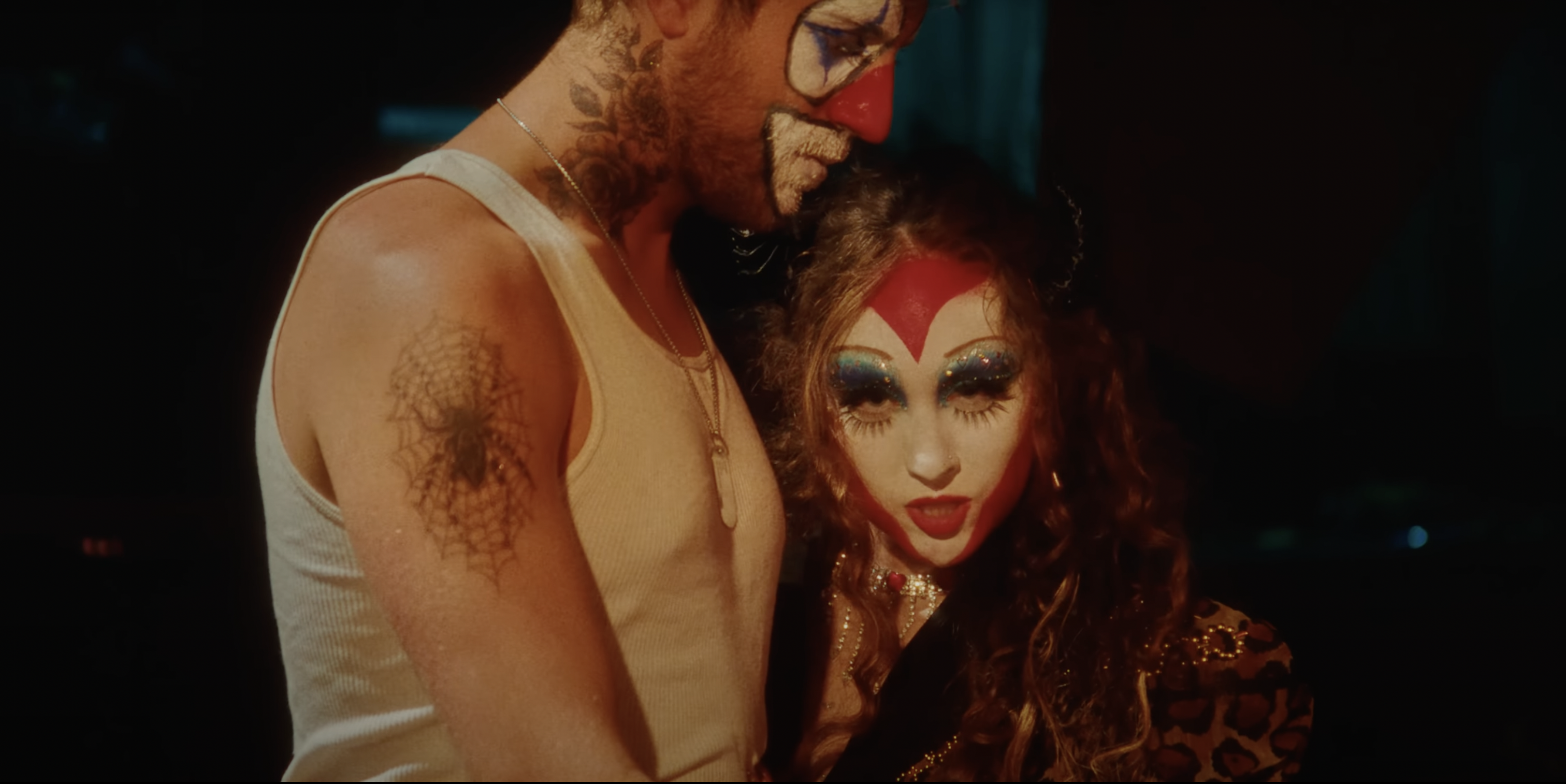
It’s 2023. I have just shut my computer after a grueling day of classes and homework, all to turn my attention to yet another blue-lit screen. As I catapult myself into my bed, I open YouTube in search of the Bob Ross marathon live-stream that I can always count on being my first suggested video. As the app opens, instead of Bob Ross’ comforting face, I am greeted by a smirking woman with curly red hair, glittery clown makeup, and devil horns. Her name is Chappell Roan. As a drag queen myself, I was instantly intrigued. I click on the video, named “My Kink is Karma”, and watch intently.

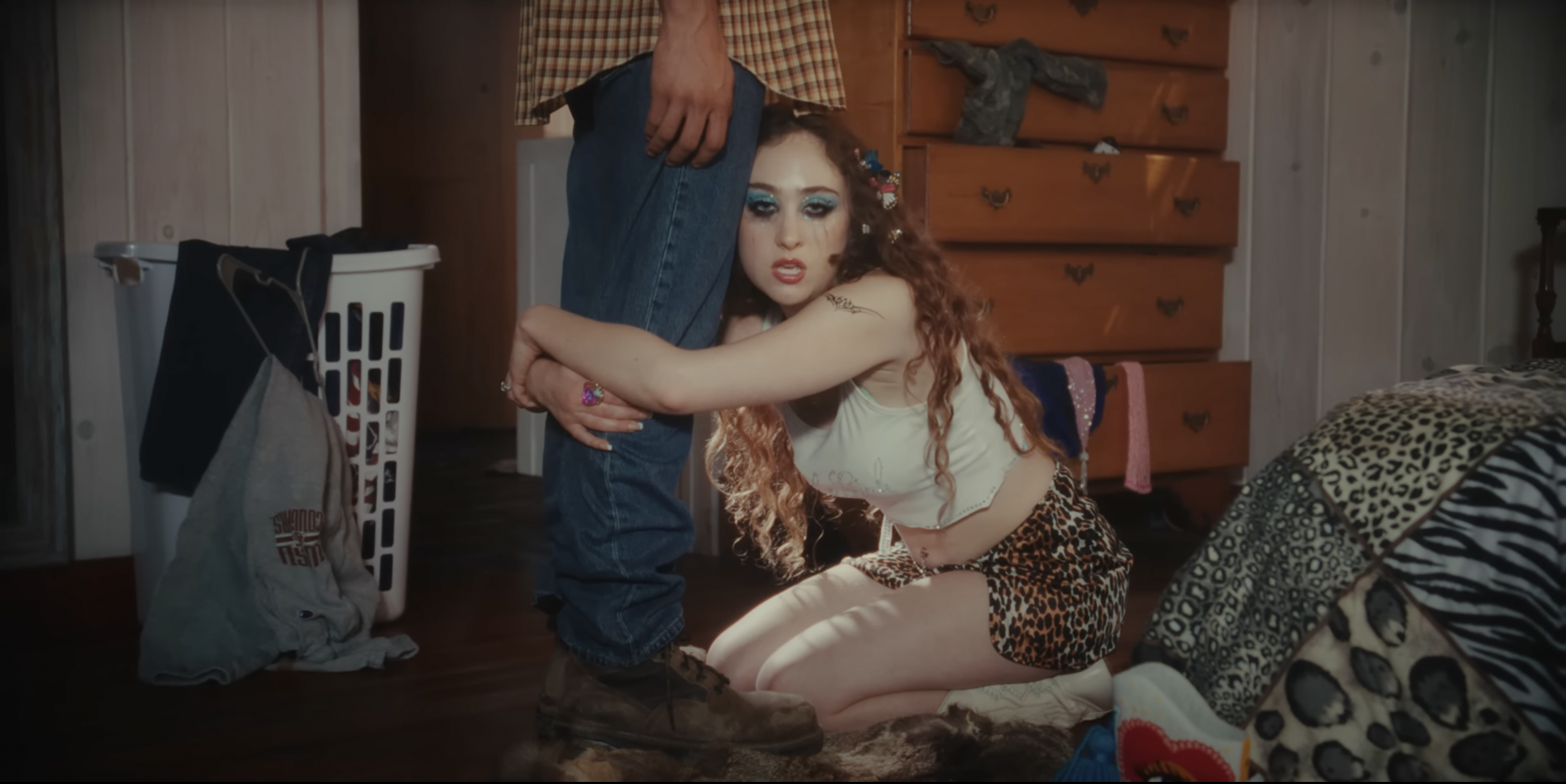
Chappell Roan and Clownie: Woman with red curly hair, white tank top, and cheetah print shorts kneeling on the ground hugging the legs of a man in blue jeans and a yellow flannel. She is in a messy and disorganized bedroom.

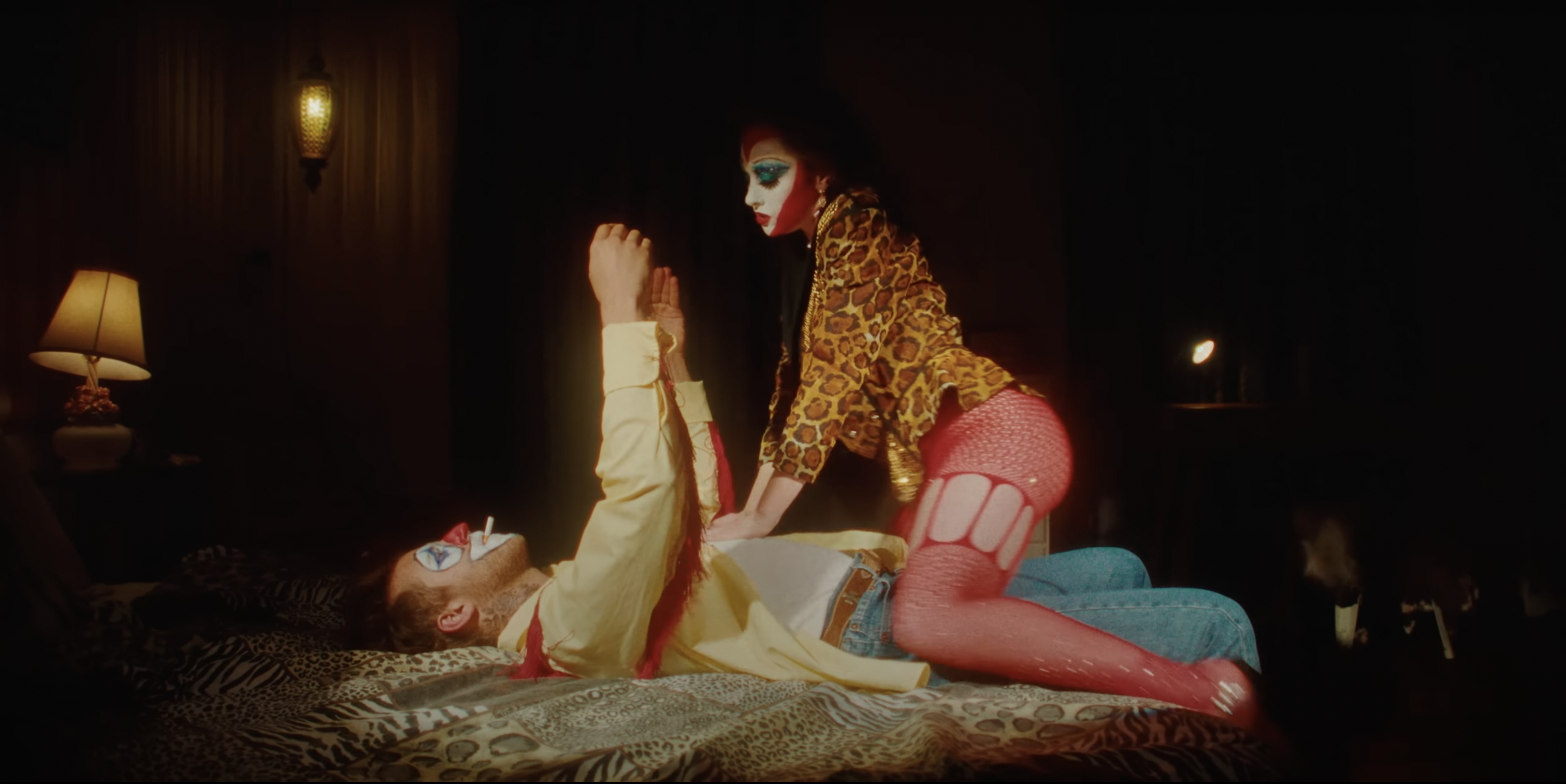
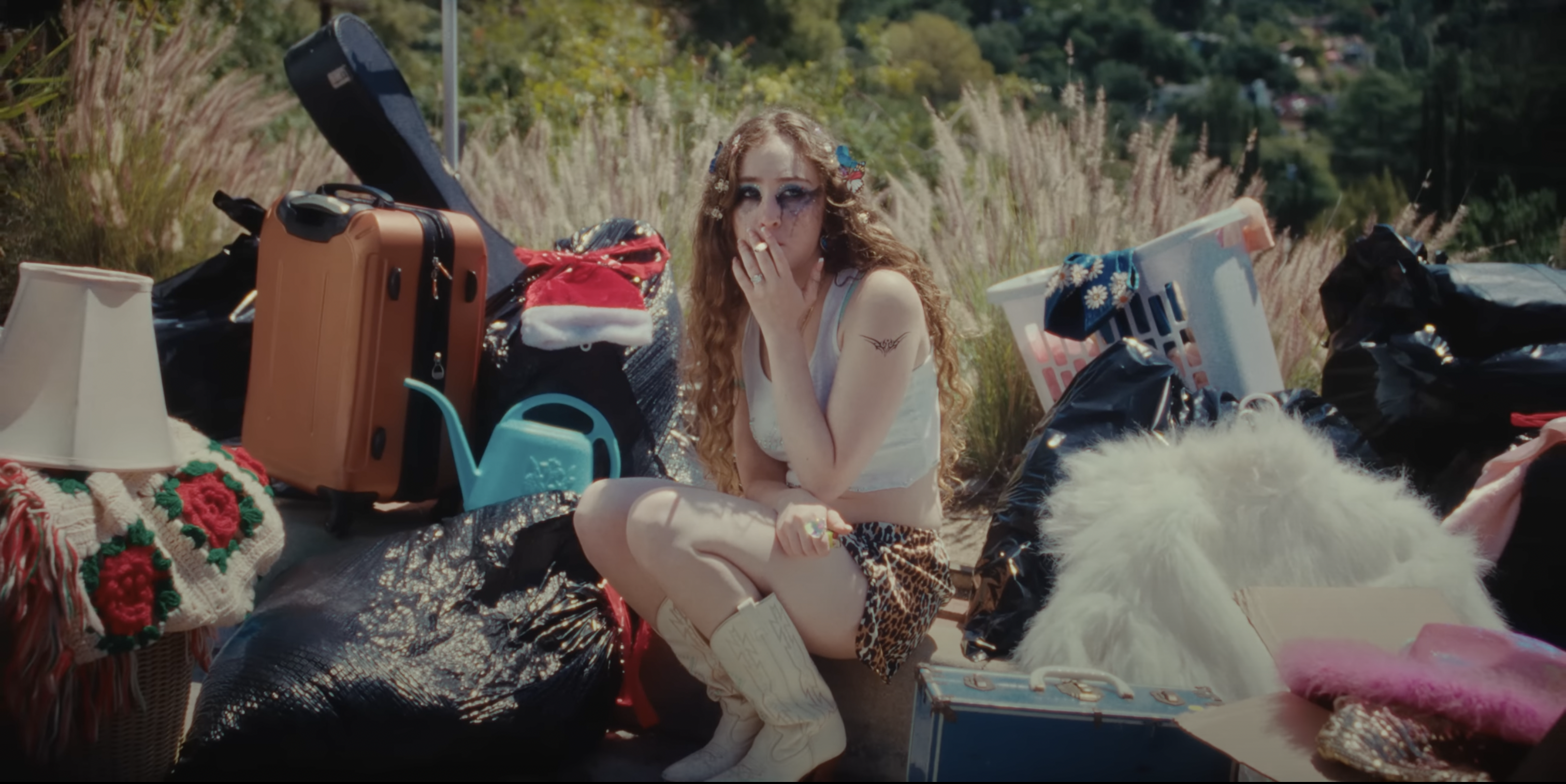
The video begins with Chappell packing her things, mascara running down her face after she broke up with her cheating boyfriend, Clownie. Her body language in this first scene communicates that her potential is repressed by Clownie’s emotionally abusive nature. I notice how during the first verse, it is made very clear that this story is not about him. In fact, his face is not shown throughout the first minute and twenty seconds of the video. As the first verse builds into the chorus, Chappell transforms from sitting timidly on a street curb to embodying power, confidence, and control. Her transformation into her drag persona represents a shift in embodiment, from a place of trauma to a place of dominance. For the majority of the video, aside from the first minute or so, Clownie is notably docile, in a trance-like state controlled by Chappell Roan. This dynamic in music videos, where one party has total control and the other serves as decoration, traditionally mirrors gendered expectations of embodiment. “My Kink is Karma” subverts this dynamic by explicitly depicting how this level of control looks when the roles are reversed.

Chappell Roan and Clownie: A woman with red curly hair, clown makeup, cheetah print blazer and red fishnets straddling a man in clown makeup, yellow shirt, and blue jeans on a cheetah print bed. The room is dimly lit with a spotlight on Chappell Roan and Clownie.

According to Iris Marion Young’s piece “Throwing Like a Girl” (1980), feminine bodies are taught to occupy less space and use less bodily power compared to masculine bodies. When someone is socialized as a girl for example, they are taught to throw a ball without engaging the entire body; this results in a throw less powerful than someone who is socialized as a man, who is traditionally taught to maximize their physical strength. This dynamic can be seen in the first part of the video. Chappell’s posture is submissive and defeated while Clownie is throwing her things to the curb in a fit of rage.

Chappell Roan: A woman with red curly hair with tear-streaked makeup, white tank top and cheetah print shorts, and white cowboy boots sitting on the curb smoking a cigarette. She is surrounded by disorganized piles of her belongings.

During the rest of the music video, Chappell Roan breaks every rule of gendered embodiment. She looks directly into the camera while Clownie exists in his submissive state of hypnosis. He does not react when she pushes him down onto the bed, or when she throws his jacket into the fire. He does nothing when Chappell smashes his face into the cake, or when she pins him to the heart-shaped target. Clownie is not there to take up space like men typically do in music videos, but to receive the karma that Chappell exacts. His embodiment is completely in Chappell Roan’s hands.

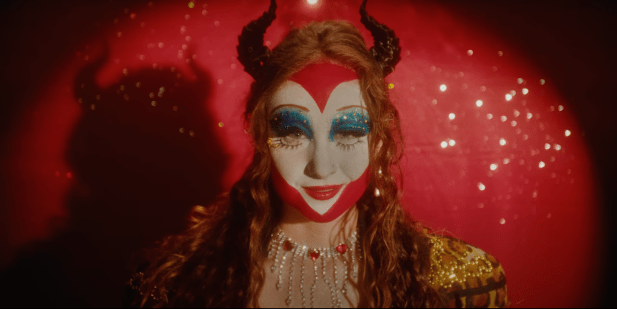
Chappell and Clownie: A woman with red curly hair, a cheetah print blazer and heart-shaped clown makeup is staring into the camera, while a man in clown makeup and a white undershirt is staring down blankly.

Although I’m sure there is an argument to be made that reversing the roles of gendered embodiment is problematic because it still privileges one socialized group over another, I find Chappell’s subversion of feminine embodiment extremely compelling. Her video inspired me to revisit the ways that I practice embodiment through art. The next time I am on the stage in my heels (it’s where I belong 🎶), I will think of Chappell Roan’s subversive embodiment.

Sources:

Roan, Chappell. “My Kink is Karma”. YouTube. May 13th, 2022. https://www.youtube.com/watch?v=ePsqyPMIg6I

Young, Iris M. “Throwing Like a Girl: A Phenomenology of Feminine Body Comportment Motility and Spatiality.” Human Studies, vol 3, 137-156. 1980.

Reflecting on the Philosophy of Consciousness in the Context of Embodiment

The concept of consciousness and individuality has always been of great interest to me. The idea that every individual is experiencing something utterly unique in every moment goes beyond what I believe we can adequately perceive or understand as humans; it is like the concept of infinity. In a way, we’ll never know if everyone around us experiences things consciously or exists in the way we do, because when it comes down to it, our world is how we perceive it on an entirely individual level. I have thought that it is interesting to approach the subject of the human experience in an objective way, because this seems like a paradox to me. The idea of the “human experience” is directly linked to our humanity and therefore identity, so I wonder then how it can be examined in an objective way when the idea of experience is entirely subjective in it’s own right. 

If we assume that an “experience” is a conscious thing, and then that our consciousness is shaped by our identity and individuality, then experience by nature cannot be examined objectively. Because we ourselves are conscious beings we cannot strip ourselves of subjectivity because it is exactly that that makes us who we are and constructs our very thought. We are, in a way, burdened by our consciousness and thought, but then again this is in essence our humanity. Therefore if we dismiss this notion of objective examination and embrace our consciousness and the effect of our identity, we can discover new ways to address experience and accept this examination as a subjective thing.

On Embodiment and Gender

As I understand it, the concept of embodiment seeks to move away from the Cartesian mind-body dualism, which posits that our minds and our physical bodies are distinct entities, and towards the idea that we are our bodies. We experience, know, and perceive the world through our bodies, and in return we are experienced and perceived by others through the lens of our bodies. An important factor in our body experience and the way our bodies are perceived is gender. Do I have a gender, or am I my gender? Do I have a body, or am I my body?

Continue reading

A monstrous matryoshka

As I had read Susan Stryker’s article on trans rage and the comparison of Victor Frankenstein’s unfortunate monster, I found myself following each word closely. I had so rarely seen anyone talk so openly about the pains and sorrows that are hidden about transgender identity. The discussion in class presented an extremely important point on who is allowed to show and vocalize strong negative emotions like rage and pain. As a person of color, as a queer and transgender individual, my permission of showing these emotions has been quite small, but looking further inward I know that there are other reasons I am not one to show these emotions. For my last post I call upon Stryker’s voice of these negative emotions and a monstrous identity, but not for my transgender identity, but one I am coming to terms with existing within me. I open up the physical patchwork body of mine to see inwards, within the darkness I see a cage chained to the ground. Moving closer I can hear the rattling of anger, I peer inside the cage to see a gnarled and patched up figure, teeth unnaturally pointed and sharp objects partially embedded in its body. I instinctively know these objects were brandished weapons with the purpose of subduing and killing this figure, but they have failed. This figure was human once and I can’t help the sadness I feel seeing what has become of them.

“What happened to you?” I ask cautiously.

The pause feels deafening.

“I’d think you’d recognize us, not many come back from the war of trauma unscathed.”

It’s said that what doesn’t kill you makes you stronger, but no one should be forced to be this strong to the point of being caged in fear.

As an echo to the original article, my comparison of monstrous identity in regards to trauma is not one to be used against all who have trauma. This is my sole reclamation of my past and should never be used against individuals who do not wish to do the same. This post will include raw calls to mental health happenings in response to traumatic experiences. Though there will be no details of happenings, there are insinuations of abuse on varying levels.

Continue reading