Who am I trying to be?

I have always been a socially anxious, awkward, and emotional person. I was diagnosed with autism and at 16 and I’m 26 now. I’ve spent the last 10 years aggressively pushing myself out of my comfort zone in an attempt to escape my own innate social and emotional challenges. I’ve been sprinting as fast as I can away from the emotionally unregulated little girl I was towards what I envisioned as my “true self”. I’ve been convinced my whole life that my future idealized, neurotypical-acting self with no social deficits is my “true self” and that with enough self-discipline and practice I can become her. Identifying with the undiagnosed, untreated version of myself is scary, because it was alienating and painful to be that little girl. But autism doesn’t go away, even if you try really hard to forget you’re autistic.

In the book Brilliant Imperfection, Eli Clare critiques the notion that disability is something people can or must overcome through hard work in order to thrive, and explains that this belief is rooted in the ideology of cure, which doesn’t neatly apply to most disabled people since so many disabilities are congenital and uncurable.

But for some of us, even if we accept disability as damage to individual
body-minds, these tenets quickly become tangled, because an original
nondisabled state of being doesn’t exist. How would I, or the medical-
industrial complex, go about restoring my body-mind? The vision of me
without tremoring hands and slurred speech, with more balance and
coordination, doesn’t originate from my visceral history. Rather it arises
from an imagination of what I should be like, from some definition of
normal and natural.

The person I try every day to become never existed, does not exist now, and may never exist. That is a difficult thing to accept in a world where autistic people are punished for not conforming, for being “weird”, “immature”, “off-putting”, “cringe”, etc. I’ve never felt like I was trying to cure myself, but reading Brilliant Imperfection made me realize how deeply my own internalized ableism is rooted in the ideology of cure. This realization has not magically cured my internalized ableism, but it certainly held a mirror up and opened my mind to another line of thinking that I will continue to explore.

Docile Bodies and Stimming

The reading in Docile Bodies reminds me greatly of the disability acceptance movement and modern strides in autistic advocacy.

Docile Bodies describes how society seeks to control individuals by controlling how they move their bodies. The written work focuses mainly on people and general, and then the differences in how it may present for women and men. I will be focusing mainly on their comments on humans and general and how it may relate to autistic people.

“A body is docile that may be subjected, used, transformed, and improved” – Foucault, Docile Bodies, pg.136

Autistic people often have similar experiences of their stimming being shunned by members of authority, peers, family, and strangers. Receiving strange looks, biting comments, or disappointed speeches in response to moving their body in the way they felt fit. Though modern ABA therapy is stated to help clients learn to manage their stimming, and not eliminate stimming completely, it can be said that the way in which medical professionals have treated stimming is less than ideal. Stimming is seen as a disadvantage in social spaces, a way of making yourself stick out like a sore thumb, even sometimes interpreted by strangers as “performing disability”. Masking autistic traits is a way of fitting in as a docile body.

Many Autistic advocates and content creators have advocated for the freedom to stim and posted videos of stimming to help normalize the behavior to non-autistic viewers. It is important that if we ever feel inclined to judge or frown at someone moving their body, how they see fit, we reflect on whether that’s something we actually care about them doing, or if we’re reflecting the docile bodies message that was pushed onto us.

Life After Diagnosis

Phenomenology is the study of first-person experiences and sensations that give life more meaning. When we were discussing this topic in class I immediately thought about how much my experience and perspective on my life shifted after my adult autism diagnosis. After the diagnosis I began to look back at my life and pick out moments and traits that, in hindsight made so much sense with me being autistic. But before the diagnosis, were just a confused, muddled mess. I remember thinking back on basically every interaction I had ever had and wondering if I would have reacted differently had I known. They say ignorance is bliss, but in all reality the not knowing led me to become a traumatized, jaded individual. The world isn’t built for autistic folk, and imagine going about your life wondering why you are facing barriers and roadblocks at every turn and not even knowing why. It messes with your sense of self and you begin to think something is deeply wrong with you. I am still having to unlearn that one. Yay for therapy!

Something that you do when you spend your whole life not knowing you’re autistic, is you get really good at masking. I was able to play the part semi-well and be sociable, friendly, and well-mannered. And when I got older I became even better. But when you learn that you are autistic, that mask begins to crack. It crumbles away and you are left with a messy, soupy, puddle of sensory issues, lack of social awareness, and fixations. It’s extremely common for adults who are diagnosed with autism to regress in a lot of their skills once they find out about their diagnosis. After holding themselves together by the seat of their pants their whole lives, their whole world is turned topsy turvy. This is what happened to me. It’s taken me years to reacclimate to my new way of perceiving the world, and myself. Slowly I’ve built myself back up and created a new, stronger identity. Diagnosis saved my life.

My Invisible Disability

(Trigger Warning: mention of ABA therapy) 

Although I haven’t formally been diagnosed with autism, the understanding is that if you feel as though you have autism you should treat yourself as if you have autism. As the Stevenson article discussed the infantilization of autism erases the existence of autistic adults. But, here I am an autistic adult. I can discuss my experiences with autism. 

I did not have any experience with ABA therapy. At best it seems controversial at worst it looks problematic. As we discussed in class if we have adult autistic representation in the ways of them talking about their experience with ABA therapy and how destructive it can be. Then, this would lead to a capitalist problem, in that, it would lead to the multibillion-dollar industry of ABA therapy to its demise. 

Growing up I would stim, have trouble with eye contact, not understand or be able to read emotions, and was just in general weird. Not to associate negatively with the word weird just like atypical, not a part of the norm, not “normal.” Whatever that means. No one noticed. Maybe I became really good at masking? Later in life, I thought I had ADHD, another invisible disability, this explained the stimming, but not the other symptoms. But, here I am an autistic adult. And I’m confused about what I should do in the future. A diagnosis is much too costly and I don’t know if it would help. I guess I will just be emboldened by community. 

Autistic Masking & Trans Passing — The Venn Diagram is a Circle

Autistic people are a lot more likely than the neurotypical population to identify as transgender — something I personally chalk up to us having a keener eye for social norms that make no sense (the gender binary being no exception). As an autistic trans person who has to deal with the social repercussions of both these parts of myself, I have noticed how society is built not only to prioritize cisgender neurotypical people, but to actively shun those who don’t fit in either category in very similar ways.

Continue reading

An Ode to Yonder City

Or; What is ‘here’ and ‘yonder’ in the home?

This week, one of the works that resonated with me was Young’s Throwing Like A Girl, and I looked back on my childhood. The part about ‘yonder’, the space outside of a girl, hit something different than we touched on in class.

Continue reading

His little world

I wanted to talk about my family friend’s son named Shaun. I’ve known Shaun for a while, he was really young when I met him, I was still young however, in my middle school years I was still learning things. Shaun, along with his brother Stefon were autistic. Whenever it came to the family parties I would be the one to watch over them and keep them company since I was still young and couldn’t be a part of the adult or even the teenage conversations. Shaun was an interesting kid, although he didn’t communicate verbally with words, I felt like I could still understand him and what he needed. I felt like I could understand his emotions.

Shaun would always get in trouble for breaking things, but I knew it was him just stimming because that was one of his habits. I remember during a Christmas party he grabbed one of the ornaments from the tree and smashed one to the ground, and then another, several times until he was stopped by his mother. Shaun got in trouble with his mother. I felt bad for him, I knew he wasn’t doing it to make anyone mad, yet his mom did get mad at him for doing it anyway since it wasn’t his house. She looked defeated, like she didn’t know how else to help him whenever his behavior would get worse. She looked tired too, like she was doing everything she can to just enjoy her time at the party and also watching her boys making sure they didn’t break anything or do something dangerous. My parents loved Shaun and his brother, my dad always made an effort to let Shaun be seen, playing with him, making jokes and funny faces. Whenever Shaun was with me, I tried my best to entertain him, to make him feel heard. He always had a fascination with my hair (back then I used to have hair that would reach the floor I had to keep it in a braid since it was so long, I’m not kidding haha) so every time we sat in a room to calm him down he would touch it and slowly begin to settle. The way he felt my hair and stared at it gave me a sense of comfort knowing that I was there with him making sure he was okay. He would hum the majority of the time, whenever he wanted something he would hum in a pattern and point at the object that he wanted. Shaun never had good focus either, after touching one object he would go onto the next and then the next. Shaun’s mom works with other children who are autistic, whenever she would come to these parties, she would bring books for them to read, I would read the books to Shaun and his brother. Shaun was always mesmerized by the images in the books, he would hum and point at the characters. He always made me feel like whatever I was doing was helping him and that gave me a deep sense of reassurance.

I just feel like people are always afraid to try to communicate with people who have this disability because they don’t understand the way autism works and the levels of the spectrum. Every time I see a child with autism, or introduced to someone, I am never afraid to interact or learn from them, because with Shaun, all I ever did was make him feel heard and safe, and I want to do that for every other boy or girl who has autism. Society likes to put this negative connotation and label of people with disabilities which to me is just undermining their true potential and power, I learned a lot from Shaun and my other experiences after that, and seeing how their minds think and interact made me open my eyes to a whole different concept of learning and understanding. I learned more patience, I learned to really slow down my “normal” thinking and try and fit their perspective into my life. Doing that type of thinking really does open up your mind to a lot of ideas and thoughts. I am thankful for Shaun and the way I made him feel comforted and cared for, that’s something I won’t ever forget. I do know his parents were really good when it came to teaching him, but just like Shaun and other kids who have it I hope the world is able to see that there is nothing wrong with them they just have a different perspective which isn’t and shouldn’t be seen as a negative thing.

My Autistic Reading of Elsa from Frozen

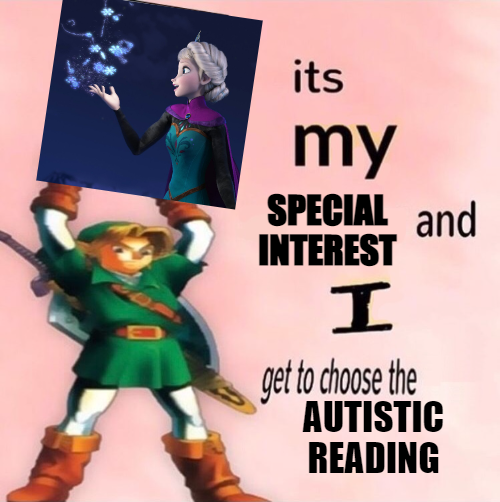
picture of Link from Legend of Zelda, holding an image of Elsa (Frozen). Text that reads "It's my special interest and I get to choose the autistic reading"

A lot of people have read Elsa’s story from the Frozen movies to be queer. Relating her letting go of fear and embracing her true self to be similar to a coming out story. As a queer person myself, I can see why and I totally agree, but I would also like to share why I consider it to be autistic. I’m a little bias since her story helped me cope a lot with the changes I made figuring out I’m autistic. There was a lot of anger, fear, and anxiety which is very prevalent in her arc of the first movie and it connected with me a lot.

The 3rd song of the movie, “For the First Time in Forever“, has some really interesting lyrics from Elsa:

Conceal, don’t feel

Put on a show

Make one wrong move and everyone will know

This is during her preparations for her coronation, where I feel that she is having to mask. She has to appear normal and if she messes up, everyone will know she isn’t. I relate it a lot to social expectations, being reserved and scared to mess up. I’m still that way, because I haven’t really figured out when it’s okay for me to talk. I beat myself up after any social interaction when all I did was add to a conversation, but I feel like I take up too much space when I do.

Moving on, I get sensory overload really fast and it takes a really long time to recover and I need to be alone for that. This is where I relate to her outburst at the event, and she runs away. She reveals herself and retreats and it feels very very similar to slipping up and the need to hide because of that. It’s embarrassing to be autistic around people who don’t really understand.

If we consider Elsa’s ice powers as a metaphor for autism, there’s a lot that can be done with that. This obviously isn’t explicit in the movie, nor the intention, but I will do it anyway. I think using her hands for create spirals of ice, especially in her song “Let it go”, where she is finally free to be her true self, the motions could be considered stimming. Stimming can be a lot of different things, but hands movement is common enough that I can relate, and hopefully so can other people. Apart from that, I think that her having to hide that specifically is good for an autistic reading. Her powers is the specific thing other people can’t see and it’s the one thing preventing her from “being/appearing normal”. Her parents desperately trying to teach her to conceal the powers is a lot like being trained in behaving “correctly” (obviously this isn’t about “bad” behaviors, but rather harmless autistic ones).

If we rewind a little, to the beginning of the film, the ice powers being a source of joy for Elsa and Anna, is a lot like embracing differences before you find them to be “weird”, before you’re taught to not be *like that*. Anna’s inclusion in this reading is really meaningful, because she is supportive. We know the parents care, but are going about it in a terrible way. Anna’s acceptance and care are the only reason the movie can end with Elsa being embraced by the kingdom and being able to use her ice powers freely.