Viola Davis: Oscar Loss, Natural Hair Win

Viola Davis, an award winning black actress, recently starred in the movie The Help. At the 2012 Oscars, Viola appeared on the Red Carpet glowing and debuting her natural hair. The media, of course, made this a into a huge story. When asked what made her decide to wear her natural hair to the Oscars, she stated that h

er husband encouraged her to do so.

I believe that Viola Davis was radiant and confident that night. She was absolutely beautiful. Many black women and young girls appreciated seeing natural hair on the red carpet. Wendy Williams, radio talk show host turned television host, did not feel the same way. On her self titled talk show, Wendy Williams insinuated that the Davis’ TWA (teeny weeny afro) made her look mannish, like the history teacher in the 70’s sitcom “Room 222”. At another time, Williams stated that Davis’ hair was just not professional. Many black women were appalled at her statements. They felt that Williams was attacking black women. As you can see in the picture on the left, Davis display of natural beauty was inspirational to black women and girls; and, Williams blatantly shot it down on national television to an audience who probably does not understand natural black hair to begin with.

Black hair has so much politics attached to it. In the past, black women have felt restricted by white beauty standards of straight or wavy hair that is often unnatural to them. I, like many others, am appalled that a black woman would scorn another black woman for displaying her natural beauty. “Natural” hair is our hair. Kinky, curly, wavy, coarse, whatever, it is our hair. I am encouraged by the fact that so many black women have decided to transgress white beauty standards and free themselves from chemical relaxers, letting their own unique beauty shine. Viola Davis certainly took a stand at the Oscars and became even more of an inspiration to black women.

The Girl With The Dragon Tattoo (WARNING! i tried my best not to spoil anything but….you never know soooo proceed with caution)

Just recently I viewed the movie “the girl with the dragon tattoo”. Though I had never read the book, rave reviews had me really excited to see the film. Ill do my best not to spoil anything for those who still plan on seeing it or those who have not read the book, however there were a few things that definitely stuck out to me.

For one thing, I took notice of how the main character was viewed and treated as a result of her appearance. I would love to say I was shocked, but it is very representative of what goes on everyday in our society. The main character seemed to be a rebel from her piercings and tattoos down to the way that she chose to dress.  Because of this, certain people with whom she worked closely with doubted her ability to complete intricate tasks successfully, though she would prove throughout the movie that she was clearly the best for the job.

At times, the movie reminded me of a class discussion that we had towards the beginning of the semester when we talked about embodiment and how mental abilities are separate yet go hand in hand with what is embodied in physical form. The main character in the movie, who was a warden of the state, was deemed incompetent and as a result was not in charge of everyday things like her own finances for example. It was interesting to me how certain authorities that she had to report to, acted as this so called “mental incompetence” viewed her body.  I think this often times happens during this day and age which leads to serious things such as violence as well as sexual assault.

Face Transplants

I saw this article relating to a face transplant that occurred in Maryland within the last week or so.  This article is extremely relevant to the book we just discussed (Autobiography of a Face).  The man who received the transplant needed one due to a gunshot wound and damage from about 15 years ago.  The article can be found here:

36-hour face transplant ‘most extensive’ ever

The story is an amazing one.  The medical technology and techniques that we now know are phenomenal.  I wish I could interview this guy and ask him how he feels about having a new face after hiding behind a mask for so long and having to use a breathing tube to breathe.  The transplanted face came from a donor whose other organs were also donated to save 5 lives.  The article states that the recipient’s new face is a combination of his own face and the donor’s face and a little bit of customization.  I wonder how this man feels about having another person’s face fused into his.  I also wonder how that impacts his identity.  How would you feel?  Would you be relieved to have the new face so you can appear what is “normal” to society?  Or would you have some reservations and other ideals about how this re-creates your identity?

The Great Wall of Vagina

Artist Jamie McCartney is trying to start a sexual revolution… but not the kind we usually think of.

Image

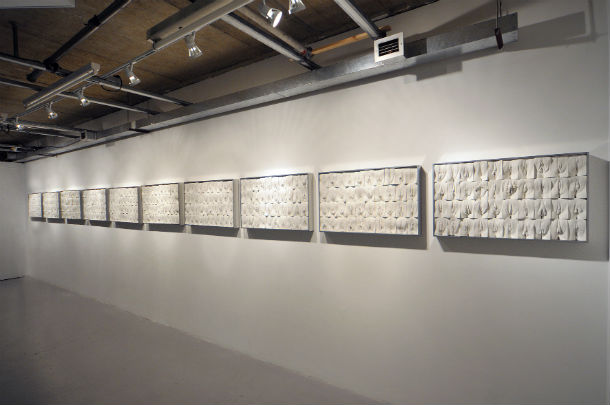
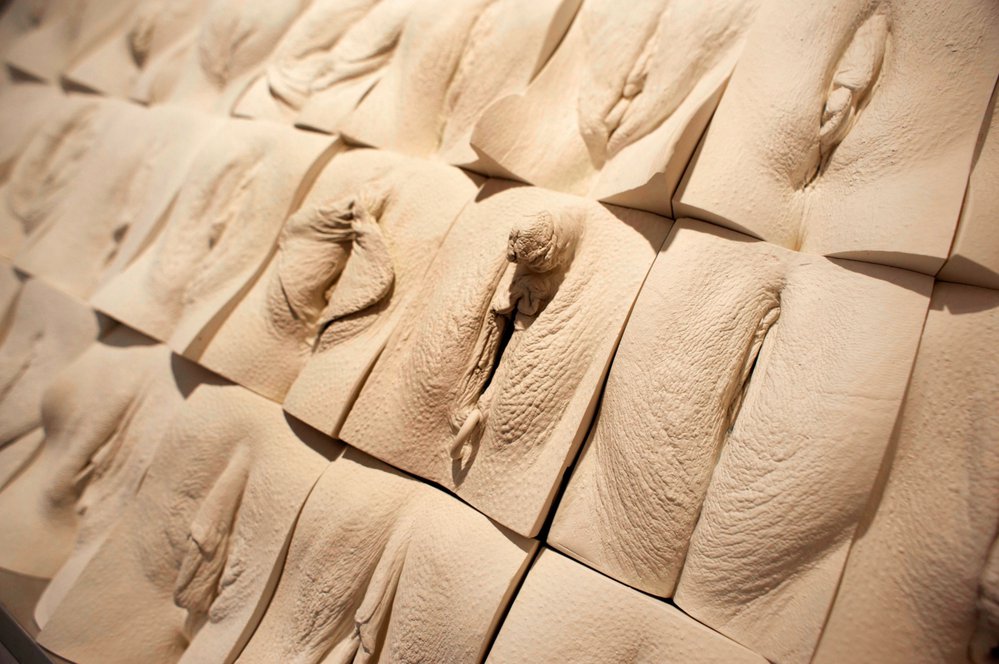
He is attempting through art to change female body perceptions and show us that every woman’s vulvas are normal.  McCartney is a life cast artist; he spent five years collecting casts of volunteers’ vulva mounds and has turned the result into The Great Wall of Vagina.

Image

The work includes 400 casts, as accurate as photographs, displayed in ten wall panels. They range in age from 18 to 76 and include mothers and daughters, identical twins, transgendered men and women, women pre and post natal, and another one pre and post labiaplasty. It is impressive and at times overwhelming, but by reducing the body part to a simple white plaster cast, he removes the sexualization we would typically attach to such a display.  His use of spectacle shows us how absolutely diverse each and every woman’s vulva is – on the website it mentions how each one is as unique as a face.  And they are!

Image

“For many women their genital appearance is a source of anxiety and I was in a unique position to do something about that.” - Jamie McCartney

There are several things I find interesting about this art project.  First, by bombarding us with 400 vulvas in a small space, he reduces the body to a single part, from a view many of us have never seen. And while we ARE viewing the diversity and differences in vulvas, it also manages to emphasize the similarities.  We see the similarities in our differences.

Image

And second, if women are shocked and surprised at the diversity shown here – why is that?  Is it simply because most heterosexual women haven’t seen other women’s open vulvas?  Or is it the “pornification” of our modern culture?  If labiaplasties are on the rise, do you think an exhibit like this would help stop that trend? Do you think hetereosexual men and lesbians are surprised by this diversity?

So, would you go see the show?  And if you are the owner of a vulva, are you looking for one that looks like yours?

Image

“It’s time our society grew up around these issues and I’m certain that art has a role to play.” - Jamie McCartney

Hijabs and Hoodies

After we discussed the horrific and tragic murder of Trayvon Martin in class today, this article in particular caught my attention:

Shaima Alawadi, a resident of San Diego, California, was found beaten unconscious in her home last Wednesday and died of her wounds this past Saturday.  A note was found saying, “Go back to your own country. You’re a terrorist”.

Shaima was a stay at home mother with five children.

http://www.reuters.com/article/2012/03/28/us-california-iraqi-memorial-idUSBRE82R01N20120328.

This happened less than a week ago.

There was mention in class of how certain ideas in society become normalized, for better or for worse. In Trayvon and Shaima’s case there is no question these ideas create a poisonous environment.

But in both cases there was a similarity: clothing.

Trayvon was wearing a hoodie; which according to sources across the spectrum, most notably Geraldo Rivera, made him a target for suspicion. Last I checked wearing a hooded sweatshirt left no one with the ability to label someone as “suspicious” and cause cruel loss of life to another.

Shaima also had an article of clothing that marked her; a hijab. For those who are unfamiliar with a hijab, it is a head covering traditionally worn by Muslim women for reasons of modesty. Yet by wearing a hijab Shaima marked herself as “other”.

I find myself wondering if we can draw parallels between Shaima’s and Trayvon’s murders. They were both marginalized members of society, Trayvon was black and Shaima was an Iraqi-American immigrant. Both were wearing articles of clothing that are innocuous (although a hijab may stand out for those unfamiliar with the garb) but these clothes became threatening to those with prejudices and stereotypes.

I think we, as a Western society, are not past our cultural and racial biases when two murders are committed within a month of each other on the basis of race and ethnicity, with the flimsy excuses of clothing as reasoning. (By the way, I’m not ignoring that there are far, far too many of these crimes that go purposely unnoticed or are unreported).

In response to this hate crime there has been an out pour on social media and I found a group on facebook that seemed particularly fitting: http://www.facebook.com/pages/One-Million-Hijabs-for-Shaima-Alawadi/137306256397032.

When women are told, “you were asking for it”, if they are raped and happened to be wearing a miniskirt, when young black men are shot for wearing hoodies, and a woman is beaten to death in California for wearing a hijab because it “makes her a terrorist”, I have to wonder about the emphasis placed on clothing and the body-the cycle of violence around the clothing people wear for religious or personal reasons and why people use these articles of clothing as excuses for committing atrocities.

I find myself sick at heart with the violence, the hate, the prejudice, and the inbred bias. I send loving and peaceful wishes to the members of Trayvon Martin and Shaima Alawadi’s families.

Obesity in our current generation

Obesity is prevalent in our current generation especially among women due to a variety of factors. Ironically, the price of eating out is cheaper than cooking food in your own kitchen. For example, the price of a cheeseburger is cheaper than a salad. Trying to buy organic food which is considered more healthy for our bodies is more expensive than fast food that is easily accessible. If we go to McDonald’s we can get a cheeseburger from the dollar menu but if we walk into Whole Foods market, a salad can range from $5 to $10. Ironically, employees at Whole Foods who weigh less are given a greater discount than their fellow employees whose BMI are above a certain range. Although this is supposed to be seen as motivation and an incentive for their workers to become more “healthy” it seems discriminatory. Their thinner workers receive an additional 10% off their discount for having a lower body mass. Therefore, if your BMI is above 30, you get to keep your original 20% employee discount, but “thinner” co-workers get as much as a 30% discount.

For some people it is harder to lose weight due to restrictions from their body or even genetic disorders. Also, looking at our society in the United States our portions for food are larger than countries everywhere else. Everyone’s lifestyles are different and so the convenience of getting cheaper and fast food is easier than attempting to cook a healthier meal that is more costly. When I went to Korea, their McDonald’s big mac was half the size of our big mac in the states and they didn’t even have the option to get larger sized fries. Only in the United States do we have the option to “super size” and it seems that our lifestyles provoke this problem of obesity.

Summer, Sandals and Socialized Feet

So summer is swiftly approaching. The heat will of course cause a large shift in the way bodies are covered. Shorter and shorter skirts, barely there shorts, sleeveless tops and if your really hot, just bikinis all day! This of course horrifies the conservative sector of society that prefers woman cover up for moral reason. I however am concerned with a very specific body part that suddenly gets over exposed. FEET.

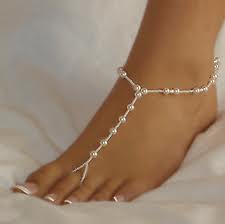
They are everywhere. There are flip-flops, peep-toe heals, strappy sandals and more, all overly exposing the foot to the population. I recognize this is not generally considered a big deal. I’m sure members of the foot fetish society community love this time of year. As for me, it is dreadful.

Here is why. All winter I had the luxury of socks and boots, fully protecting my feet from the public view. Now I have the added hassle of constantly preparing my feet for society. Painting my nails, making sure my heels and toes have lotion at all times, and making sure they have a generally attractive appearance. No one told me explicitly that I need to put the extra effort toward my toes. Yet I know, from the sexy models with the perfect feet in the DSW and Payless commercials. Every single one has toes painted with wonderfully bright colors, their toes fit perfectly in the shoe as if the designer tailored the shoe for that specific foot. Meanwhile, I have to pull of the same strappy sandal with my imperfect feet.  This may just be a personal dilemma, but I’m certain I’m not the only one who has noticed how even the barely noticed parts of our bodies have been subjected to socially constructed norms.Image

The Werewolf as Synecdoche of the State?

Two or so years ago in the process of having my political mind entirely changed forever by reading Giorgio Agamben’s brilliant Homo Sacer: Sovereign Power and Bare Life, I came across a lively section on the archetypal wolf-man, or werewolf. Agamben’s thesis in the book is essentially that, since Enlightenment thought and the construction of statehood as a rational institution subject to a code of normative ethics, sovereign state power has been based upon the principle of “exception.” The individual subject is theorized in Enlightenment political literature as being the result of the imposition of a political structure upon a natural “bare life.” Agamben counters this top-down theory by proposing that “nature” or “bare life” only becomes intelligible through the apparatus of sovereignty. The “natural” that lingers outside of the polity or municipality is always already formulated within state terms. The “state of exception”, popularized in World War II era by political scientist Carl Schmitt, is the concept of an emergency structure put in place, outside and beyond the written law, in particular situations (a recent example would be George W. Bush and Barack Obama’s suspension of international human rights laws, through torture and unjust imprisonment, in the name of defending “freedom” in wartime.) Agamben’s theory postulates, however, that state sovereignty is always already a state of exception: “rights,” as the bedrock of law, are always constructed by and “enforced” by the same powers that are supposedly equally subject to them. Thus state power is always already “outside” rights and the law. The rights that are based in “nature” and the natural sovereignty of the individual are codified by state power. The state is thus a liminal between-space, with nature and the political not as two poles but as between and within each other.

Agamben illustrates this theory with the archetype of the werewolf. The werewolf acts as a symbol of state sovereignty as the threshold between bios and nomos, between nature and the political. “It is a threshold of indistinction and of passage between animal and man, physis and nomos, exclusion and inclusion: the life of the bandit is the life of the loup garou, the werewolf, who is precisely neither man nor beast, and who dwells paradoxically within both while belonging to neither.” The werewolf embodies the concept of liminality upon which state sovereignty is founded. Pretty cool, right? I realize I spent more time explaining Agamben’s central thesis than on the werewolf paradox, but it’s something to consider when thinking about the ways in which (fictional and nonfictional bodies) are simultaneously “natural” and continent/political. 

A Strange Kind of Mirror

This post could be triggering for people who struggle with body image.

Or maybe not.  That’s the question.

My Body Gallery first appeared on the internet sometime around August 2011, judging by the number of posts written about it on other websites during that time (see: Jezebel, The Hairpin, NY Daily News, Yahoo, and more).  The basic idea is that women upload pictures of themselves and then categorize them based on their height, weight, pant size, shirt size, and perceived body type.  Other women can then search the site by their height and weight, and to see what that looks like on other women.  According to the website, the point is to allow “other women to see that the world is not a place of cookie cutters,” because women “are all different in our body shape and size as well as our place in our journey to loving our bodies exactly as they are, not as we (or others) think they should be.”

Initially, though I recognized that the site obviously had its problems, and that it could be difficult and triggering for people who already had a history of or an inclination to compare themselves to others, I found the site interesting.  It could be helpful for people who have an “ideal” weight to see that their ideal might be different in reality.  There are not a lot of people of my height and weight, on this website or otherwise, especially considering the number of people that uploaded pictures for, say, 5’5″ and 120 pounds.   I like knowing that there are other people who look like me (and, notably, all of the people in that category appear to be white).  If sleeves are never long enough and pants are rarely made in your size (and, when they are, they’re never labeled “regular”), or if you have to order your shoes from a niche company who makes them large enough, or you have to shop in a “special” store, or you’re always hitting your head or ducking, or you’re not tall enough to ride the roller coasters, it can be comforting to know that you’re not the only one.  But good luck if you’re 5’5″ and 360 pounds.  Apparently, there is no one else like you.

So that, then, is one of the problems.  Even if the site continues to exists for several more years, even if people continue to submit their pictures to it by the thousands, it will never encompass the entirety of bodily experience.  It is possible to search for any weight by an interval of ten pounds between 100 and 500 pounds.  That’s a decent range, but there are not many people in the larger or less frequent categories.  They are possibly the people who would benefit most from knowing that there are others with similar bodies.  On the other hand, seeing that there are no pictures in your category- but plenty that are 5’5″ and 120 pounds- only reenforces those feelings of deviance.

Then there’s the fact that the pictures are almost entirely of white people, which in part reflects the general whiteness of representation on the internet.

And the fact that, even though women are not “cookie cutters,” they’re still trying to categorize women into categories of weight, and more tightly into categories of “body type,” which is apparently limited to pears, apples, bananas, and hourglasses.  I have never personally met anyone shaped like a banana.  If you do identify as banana-shaped, I certainly don’t want to deny your experience, but I imagine it would be hard to stand, and harder to walk (Have you ever tried to stand a banana up?  All you get is bruised bananas.).
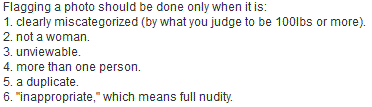
"Flagging a photo should only be done when it is: 1. clearly miscategorized (by which you judge to be 100 lbs. or more) 2. not a woman 3. unviewable 4. more than one person 5. a duplicate 6. "inappropriate," which means full nudity

Are people uploading pictures of dogs?

And then there’s the thing that bothers me most.  This site is for “real women.”  The is an alarming amount of shaming of skinny people within the “body positivity” movement, and plenty of dialogues that replace current beauty standards with other beauty standards- for example, that “real women have curves.”  Worse, the site appears to be only for women, and since whether or not a picture is of a woman is decided by how other members “judge” it, I worry that the site is only for ciswomen.

So, what do you think?  Is this more helpful than harmful?  Do you plan to upload your picture?

Racing the “White” Body, The Invisible Arab, and the Curious Hybrid.

As a child, people often asked me or my parents where we were from. Was I Iranian? Jewish? French? In eighth grade a boy told me I had “negroid” eyes, and for most of my adolescence I was mocked for having a “ghetto booty.” Last summer while in a thrift store near D.C. a complete stranger, a white middle aged man, approached me and asked in deliberately slow English if I was from Honduras. A former boyfriend once commented on the fact that I was not “pale” when naked in winter. I live in a mixed neighborhood with many Central American immigrants, and have been addressed in Spanish on a few occasions.

To most people, I assume that I appear white. I have brown hair, black/brown eyes, and an “olive” complexion. I consider myself to be on the pale side of this “olive”, paler than most of my father’s family at least.

I am of North African/Tunisian, Sicilian, and “Black” Irish decent. None of these categories have been deemed pure “white” by historically racist notions of U.S. “whiteness.” I am not a WASP. I have often wondered if I had blonde hair and blue eyes if people would ask where I’m from on a monthly basis. I gets worse in the summer as I do tan very quickly. But, if I was clearly white, of no curious or “exotic” background, would strangers feel as comfortable violating my personal space? It’s as if my height, skintone, and eye color are an accent – one to be met with “Where are you from?” My cousin, who like most of the women in my family, has very curly hair, was called a “mulatto” all through high school. We have all learned to laugh this off. We eat ravioli, my grandmother travels to Sicily frequently, we know where we are from. And yet, of all the assumptions strangers have made regarding my or my family’s ethnicity, Arab is never one of them. If we all wore headscarves perhaps our “origins” would be more apparent, more clearly marked. After 9/11 some of my friends would joke about my father getting pulled over due to racial profiling, and I would laugh with them.

So after years of being hailed as less white than my white friends I decided that I am not. I am not entirely white. A few years ago when the U.S. census came to my apartment, I had to check off my ethnicity. While “Other” seemed the best choice for me other than “White”, I noticed that there was no “Arab” choice. “African American/Black” was available, but many North Africans are not black. Most are Arab or Berber. Although Arabs constitute a large number of the world’s population, covering North africa and Western Asia, as a people or race they are simply invisible in the United states. So unwanted as to not be counted. I checked every single box and handed it back to the census worker.