ng disabled in any contact in a non disability friendly society is hard. I would be classified as having a disability that is not visual. I have learning issues and was born with medical issues to the point of needing a liver transplant at the age of 2 and needing my spleen removed in 11th grade in 2013. This is not visible but due to these health issues I have always been behind my grade level. As for many if not all people who have any type of disability, people tend to give you “pity” or praise for doing the simplistic things. Although most times it is people trying to be nice it is dehumanizing and hurts/irritates me and many others. The documentary we watched is nice being able to have somewhere to go where you can be yourself since when you are disabled you are often not allowed to have the same things or experiences the same thing as a “normal” person. As for myself not having a visible disability I was not shield from these opportunities but at same time this is complicated because it was not as noticeable I was not offered the help I needed when I was young would never really get much help until I was in my late 20s when I had advocated for myself it even still I feel I am not completely diagnosed therefore do not get all the help I need but i have unfortunately accepted I will never be able to truly know what it like not to struggle so much intellectually, mentally or physically.
Even with my accepts of my situation I think it is important to unite together to change things for the better for the next generation, like how they did in the video the civil right activist and black panthers helped those in the disability rights movement because they both had a goal in common of wanting to be treated equal and treated like human bringing and not monsters who are less then.
When I first watched Me Before You, I felt like my heart was ripped out of my chest. The story follows Louisa “Lou” Clark who becomes the caregiver of Will Traynor, a man who was adventurous before becoming paralyzed after an accident. Will unfortunately faces many challenges both physically and mentally, leading him to choose assisted suicide despite falling in love, and I haven’t been able to stop thinking about this movie ever since. Recently I started to question, if it was romantic, or was it reinforcing the idea that a disabled life isn’t worth living? After reading Nicole Schroeder’s “Dying a ‘Good’ Death: Disability and the Assisted Suicide Debate” from the Disability Visibility Project, I started to see the story through a completely different lens.
Before I fully dive in, I want to fully paint the picture of this movie. Firstly, Will’s parents hire Lou to care for him after his accident two years in an attempt to raise his spirits. Lou’s unapologetic, positive personality slowly breaks through his bitterness, and they form a deep connection. After finding out he plans to go to Swtizerland for assisted suicide, Lou tries her best to change his mind by trying everything from taking him to concerts and a trip out of the country. But in the end, Will does not change his mind even after falling for Lou. The movie paints his choice as noble as a way of reclaiming control over his life and giving Lou a chance to live hers. The final scene shows Lou reading Will’s farewell letter in Paris, smiling through her tears. It’s meant to be bittersweet, but it also raises difficult questions about what “a good death” really means, and whether society offers disabled people real choices about living.
Nicole Schroeder’s essay completely reframes this debate. She argues that the real issue isn’t about whether people have the right to die, but it’s about why so many disabled people feel they need to. She writes, “those of us protesting do not want people to be in needless pain; instead we want resources other than death to alleviate suffering while people are still alive.” That line stuck with me because it exposes how the conversation around assisted suicide often ignores the failures that lead people to that point: lack of access to care, isolation, and social neglect.
In the film, Will isn’t shown receiving much support beyond Lou’s companionship and his personal caretaker, Nathan. Even with wealth, he seems completely alone in a world not built to include him. Schroeder highlights that in a “hyper-capitalist world,” assisted suicide can become a cheaper alternative to improving care and accessibility. It’s haunting to think about how Will’s decision might have been shaped not by genuine choice, but by a culture that sees disability as tragedy especially after losing the hyper-active life he once had.
One of Schroeder’s most important points is that assisted suicide is often presented as a form of autonomy, when in reality, many disabled people are making choices under pressure. She shares that in Canada, nearly half of those choosing Medical Assistance in Dying (MAID) cite feeling like a burden or experiencing loneliness. That statistic immediately reminded me of Will telling Lou he didn’t want her to give up her life for him. What sounds selfless in a romantic story becomes more complicated when you realize how society teaches disabled people to internalize guilt for simply existing.
The movie’s emotional framing makes Will’s death feel inevitable, even “beautiful,” but Schroeder challenges that idea. She calls out how assisted suicide has “eugenics-centered roots,” meaning that the very systems allowing it have historically viewed disabled lives as less valuable. When I look back at Me Before You now, I can’t unsee this unfortunate pattern that tangles up love, care, and death into a message that equates disability with hopelessness.
When I first watched Me Before You, I can still remember myself tearing up during the beach scene when Will tells Lou that he is still going to Switzerland after she pours her heart out to him. Me and many fans of this movie are still heartbroken over what could’ve blossomed between Will and Lou. But now, I think the real heartbreak isn’t Will’s death….it’s that the story never gives him another option. Schroeder’s essay reminded me that true dignity doesn’t come from the “freedom” to die; it comes from having the support and resources to live fully. The film romanticizes Will’s choice, but if it reflected the realities Schroeder describes like underfunded care systems, social isolation, and ableist messaging, it might look less like empowerment and more like surrender to a world that failed him.
I still love Me Before You for its intensity and emotional honesty, but I see it differently now. It’s not just a love story; it’s also a mirror of how our society defines whose lives are worth fighting for.
This is gonna be a word salad but it’s actually crazy navigating this world as a person with anger issues, bpd, anemia and autism. I know, girl pick a struggle. To give you a little glimpse into my life. Being anemic is weird. As stated in class, people only think disabilities you can see are valid. And don’t get me wrong if I’m being honest I don’t consider being anemic disabling but maybe I don’t consider it disabling because of that subconscious bias as well. As someone with anemia one thing I do ( as well as others) is when I get up too fast my vision gets fuzzy like I’m seeing circles and static and I have to lean over and sit sometimes even lay down. One could argue that that is disabling. And I could see why because that affects me when I’m working (as a receptionist I’ve had to do that sometimes) when I’m at a conference or meeting or babysitting just anything in life.
Don’t get me started on having bpd- I sorry un-medicated and untreated bpd. And yes you guessed it ( that is because of finding a psychiatrist and therapist that will take our parent’s insurance). It affects every aspect of my life as well but especially my relationships with other human beings. People think they are accepting and “woke” until your friend goes off and becomes satans right hand man in an argument and then 25 minutes later is like “bro remember this lmfaooooo” like NOTHING happened. I’ve lost friends over it. And I’m not okay with it. I’m not. I’m not gonna sit here and lie to you guys and be like it’s whatever it’s there loss. No my feelings are hurt and I wish I didn’t have this in my brain. It’s almost kinda debilitating. But idk it feels wrong to call it debilitating because that feels reserved for things like schizophrenia, Down syndrome, paralysis etc… I wish I could just take a pick and fix my brain and be normal. Yes I said it. Don’t believe these people- having mental illnesses is not normal and that’s okay. It’s not a bad word.
And to TOP IT ALL OFF god just had to make me neurodivergent as the final touch. Everyone in my family is neurodivergent. From my mom to my dad to me and my little sister. Shit we think the dog is too 💀. But it’s so crazy cuz the reason my parents (mainly my dad) never had anything done about it was because not just because they didn’t have the money, but also the community they’re in. It’s already bad enough society is so 👀 about being autistic and then you have the black community which is like worse towards people who are different. For lots of black people who have autism/neurodivergent or physical disabilities, our first and main bullies are the people who look like us, talk like us, dress like us, worship like us. It’s so alienating. Don’t worry it’s gotten better because of the newer generations but it’s just like damn can we catch a break . It’s a good thing this is not an on paper assignment cuz there’d be tears stains all along the page😹.
I wanted to talk about my family friend’s son named Shaun. I’ve known Shaun for a while, he was really young when I met him, I was still young however, in my middle school years I was still learning things. Shaun, along with his brother Stefon were autistic. Whenever it came to the family parties I would be the one to watch over them and keep them company since I was still young and couldn’t be a part of the adult or even the teenage conversations. Shaun was an interesting kid, although he didn’t communicate verbally with words, I felt like I could still understand him and what he needed. I felt like I could understand his emotions.
Shaun would always get in trouble for breaking things, but I knew it was him just stimming because that was one of his habits. I remember during a Christmas party he grabbed one of the ornaments from the tree and smashed one to the ground, and then another, several times until he was stopped by his mother. Shaun got in trouble with his mother. I felt bad for him, I knew he wasn’t doing it to make anyone mad, yet his mom did get mad at him for doing it anyway since it wasn’t his house. She looked defeated, like she didn’t know how else to help him whenever his behavior would get worse. She looked tired too, like she was doing everything she can to just enjoy her time at the party and also watching her boys making sure they didn’t break anything or do something dangerous. My parents loved Shaun and his brother, my dad always made an effort to let Shaun be seen, playing with him, making jokes and funny faces. Whenever Shaun was with me, I tried my best to entertain him, to make him feel heard. He always had a fascination with my hair (back then I used to have hair that would reach the floor I had to keep it in a braid since it was so long, I’m not kidding haha) so every time we sat in a room to calm him down he would touch it and slowly begin to settle. The way he felt my hair and stared at it gave me a sense of comfort knowing that I was there with him making sure he was okay. He would hum the majority of the time, whenever he wanted something he would hum in a pattern and point at the object that he wanted. Shaun never had good focus either, after touching one object he would go onto the next and then the next. Shaun’s mom works with other children who are autistic, whenever she would come to these parties, she would bring books for them to read, I would read the books to Shaun and his brother. Shaun was always mesmerized by the images in the books, he would hum and point at the characters. He always made me feel like whatever I was doing was helping him and that gave me a deep sense of reassurance.
Sean was very excited about noises but more specifically with car keys. Whenever it came to these parties or Mass services because we do services in different people’s homes, Shaun would actually find people’s keys and take them and play with them because he loved the sound of the jingling. My dad didn’t care, he would give Shaun his keys so he could be happy and play with them. Of course he didn’t know any better because he didn’t understand the ownership of somebody’s property. I always felt like the adults who would get their keys taken away wouldn’t truly understand how happy it made him. They would just get a little frustrated because of the fact that their property was taken away from them. I definitely think being in middle school and being exposed to that environment where somebody has a disability made me confused at first because back then I didn’t know the true meaning of autism and the levels and how there’s a spectrum. I only got to see the behaviors and patterns of somebody with it during that time, but now being an adult and learning more about autism and neurodivergence I slowly start to understand Shaun and his behavior. He just wanted to be understood because of his different way of thinking. Unfortunately due to family issues in the past I haven’t seen Shaun in a while but I hope right now since he is older that he’s getting the proper care and going through a more suitable way of teaching for him to understand. I really do think Shaun is a good kid.
I just feel like people are always afraid to try to communicate with people who have this disability because they don’t understand the way autism works and the levels of the spectrum. Every time I see a child with autism, or introduced to someone, I am never afraid to interact or learn from them, because with Shaun, all I ever did was make him feel heard and safe, and I want to do that for every other boy or girl who has autism. Society likes to put this negative connotation and label of people with disabilities which to me is just undermining their true potential and power, I learned a lot from Shaun and my other experiences after that, and seeing how their minds think and interact made me open my eyes to a whole different concept of learning and understanding. I learned more patience, I learned to really slow down my “normal” thinking and try and fit their perspective into my life. Doing that type of thinking really does open up your mind to a lot of ideas and thoughts. I am thankful for Shaun and the way I made him feel comforted and cared for, that’s something I won’t ever forget. I do know his parents were really good when it came to teaching him, but just like Shaun and other kids who have it I hope the world is able to see that there is nothing wrong with them they just have a different perspective which isn’t and shouldn’t be seen as a negative thing.
A few weeks ago I had a difficult bipolar/autistic meltdown that spiraled me into a dissociative state. I say bipolar slash autistic because the criteria and symptoms for both disorders overlap so much that it is nearly impossible to tell them apart within my own body at this point. I wasn’t able to attend some of my classes for two weeks because my mental state was feeling immensely guilty about using my accommodations. Every time I typed up another email to a professor, saying that I once again had to rely on my disability accommodations, I felt my chest tighten with anxiety and guilt, as if I was doing something wrong by needing my accommodations. I didn’t want my professors to think that I was lying to get out of class to go out with my friends. To be fair I did hang out with my friends and try and do stuff during the time I had class, but everything we did was an attempt to pull me out of the dissociative state I was in. As someone who has heard numerous times that they don’t look “autistic” or “disabled”, I am aware that this is a judgment that many pass on me, and I was aware that my professors may think that as well. Perhaps out of guilt, I sent an email to my professors, explaining that I had bipolar disorder and was struggling to pull myself out of a rough episode that left me unable to even read and comprehend the readings for any of my classes. Most of my professors answered with supportive statements, validating my disability and granting me as many extensions as I needed. One professor emailed me back, ignoring the fact that I had just opened up to him about my identity, and demanded I turn in my work within 48 hours, because the accommodation guidelines offered a 48 hour extension as an example guideline. Evidently, I was not able to get my work in, because I am not able to pull myself out of a dissociative episode on command; to make it worse, when I finally returned to class the following week he spoke negatively about bipolar disorder in class, leaving me stunned and panicked. I made the rather obvious assumption that I wasn’t his favorite student. Rather than fighting with him every step of the way, I decided to withdraw from the class, postponing my graduation from this December to May. I was devastated telling my parents that I would not be graduating as soon as they thought, and I was even embarrassed, knowing that if I pushed myself I could have made it through the class. But just because you can do something as a disabled person, doesn’t mean it is worth it. I was reminded in a somewhat blunt manner that not everyone will accommodate your disability, and sometimes it’s better to give up, then to fight for your right to take a class.
The emotional labour it would have taken for me to fight with this professor every step of the way, just to most likely pass with a C in his class was not worth it for me. Personally, I am proud of myself for knowing my boundaries and how far I can push myself. He made me feel weak and made me hyperaware of how people view me as someone who is bipolar and on the sepctrum.
Subtle ableism is so present in today’s world that it goes unnoticed by most, unless we are directly affected by it. For me, this was an example of direct ableism, someone who would do the bare minimum to accommodate my needs, and refused to do anything more. It was dehumanizing, but it also reminded me how lucky I am to not be faced with people like him, and ableist challenges on a daily basis. Our world was not made for disabled bodies, whether it’s expectations at work, to campuses being not accessible, to the general population applying certain stigmas to disabled people as a whole. As a physically abled person who is usually able to mask their disability in public, I don’t have to constantly worry how I will make it to class on time, or if the elevator will work today, or if I will be able to make it up the hill to my building for class, and that gives me a certain privilege. The dialectic of both being disabled and abled is an interesting limbo to live in. I can’t imagine how it would be if I had to worry about physical disability on top of my ever present mental disability, still, I can’t help but wonder if I would have been treated better by that professor if my disability had been more visible.
The following is a series of excerpts for an article that I wrote for The Retriever that was published on Wednesday. (Below is from my original draft, some changes have been made in the final version for newspaper formatting.) If these tidbits interest you, you can find the whole article in print on campus now!
UMBC, I have a challenge for you.
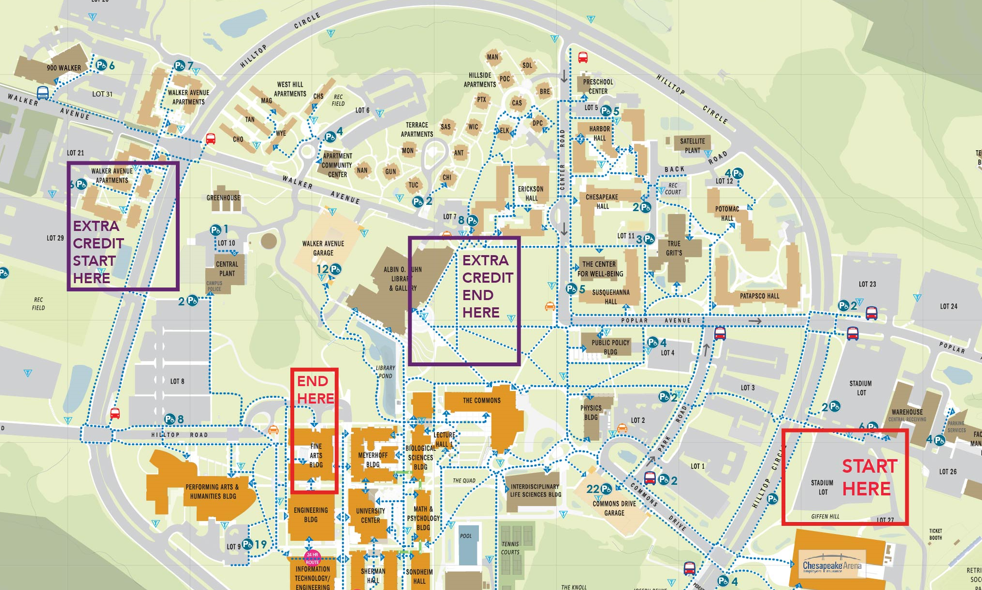
Administration, Student Disability Services, and Facilities all tout the campus accessible routes map as the end-all, be-all solution for disabled students navigating campus. My challenge for you is this:
Make your way to the stadium lot, and then walk to the Fine Arts Building using only routes labeled as accessible. You are not allowed to use stairs, though you may use the short cuts available through buildings via elevators. (The elevator short cuts are labeled on the map below.) For extra credit, start at the top of the hill near the Walker Apartments and go to the library.
While you are walking, focus in on your body. Ask yourself: What would this walk be like if my calves were screaming in pain? What if I struggled with balance and were prone to tripping on uneven surfaces and could fall? What if I were using a walker right now? What about a non-motorized wheelchair?
What about crutches, or a lower-limb cast? When you arrive at your destination, take a note of the time. How long did it take you compared to using the stairs? Did you have to use a new route compared to your ordinary routine?
It was disclosed to me by several students that after they met all of the (stringent and privilege-laden) requirements to receive an accommodation appointment with SDS, they are told they will be unable to get the accommodations they need. In addition, it has also been reported to me that these meetings are often negative in nature with the student seeking accommodations being met with derision and/or hostility for their accommodation requests. One student, who wishes to remain anonymous, reported being “refused note-taking assistance because they needed to ‘learn how to take notes themselves,’” as well as being refused alternative text formatting as that is up to the teacher and “they cannot do anything about it.” The student accurately pointed out that both of these accommodations are among the published list on the SDS website. Another anonymous student trying to receive accommodations was told, “I know migraines can hurt sometimes but that doesn’t mean you can miss class.”
Many of the interactions that were shared with me have a common thread that is heard all too often by the disabled community: “You’re just not trying hard enough” or “It can’t be that bad”. The implications that we are lazy, that we haven’t developed strategies to succeed in our classes, or that we are somehow exaggerating our health problems are not only outdated ways of thinking about disability but are also extremely harmful. The reality of our lives is that it frequently is “that bad,” and that we wouldn’t be asking UMBC for help if we hadn’t already exhausted all of the resources available to us as individuals. To hear these words from the people put in place to help us succeed is equivalent to lifting us up only to kick us back down. UMBC is not the only institution in Maryland struggling with this problem, as this article (https://www.jhunewsletter.com/article/2021/08/disability-isnt-taken-seriously-at-hopkins) written by a graduate student at Johns Hopkins details out. Laurel Maury was awarded accommodations by JHU but found that her professors refused to use them (even under threat of legal action) and some went as far as to bully her for having them. Maury’s struggle echoes many of the sentiments that have been expressed to me by current UMBC students.
To my fellow disabled students: You are not alone, you have a voice, and your voice deserves to be heard.
First, let me just say that TikTok is a great platform for people to speak out on what seems like small moments in their lives but are ultimately extremely impactful: few other platforms expect you to produce 60-second vignettes of information with little further context, but TikTok allows and almost requires the person behind the camera to get to the point very quickly.
To summarize the video that does not have captions (not all creators in all countries have access to that feature yet): This person is deaf and was raised in a hearing community. They started a new job, and were surprised and overwhelmed when they walked in on their first day and everyone in the office was wearing clear, see-through masks, meaning they would be able to lip read. Their first reaction was to feel gratitude for what felt like a gesture of kindness and welcome, and that they feel seen as a person.
I want to take what this person almost said and bring it a step further. This creator felt gratitude, felt welcomed, and felt seen, and they felt these things because their workplace had done what could be argued they are legally required to do in order for them to be functional in their job. While clear masks may not be spelled out as an accommodation in the ADA, it definitely became necessary during COVID-19 for the deaf community in order for them to be safe, but also to participate in society. Providing clear masks to what is presumably an office would not be considered undue hardship as it would be only slightly more expensive than providing ordinary masks to the workforce. An office with a mask mandate is most likely providing their employees with masks, so an office with a mask mandate and a deaf employee would then be legally required to provide clear masks to their workforce.
I will reiterate: This person felt gratitude because their employer did what they were legally required to do to accommodate their disability and did it promptly so the accommodation was in place when they started their first day of work.
As a member of the disabled community this tells me that the bar is on the ground. It may even be buried, and we are then overwhelmingly grateful when someone unburies the bar and hands it to us. It may still be covered in dirt and we may have a new worm friend but it’s been so long since some of us have seen the bar that we accept it as-is.
Can we even conceptualize what it would look like if every disabled person was given their accommodations on their first day of work? What would it look like if in an interview we could just hand a list to our potential employer and it wasn’t a factor in the hiring decision but simply part of their resume? What if everyone was required to submit a list of accommodations and workplace preferences as a part of their application, and it was simply accepted as standard and a best practice in hiring? What if these were accepted as necessary and automatic requirements as long as they fell under ADA guidelines and did not cause undue hardship to the employer, and thus every employer automatically provided them?
Let’s take this thought experiment one step further. What comes next? What does disability acceptance look like in a world where each individual’s needs were met to the furthest extent possible?
This may take some creative thinking on our part, but I think it’s possible to imagine. I personally can imagine an office where wheelchairs were equally as common as chairs. I can imagine that one person may be at a treadmill desk (there’s always at least one fitness enthusiast in an office) and another desk may be empty most of the time, as its owner largely worked from home. I can imagine that transcription of recorded virtual meetings would be as automatic as meeting notes, and that it would be an expectation that the office would rotate through who took on that job just like we do note-takers. I can imagine that this office would throw out traditional concepts of what a work day would look like, and what work production would look like, and that each individual would be allowed to work and produce work in a way that best suited their personality, lifestyle, neurodivergences and sleep schedules.
These ideas, though, still linger within the realm of accommodation. Is it possible to get even more outlandish in our conceptualization of disability in the workplace?
I can imagine a workplace where a disabled person has been promoted several times. I can imagine a workplace where when someone schedules a happy hour, they take into consideration locations that would be functional and welcoming for every member of the team, which may mean having drinks at a quiet restaurant instead of a loud, difficult-to-navigate bar. I can imagine that at the desk of the person who works from home, there is a prank hidden in the drawer for that person to find from a coworker who is thinking of them whether they’re physically there or not, and doesn’t care how long it takes them to find it. (Who doesn’t enjoy the long game?) I can imagine a scenario where every team member is appreciated for their social contributions to the team, and that for some people that may mean not eating lunch in the cafeteria, but may look like them tracking everyone’s birthdays and sending out celebratory emails to everyone. I can imagine that people with disabilities are treated like people and are accepted in all contexts of the word and are welcomed not only on the surface of being able to do their work adequately, but are welcomed as a human being joining a collective enterprise.
When the bar for disability accommodation is buried underground, acceptance and equity for disability is buried along with it.
I have failed to work with a system that prioritizes productivity over personhood.
I have chosen moving forward over suffering
I will accept myself to spite a value system that does not want acceptance – but always striving for “better”. If I internalize it, that I am always striving for “better”, then I build a comfortable place for the belief that I will never be enough, to rest upon. Instead, I will build space within myself to be less than ideal.
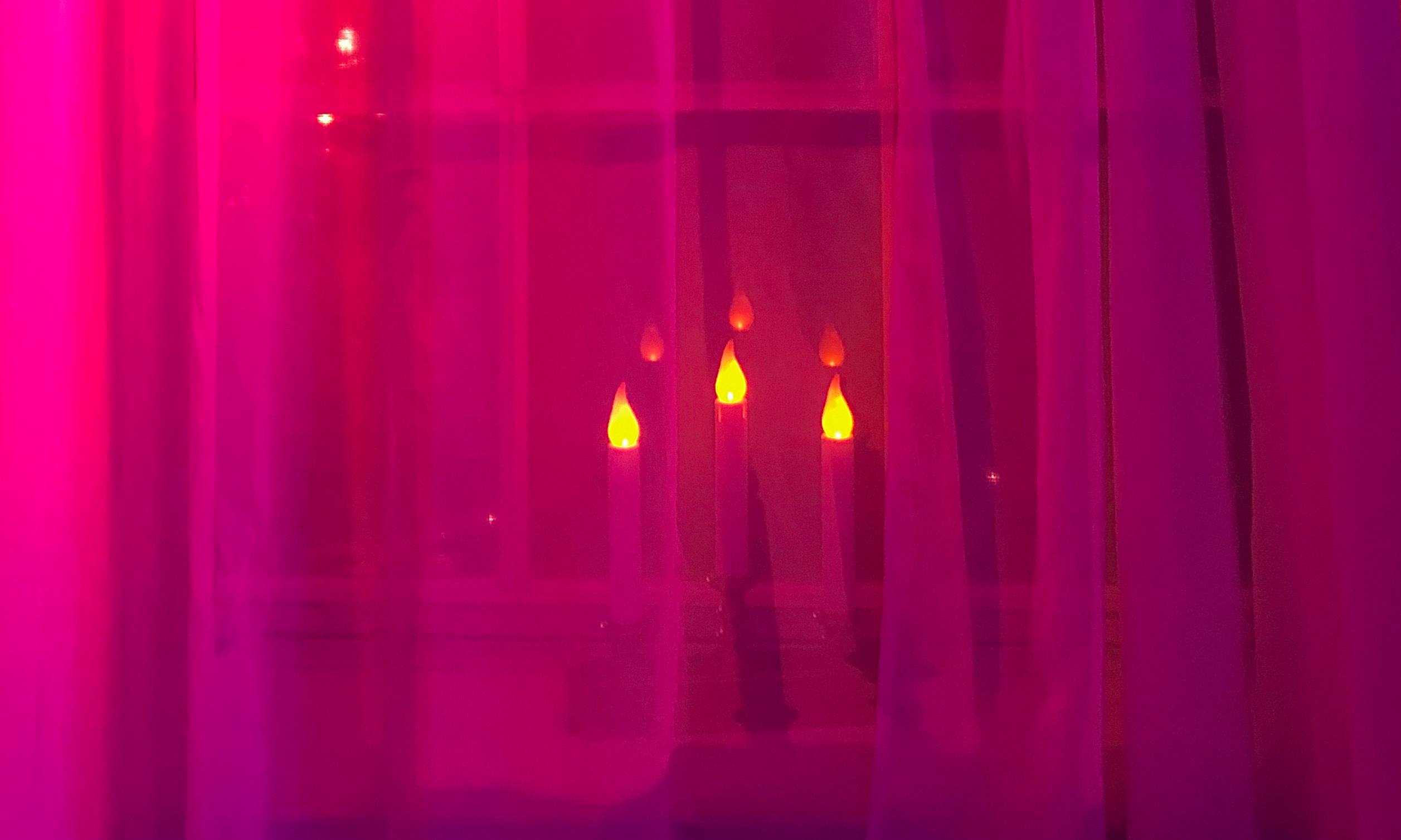
A view from my bed [ID: Hazy photograph of a window illuminated by vibrant red and purple lighting. In the center there is an electric candelabra sitting on the window sill, slightly obscured by sheer curtains.]
2011 was the year I began distancing. By which I mean, I began a life lived from my twin bed, fueled by goldfish crackers and electrolyte drinks, seldom able to access the outside world. It wasn’t mine to call home anymore.
I was drowning in conditions that these doctors hardly knew about. I had no choice but to become my own doctor, nurse, and historian. More than anything, I became my own community.
The outside world was stolen from me by sickness, uncertainty, and administrative violence – this world was never built for my survival. Such predicaments were met with constant calls to push through – go into the world anyways, risk it all for a “normal” life. They said adapting to it would make me better. It wrecked my body and my mind. Being bedridden was extraordinarily taxing and painful in a way that cannot be understood by those who have not been fully immersed in it in this way, yet. But I am inseparable from my bedroom life, I am made of soft pillows and the world I built among them.
If anything has debunked the mind-body split for me, it’s living with OCD. My obsessions are felt as deeply as they are thought. Every day I physically feel my compulsions begging for my submission. In resisting them, my body is flooded with a deep, gnawing unrest.
The normalization of perfectionism convinced me that my OCD was good for me. I looked good on paper – but I see no paper in my skin, my blood, my brain, my bones. I have learned that to save this body, I cannot give everything my best. “Just right” can never be achieved so long as I am the judge. The goalpost moves too quickly to register.


 Unruly Bodies