Existing Alone (alternate title: dating myself)

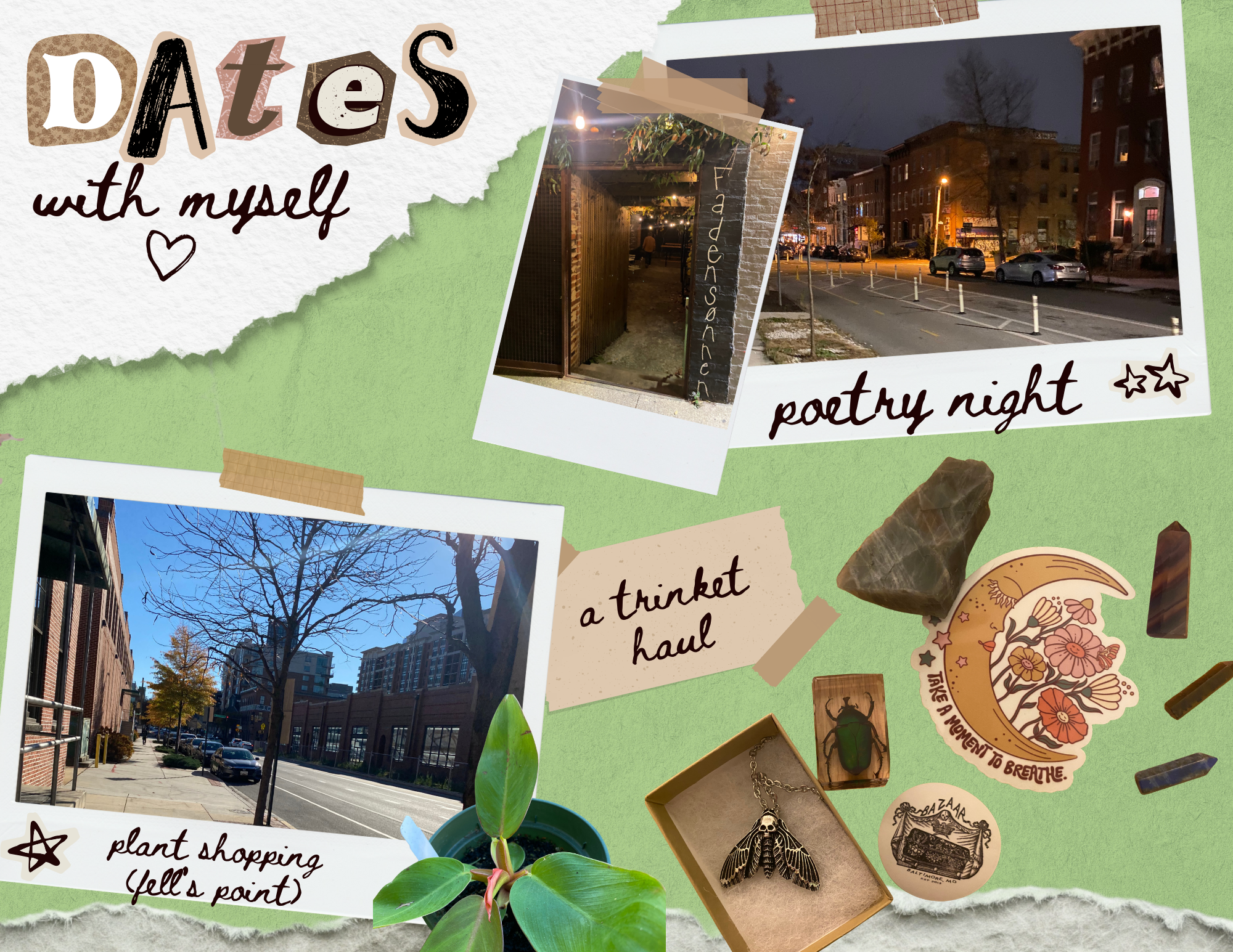
A collage made by me on Canva, consisting of different images I've taken while "taking myself on dates" over the past few weeks. Text reads: (top left corner) "Dates with myself", (top right corner) "poetry night", (bottom right corner) "plant shopping (fell's point)", and "a trinket haul".

A collage made by me on Canva, consisting of different images I’ve taken while “taking myself on dates” over the past few weeks. Text reads: (top left corner) “Dates with myself”, (top right corner) “poetry night”, (bottom right corner) “plant shopping (fell’s point)”, and “a trinket haul”.

I came to the realization this past summer that I have never lived alone. I grew up with a large family, lots of siblings and cousins always around, and went straight to living with my partner and their family at eighteen. After that, I came to college, where I’ve always shared a dorm or apartment with three other people. So learning to exist by myself, in a way that is not dictated or defined by the people around me, has been trickier than I’d care to admit.

Continue reading

A Modicum of Power, Respect, and Autonomy

Within the strictly imposed, purposeful, and artificially manufactured hierarchy of our society, the term ‘power’ consists of numerous meanings. The first definition that most think of is how, in many settings, power is about dominance, control, authority, and oppression. It is a matter of commanding people how to act, what to look like, and where to place one’s body. This is presumably the type of power that most incites the oppressor or the privileged to fear any semblance of gain from oppressed groups, as one’s acquisition of power is identified as something that only happens at the detriment of another’s. It is as though some are terrified that they will be unable to impart shame, terror, disdain, or indifference if those they subject to such tools of oppression and control have enough power to refute their efforts. When someone places themselves wherever they choose, exists in a body that defies social norms, or performs actions that are implicitly or explicitly forbidden without politely carrying the emotional or cognitive burdens for others’ comfort, the power dynamic experiences a significant shift.

Perhaps this view of power, as if it is a finite resource, is why our society so carefully enforces arbitrary rules and prioritizes those who can embody them. One can see this when Roxanne Gay is shouted at by a stranger who feels entitled to comment on her body, when civil rights protesters are subjected to horrific violence for challenging atrocious laws and attitudes, when the demands of disabled protestors to attend the activities of everyday life are ignored, and when incarcerated people are forced into appalling conditions. The same message applies: if we cannot control every aspect of your physical being, we will at least attempt to control our view or knowledge of your presence. 

In parallel, power can be regained by the supposedly powerless in many ways, such as when one reclaims one’s autonomy and refuses to accept, either internally or externally, the disrespect one has been bestowed. What is power, if not the presence of respect? What is power, if not autonomy over oneself, and even over others? Power is in the ability to go on with one’s day without being harassed and criticized; it is in the circumstances that allow one to move about the world freely, without social or physical barriers; and it is wholly anchored in the presumedly simple concept of peacefully living one’s life however one chooses. Why should one not have the opportunity and ability to determine one’s own life as much as possible in one’s circumstances, with as few barriers as possible? One should further ask oneself, why is seeking oppressive power over others normative and incentivized, yet the simple request of wanting to be seen and treated as human is consistently dismissed as grossly idealistic?

Me Before You: A Tragic Tale of Romance and Assisted Suicide 

When I first watched Me Before You, I felt like my heart was ripped out of my chest. The story follows Louisa “Lou” Clark who becomes the caregiver of Will Traynor, a man who was adventurous before becoming paralyzed after an accident. Will unfortunately faces many challenges both physically and mentally, leading him to choose assisted suicide despite falling in love, and I haven’t been able to stop thinking about this movie ever since. Recently I started to question, if it was romantic, or was it reinforcing the idea that a disabled life isn’t worth living? After reading Nicole Schroeder’s “Dying a ‘Good’ Death: Disability and the Assisted Suicide Debate” from the Disability Visibility Project, I started to see the story through a completely different lens.

Before I fully dive in, I want to fully paint the picture of this movie. Firstly, Will’s parents hire Lou to care for him after his accident two years in an attempt to raise his spirits. Lou’s unapologetic, positive personality slowly breaks through his bitterness, and they form a deep connection. After finding out he plans to go to Swtizerland for assisted suicide, Lou tries her best to change his mind by trying everything from taking him to concerts and a trip out of the country. But in the end, Will does not change his mind even after falling for Lou. The movie paints his choice as noble as a way of reclaiming control over his life and giving Lou a chance to live hers. The final scene shows Lou reading Will’s farewell letter in Paris, smiling through her tears. It’s meant to be bittersweet, but it also raises difficult questions about what “a good death” really means, and whether society offers disabled people real choices about living.

Nicole Schroeder’s essay completely reframes this debate. She argues that the real issue isn’t about whether people have the right to die, but it’s about why so many disabled people feel they need to. She writes, “those of us protesting do not want people to be in needless pain; instead we want resources other than death to alleviate suffering while people are still alive.” That line stuck with me because it exposes how the conversation around assisted suicide often ignores the failures that lead people to that point: lack of access to care, isolation, and social neglect.

In the film, Will isn’t shown receiving much support beyond Lou’s companionship and his personal caretaker, Nathan. Even with wealth, he seems completely alone in a world not built to include him. Schroeder highlights that in a “hyper-capitalist world,” assisted suicide can become a cheaper alternative to improving care and accessibility. It’s haunting to think about how Will’s decision might have been shaped not by genuine choice, but by a culture that sees disability as tragedy especially after losing the hyper-active life he once had. 

One of Schroeder’s most important points is that assisted suicide is often presented as a form of autonomy, when in reality, many disabled people are making choices under pressure. She shares that in Canada, nearly half of those choosing Medical Assistance in Dying (MAID) cite feeling like a burden or experiencing loneliness. That statistic immediately reminded me of Will telling Lou he didn’t want her to give up her life for him. What sounds selfless in a romantic story becomes more complicated when you realize how society teaches disabled people to internalize guilt for simply existing.

The movie’s emotional framing makes Will’s death feel inevitable, even “beautiful,” but Schroeder challenges that idea. She calls out how assisted suicide has “eugenics-centered roots,” meaning that the very systems allowing it have historically viewed disabled lives as less valuable. When I look back at Me Before You now, I can’t unsee this unfortunate pattern that tangles up love, care, and death into a message that equates disability with hopelessness.

When I first watched Me Before You, I can still remember myself tearing up during the beach scene when Will tells Lou that he is still going to Switzerland after she pours her heart out to him. Me and many fans of this movie are still heartbroken over what could’ve blossomed between Will and Lou. But now, I think the real heartbreak isn’t Will’s death….it’s that the story never gives him another option. Schroeder’s essay reminded me that true dignity doesn’t come from the “freedom” to die; it comes from having the support and resources to live fully. The film romanticizes Will’s choice, but if it reflected the realities Schroeder describes like underfunded care systems, social isolation, and ableist messaging, it might look less like empowerment and more like surrender to a world that failed him.

I still love Me Before You for its intensity and emotional honesty, but I see it differently now. It’s not just a love story; it’s also a mirror of how our society defines whose lives are worth fighting for.

When My Body Wasn’t My Own

TW: mentions of SA, dissociation

Growing up in a conservative household, I was constantly told to cover up because of men’s “wandering eyes”. I was taught that if I were to be sexually assaulted, it would have been my fault, instead of the person who sexually assaulted me. Out of fear, I obliged, wearing modest clothes throughout my childhood, convinced that I could never be safe. My mother also told me to speak properly, to never talk back to elders or men, and to hold my tounge if I was uncomfortable. In Throwing Like a Girl, Iris Marion Young describes how women move with “inhibited intentionality”, we know we can act, but we feel like we shouldn’t. That was my childhood: constantly silencing and covering myself to make myself more palatable for men. These habits became ingrained in me, because for so long, they were all I knew to do.

Continue reading
The Muse’s Misfortune

The Muse’s Misfortune

The Muse’s Misfortune 

To be a muse is to be worthy. To be a muse is to be beautiful and talented, chosen and seen. To be a muse is to be exhilarated and exhausted, honored and objectified, proud and pornified. There cannot be one state of being without the other, so long as there is one being to perceive and one being to be perceived.

Read more: The Muse’s Misfortune

In some societies, perhaps, it is possible for a muse to exist without the constant fear and awareness of their own and another’s presence. In patriarchal and sexist cultures, however, the muse faces an internal and external threat of surveillance, and therefore sexualization. “(Patriarchal and sexist) society defines woman as object, as a mere body, and… are in fact frequently regarded by others as objects and mere bodies” (Young, I. “Throwing Like a Girl: A Phenomenology of Feminine Body Comportment Motility and Spatiality,” p. 153-154). For feminine muses, they “learn to live out (their) existence in accordance with the definition that patriarchal culture assigns to (them, and) are physically inhibited, confined, positioned, and objectified” (152). The definition becomes internalized, which then manipulates and forces women into being more feminine- more submissive, docile, small, quiet. “Women often approach a physical engagement with things with timidity, uncertainty, and hesitancy… (They) lack an entire trust in (their) bodies to carry (them to their) aims. There is… a double hesitation here. On the one hand, (women) lack confidence that (they) have the capacity to do what must be done… The other side of this tentativeness is… a fear of getting hurt… (They) often experience (their) bodies as a fragile encumbrance, rather than the medium for the enactment of (their) aims” (143-144). The subordination of feminine beings is at the root of patriarchy, and it grows as more minds and bodies accept the notion that feminine and masculine categories cannot intermingle. The stronger the patriarchy becomes, the more ‘natural’ it seems that feminine bodies are weaker than masculine bodies. In reality, women “have more of a tendency than men to greatly underestimate our bodily capacity,” as well as the relentless pressure of being perceived as a muse, which results in under-performance.

What Were You Wearing

“I was seven,
Wearing play clothes,
When he decided,
I was his experiment
I was seven,
Playing in my home,
When he decided to
Claim my innocence”

“I was eight,
Wearing a black shirt,
And pj pants with pink stars
When it all started
I was eight,
In the trusting lap
Of my uncle,
Too young to question,
Too young to debate”

“I was three,
Or possibly five,
When it became,
A monthly encounter,
I think I was three,
Sometimes in a sundress,
Others in pajamas,
When he decided
He had the right to me”

This poem was inspired by an exhibit called What Were You Wearing. The title of the exhibit is a question commonly asked to victims of rape/sexual assault, implying that what happened to them was somehow their own fault. The exhibit proves that clothing is irrelevant when it comes to sexual assault, and that we should stop victim-blaming by asking this question. 

My Reflection

Who am I?
I,
I’m my thoughts,
My dreams,
My aspirations.
I’m my name,
My looks,
My imagination.
That’s what I see,
When I stare,
Into my reflection.

My reflection,
Ripples in the river of life,
The shallow,
Shallow river of life.
To the world,
I am my reflection:
I am only what the world sees,
Only what the world decides I am.
My body is but a vessel;
Why must the world ignore me,
But acknowledge the vessel?!

Books, merely objects
Are still judged 
By only their covers,
So who am I to demand
They not judge me
By only what they can see.
The inside of a book
Is where the value lies
But most people don’t bother;
It’s easier to judge
From the outside

My body is a part of me,
It embodies my soul
My personality,
But it is not all I am.
I am not my scars,
My disability,
I am me,
A completely separate entity.
I, Me,
Not just what you see

What about the “right-to-live?”

I remember when Jahi McMath died—for the second time. 

Senior year of high school, I came across an article about Jahi McMath, a 13-year-old Black girl who was declared brain dead after her tonsils were removed. It was Jahi’s first surgery, and she was scared. She didn’t want to go through with it, but her mom convinced her it would make her life easier (Jahi had sleep apnea, and removing her enlarged tonsils was intended to help). After speaking with the doctor, Jahi consented to the surgery, and she was fine for about an hour afterwards.

Jahi’s blood vessels were unusually close to the surface of her throat; the doctor had noted this in his chart for her, but the post-op staff was unaware. So when Jahi started coughing up blood, they didn’t see it as the alarm that it was, although Jahi’s family did. They repeatedly raised the alarms for her, but no one listened until her heart stopped.

Jahi was declared brain dead; her brain had stopped functioning due to the massive blood loss. In California, brain death is legal death. But Jahi’s family didn’t accept that. Her mother, Nailah, was convinced Jahi was still alive; Jahi responded to some stimuli and questions. Nailah asked Jahi if she wanted to be taken off life support, and Jahi said no through physical movements her mother taught her.

In the long legal battle that followed, Nailah and her family were forced to flee the state with Jahi under threat of legal action and jail time. Nailah’s insistence that Jahi was alive, and refusal to take her off life support, violated California’s medical ethics, so they went to New Jersey, where families can reject the notion of brain death on religious grounds—Nailah technically “kidnapped” Jahi to do this. There, Jahi had at-home around-the-clock medical support from nurses and doctors who were willing to lose their medical license or be shunned from the medical community; the doctors that treated Jahi were treated as quacks by the medical community. In the view of the community at large, you cannot treat a body that is already dead, and although Jahi’s body was not dead, her brain technically was. The California hospital where Jahi had been declared dead consistently disavowed the McMath family’s efforts and actively disparaged them for “desecrating a body.” But they were wrong.

With consistent care, and rogue researchers willing to look into her case, Jahi was able to exhibit signs of life, brainwave activity, and even underwent puberty. In 2017, a neurologist at UCLA independently confirmed that Jahi was no longer “brain dead.”

Jahi died—for the final time—in June of 2018, not even six months after the New Yorker article was published due to internal bleeding from abdominal complications. Despite overwhelming evidence, the hospital that issued Jahi’s death certificate refused to ever accept Jahi’s recovery and overturn her death certificate.

In 2020, I, much like Jahi, was preparing to go into surgery to get my tonsils removed for sleep apnea, just as she had been. Her name haunted the back of my mind in the days counting down to my surgery, but I, just like Jahi, spoke with my surgeon and asked him how many times he had done the surgery, what the risks were, how long he had been a surgeon. I had the insight that a 20-year-old had and a 13-year-old didn’t, but we were in the beginning of a pandemic, in the middle of the shutdown, and my mom wasn’t even allowed in the waiting room with me. Though I was nearly certain I would be fine (my surgeon routinely did much more complex and precise surgeries, like removing tumors that had grown into the blood vessels of the throat), I was alone when I frantically pulled the anesthesiologist aside and had to shamefully admit that I had been taking quinine pills until yesterday morning, a stupid superstition I had bought into as a way to stave off a Covid infection.

Quinine, for those unaware, is an herbal supplement that used to be used as a “cure all” back in the days of the Black Plague and the Spanish Flu. It didn’t work back then, but I’m a big believer in the placebo effect, and I needed to take something to put my mind at ease. One of the side effects of quinine—that I didn’t know until the morning before my surgery when I actually read the bottle—is that it can thin your blood. This makes you a higher risk for surgery; you’re more likely to bleed uncontrollably because the blood is much harder to coagulate. The bottle said to stop taking quinine two weeks before surgery. Feeling like I was going to cry, and possibly even about to die, I waited anxiously to be taken back and prayed that I would wake up afterwards.

Obviously, I did, or I wouldn’t be writing this right now. But I’m aware how lucky I was, and am. Jahi’s case is in direct opposition to Terry Schiavo’s: Terry Schiavo was a White woman declared brain dead who the hospital refused to stop treating, whereas Jahi was falsely declared brain dead and refused further treatment. Jahi’s family noticed this too; they knew if Jahi had been White, she would have likely received the attention she needed, and even if she had still been declared brain dead, her family’s choices would have been respected. Having come after both of them, and being light-skinned myself, I know my family would have had the respect and space they needed to make whatever decision for me they felt was right if my surgery had gone wrong.

Still, it haunts me; Jahi’s story is barely told outside of fringe medical pieces, but Terry Schiavo’s is well-known enough to be casually referenced in feminist writings. Who gets the right-to-live? Who is allowed to die? Why are our bodies’ needs and wishes ignored depending on the kind of body we inhabit? I hope Jahi is resting peacefully now, but I carry the anger and fear of what was allowed to happen to her.

When Accommodation is the Bare Minimum, What Next?

@acaffeinateddesi

why is November is making me so emotional #deaf #deaftiktok

♬ original sound – Sita

First, let me just say that TikTok is a great platform for people to speak out on what seems like small moments in their lives but are ultimately extremely impactful: few other platforms expect you to produce 60-second vignettes of information with little further context, but TikTok allows and almost requires the person behind the camera to get to the point very quickly.

To summarize the video that does not have captions (not all creators in all countries have access to that feature yet): This person is deaf and was raised in a hearing community. They started a new job, and were surprised and overwhelmed when they walked in on their first day and everyone in the office was wearing clear, see-through masks, meaning they would be able to lip read. Their first reaction was to feel gratitude for what felt like a gesture of kindness and welcome, and that they feel seen as a person.

I want to take what this person almost said and bring it a step further. This creator felt gratitude, felt welcomed, and felt seen, and they felt these things because their workplace had done what could be argued they are legally required to do in order for them to be functional in their job. While clear masks may not be spelled out as an accommodation in the ADA, it definitely became necessary during COVID-19 for the deaf community in order for them to be safe, but also to participate in society. Providing clear masks to what is presumably an office would not be considered undue hardship as it would be only slightly more expensive than providing ordinary masks to the workforce. An office with a mask mandate is most likely providing their employees with masks, so an office with a mask mandate and a deaf employee would then be legally required to provide clear masks to their workforce.

I will reiterate: This person felt gratitude because their employer did what they were legally required to do to accommodate their disability and did it promptly so the accommodation was in place when they started their first day of work.

As a member of the disabled community this tells me that the bar is on the ground. It may even be buried, and we are then overwhelmingly grateful when someone unburies the bar and hands it to us. It may still be covered in dirt and we may have a new worm friend but it’s been so long since some of us have seen the bar that we accept it as-is.

Can we even conceptualize what it would look like if every disabled person was given their accommodations on their first day of work? What would it look like if in an interview we could just hand a list to our potential employer and it wasn’t a factor in the hiring decision but simply part of their resume? What if everyone was required to submit a list of accommodations and workplace preferences as a part of their application, and it was simply accepted as standard and a best practice in hiring? What if these were accepted as necessary and automatic requirements as long as they fell under ADA guidelines and did not cause undue hardship to the employer, and thus every employer automatically provided them?

Let’s take this thought experiment one step further. What comes next? What does disability acceptance look like in a world where each individual’s needs were met to the furthest extent possible?

This may take some creative thinking on our part, but I think it’s possible to imagine. I personally can imagine an office where wheelchairs were equally as common as chairs. I can imagine that one person may be at a treadmill desk (there’s always at least one fitness enthusiast in an office) and another desk may be empty most of the time, as its owner largely worked from home. I can imagine that transcription of recorded virtual meetings would be as automatic as meeting notes, and that it would be an expectation that the office would rotate through who took on that job just like we do note-takers. I can imagine that this office would throw out traditional concepts of what a work day would look like, and what work production would look like, and that each individual would be allowed to work and produce work in a way that best suited their personality, lifestyle, neurodivergences and sleep schedules.

These ideas, though, still linger within the realm of accommodation. Is it possible to get even more outlandish in our conceptualization of disability in the workplace?

I can imagine a workplace where a disabled person has been promoted several times. I can imagine a workplace where when someone schedules a happy hour, they take into consideration locations that would be functional and welcoming for every member of the team, which may mean having drinks at a quiet restaurant instead of a loud, difficult-to-navigate bar. I can imagine that at the desk of the person who works from home, there is a prank hidden in the drawer for that person to find from a coworker who is thinking of them whether they’re physically there or not, and doesn’t care how long it takes them to find it. (Who doesn’t enjoy the long game?) I can imagine a scenario where every team member is appreciated for their social contributions to the team, and that for some people that may mean not eating lunch in the cafeteria, but may look like them tracking everyone’s birthdays and sending out celebratory emails to everyone. I can imagine that people with disabilities are treated like people and are accepted in all contexts of the word and are welcomed not only on the surface of being able to do their work adequately, but are welcomed as a human being joining a collective enterprise.

When the bar for disability accommodation is buried underground, acceptance and equity for disability is buried along with it.