Are Men “Visual Creatures”?: A Discussion on Porn & Bioessentialism

TW//mentions of SA, porn addiction, objectification

One thing that really stood out to me in Throwing Like a Girl is how Iris Marion Young criticizes bioessentialism, which is the idea that men and women behave a certain way because it’s just “biology”. She shows how people explain things like throwing differences as natural, when they’re really learned through social expectations. It is similar to how people perform worse due to the stereotype threat, which is when minority groups tend to underperform on tests because they believe that they are not capable of performing well, leading to a self-fulfilling prophecy. 

I think that same logic of “inherent” or “biological” behaviors can be applied to how men justify watching porn by saying “men are visual creatures”, which is not based in fact at all. That phrase is so harmful because it makes it seem like objectifying women is unavoidable, instead of something that men are choosing to participate in. 

Read more: Are Men “Visual Creatures”?: A Discussion on Porn & Bioessentialism

Porn is extremely dehumanizing because it turns people, often women, into objects meant to be looked at, not individuals with complex life experiences who have their own agency. Young talks about how women are taught to experience their bodies as something to be watched and judged, rather than as something they fully control. Porn takes that even further by reducing women to their body parts and presenting sex as something women exist to provide. It trains people to see women’s bodies as products rather than as a part of an intimate and sacred human interaction.

The idea that porn allows people to “buy” consent is disturbing on its own as well. Consent in porn is always available and detached from real emotional or physical consequences. Sometimes consent can even be depicted as NOT freely given, and disrespected, as part of r*pe fetishes. Humans were never meant to have instant and unlimited access to sex like this, and pretending that it’s just “natural male sexuality” ignores how artificial and extreme this level of access actually is. The harm doesn’t just affect the person consuming porn, it impacts the women in it, who are often exploted, and women in the modern dating world that have to deal with unrealistic expectations and porn-driven violence and entitlement.

Just like Young argues, bioessentialism isn’t harmless. It is used to excuse behavior that causes real harm by making it seem inevitable, and vanishing accountability for those who are engaging in them. Saying “men are visual creatures” works the same way as saying “girls throw like that”. It hides socialization behind biology.

Femininity, Fluidity, & Faloodas

Femininity, Fluidity, & Faloodas

Being born female has always felt like a curse to me. Although I do love presenting femininely, girlhood, and feminism, femininity always felt like an objective that I could never, ever reach. Growing up, I was surrounded by ideals of what a “real woman” should look like and act like, but none of them ever felt like me.

Read more: Femininity, Fluidity, & Faloodas

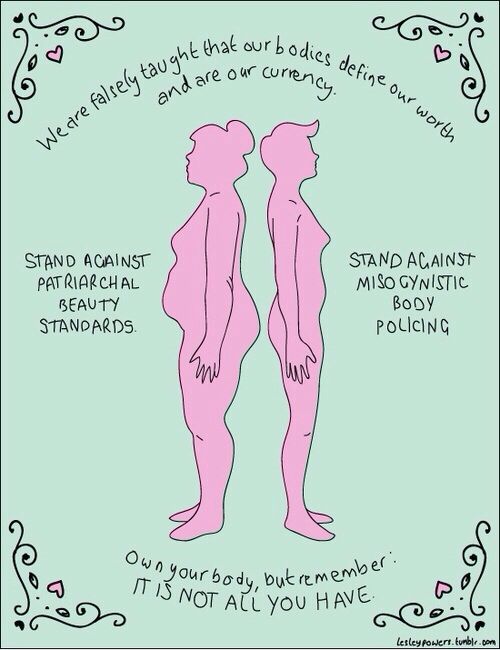
Too often, women & afab people of color, specifically black and brown people, are hyper masculinized by society. Many of us experience gender dysphoria at a young age without even realizing it. In a porn-sick, pedophilic world, we are often told to shave our legs or that we won’t be desirable if we are not petite. We are groomed into believing that compliance with these unrealistic and patriarchal beauty standards is the only way we can be loved or accepted.

This alienation often made me feel like I was a monster, much like how Stryker compares the trans body to Frankenstein’s monster, where both are labeled as “unnatural” creations rejected by society. Even the most natural and feminine part of myself, body hair, was turned into something to be erased. Body hair, a normal sign of maturity, was made to seem masculine, ugly, and unnatural. That made me feel both “not feminine enough” and “not masculine enough,” even as I came to understand myself as genderfluid. I found myself trapped between two conflicting thoughts: one that punished me for lacking male traits, and another that shamed me for not performing femininity “correctly.”

These beauty standards also erase intersectionality, especially when it comes to South Asian bodies. Generations of colonial trauma, famine, and labor have shaped our bodies in ways that defy Eurocentric ideals. Yet we are still told that our features, our curves, our body hair, and our skin are flaws to be fixed. Our oppressors wound us and then teach us to hate the scars it leaves behind.

For me, reclaiming my gender and my body means rejecting those expectations. Like Stryker’s “transgender rage”, I’ve learned that my frustration can become powerful, where I refuse to be molded by standards that were never made for me. My gender exists in the space between what I was told to be and what I choose to become.