Not Your Poster Child

CONTENT WARNING: THIS POST CONTAINS DETAIED DESCRIPTIONS OF INTERNALIZED TRANSPHOBIA & INTENTIONAL MISGENDERING

“Transsexual embodiment, like the embodiment of the monster, places its subject in an unassimilable, antagonistic, queer relationship to a Nature in which it must nevertheless exist.”  – Susan Stryker

A human is born
A life has begun
Is it a boy or a girl?
You must pick one

“It’s a girl!” they exclaim,
Teeming with joy.
But what if that human
Is really a boy?

“Sit like a lady” they say,
Your knees must touch;
“Just put on the dress” they said,
“Stop making a fuss.”

Tomboy! Tomboy! Tomboy!
It’s all she hears.
Losing her femininity
Is something she fears.

Fear of losing the attention,
The praise and the love,
So she puts on clothes
That fit her like a glove.

She grows her hair out
Year after year,
Because deep inside her
Is the fear

That one day they’ll call her
A tomboy again,
And she’ll lose her femininity
Before she really can

Grapple with the fact
That she’s not a girl,
And that this gender façade
Makes her want to hurl.

Until age fifteen,
She puts on an act,
Until she knows
For a fact

That this act
No longer works.
Inside her,
This feeling lurks.

But he knows his body
Will never conform
To social ideals
And so he’s torn.

Does he put in the effort
To be seen?
(And what does that
Even mean?)

It means he struggles
Day in and out,
And his mind
Is filled with doubt.

Transness is beautiful,
Transness is great;
But as a trans man,
I’m filled with hate.

I’m tired of keeping quiet
With nowhere to speak up,
I’ve hereby decided
I don’t give a fuck.

Political correctness
Gets you nowhere in life;
I’m not a poster child,
I don’t determine what’s right.

I’m allowed to be human,
I’m allowed to make mistakes.
I’m now living my life,
And I refuse to wait.
Thinking about Transmasculine Feminism

Last semester in my Theories of Feminism class I read “The Transfeminist Manifesto” by Emi Koyama. This text spoke out to me as a trans person, and it introduced me to Koyama’s additional work on disability, sex work and intersex advocacy that has greatly increased my knowledge of other parts of the field. However, one thing I noticed throughout the text was the focus specifically on trans women and minimal reference to the experiences of trans men, apart from a couple of paragraphs in the gender-based violence section along the lines of “trans men also have something like this problem, we should also advocate for them.” Koyama herself at the end of the paper points out that while she did have the intention of transfeminine focus due to a higher visibility of injustice within transfeminine experiences, there is more information she could have covered on trans men’s experiences, and invites the reader to think more on the topics she did not discuss (e.g. intersectional analysis, trans men).

I did some Google scholar and library archival research after reading this paper and found out there is indeed not very much overlapping scholarship on feminism and transmasculinity, specifically discussing how feminism applies to – and can be done by – transmasculine folk across the gender and sex spectrums. In response to this deficit I thought, “they should make a transmasculine feminism,” and then remembered that I am in fact someone who has a say in that!

What comes to mind (at least from my perspective) as an avenue to explore transmasculine feminism is the idea of recontextualizing our lived experiences from embodied “feminine,” non-hegemonic-male experiences that feminism applies to. Examples I’ve thought of include socialization growing up, the treatment of our sexed bodies in the medical sphere (spaces commonly designated as “women’s” care), and ongoing experiences with how we are treated based on the gender others perceive us as.

I admit that while some may be comfortable discussing the controversial point of socialization, not all transgender folk may be as willing to critically discuss their socialized experiences in their assigned gender growing up, which could be due to dysphoria that could come from this recollection. While there are perfectly valid reasons for avoiding exploring this vulnerable topic in depth, I would argue that in the process of developing my transmasculine feminist thought thinking about my own girlhood, my medical encounters with my own biology, and how I have been gendered based on appearance, I have become more in tune with how I live gender than I ever have before. This might just be me growing up, but I think embracing the gendered aspects of earlier parts of my life is genuinely so constructive to thinking on how I wish to improve as a person, and more relevantly, as a feminist and activist.

So, from thinking about Koyama’s call to action to include more transmasculine thought on feminism, my personal goal in my GWST academics is to formulate something along the lines of a “Transmasculine Feminist Manifesto.” It feels like a very big task to come up with a personal Big Word for an Academic Thing and then justify to Big Academia why you think that should be a Thing, so I am quite daunted by that, especially considering I’ve been experiencing some intense burnout and for whatever reason have been having more and more of a difficult time putting words to my thoughts. But in the case of arguing for this from an embodied, phenomenological perspective, I suddenly have a lot more faith in my words than I have before, and I am very excited to get into putting research together and synthesizing that with my own life as a transmasculine person.

Childhood Gender Norms

Many people have better views on gender stereotypes, but obviously we know better than to not categorize people. Growing up in a traditional immigrant household the gender norms are even more distinct. I was told to not do sports, and only do activities that were more “feminine”. I believe that while stereotypical views about gender norms are deeply embedded in our society, they often begin from childhood.

Continue reading

An Ode to Yonder City

Or; What is ‘here’ and ‘yonder’ in the home?

This week, one of the works that resonated with me was Young’s Throwing Like A Girl, and I looked back on my childhood. The part about ‘yonder’, the space outside of a girl, hit something different than we touched on in class.

Continue reading

Trans comfort music, volume 100

The reason I like the coed 7v7 soccer league that I play in is because I get to play the sport that I have always loved, it makes my body feel good to move and run and think all at the same time, I get to play with all kinds of people and bodies, and no one is really policing gender. No one is really policing gender until there are not enough girls that show up. The rule the league goes by is that there should be a max of 5 men on the field. Even though I am non binary and I “used to be a girl,” people read me as a boy when I show up to play. That is fine with me because no one is counting us off as men and women/boys and girls. I am safe under the radar and no one is picking apart my gender. But a few days ago we had 7 total people, and only one girl. My sister is usually the second girl, but she was out of town on a work trip. Her boyfriend, however, was set on all of us playing because he knows I am not a man and the rule only stated 5 men max can be on the field. He told me he was going to talk to the referee about it and that was cool with me. After he talked to the ref, he walked over to the other team and talked to them as well, presumably asking for their permission for me to play as a non-man and for their trust about there actually being a non binary person on our team. When he came back he told the team we could all play. Naturally, they asked how/why, since we have 6 guys and 1 girl, right? I was hoping he would say that maybe the other team was okay with just letting us all play just to have a fair game instead of playing a player down. Instead, he told them all that I was non binary. I just kinda stared off into space. Then I thought to myself… “I think maybe I was just outed?” Then the ref blew the whistle and we all ran onto the field. I was shaking and wondering if I was overreacting. I just felt very anxious and was hoping that my teammates weren’t still thinking about the conversation.

On the car ride home he apologized because I think he realized I was uncomfortable. I was glad he checked in and we got to talk about what he could have done differently.

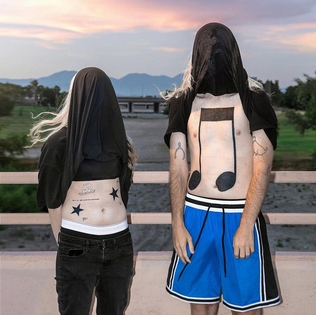
Now to the point of this post. Once I dropped him off, I was sitting in my car and decided to put on 100 gecs. As soon as the song Dumbest Girl Alive started playing, followed by Money Machine, I immediately relaxed and felt so much better. The music got me back into my body. 100 gecs is not usually my go-to artist. The music is very electronic and experimental. It serves very specific purposes for me, the moment in the car being one of them. The group is made up of 2 people, and one is a trans woman. I like listening to her voice and the sounds of the songs. 100 gecs uses autotune and pitching on their voices, and a lot of electronic sounds. The techniques they use are often considered fake or unnatural in music, and the fact that this is the case makes it even better that they lean so hard into it. Their music embodies a lot of trans experiences. At that moment in the car, I was feeling really anxious and nervous and unintelligible to my sister’s boyfriend and my teammates, and playing the music immediately put me at ease. It was like I was in the room with Laura Les singing about how she “did science to [her] face.” Most 100 gecs songs are almost too much for me because of how experimental they are, but that honestly makes them even better. They are a big “fuck you” to what you would expect, just like being trans is.

On Embodiment and Gender

As I understand it, the concept of embodiment seeks to move away from the Cartesian mind-body dualism, which posits that our minds and our physical bodies are distinct entities, and towards the idea that we are our bodies. We experience, know, and perceive the world through our bodies, and in return we are experienced and perceived by others through the lens of our bodies. An important factor in our body experience and the way our bodies are perceived is gender. Do I have a gender, or am I my gender? Do I have a body, or am I my body?

Continue reading

Flunking Bio(logical sex)

The concept of “biological sex” is bullshit. When talking about trans people and the sex they were assigned at birth, the terms “biologically female” and “biologically male” are often thrown around without any critical interrogation into their meaning. They’re a fallback for a lot of people who are aware that saying “born female/male” is reductionist, but who haven’t yet done the work to find more accurate terminology. (The terminology I use and recommend is “assigned male/female at birth”). For a variety of reasons, “biological sex” is a faulty concept, rife with scientific inaccuracies, that subtly undermines and invalidates trans identity. Like a pointillist painting, the closer you examine the concept, the more you realize it’s just a cluster of meaningless points of observation, designed to trick you into seeing a complete picture that was never really there in the first place.

Continue reading

“The Body I Wear Is Not Perfect”

selective focus photography of skeleton
Photo by Chris Mitchell on Pexels.com

When thinking about the beauty standards of today it’s hard to ignore that bodies within magazines and television are rarely realistic goals for the general public. With bodies that range from what some may consider skinny to what others may consider thick, it’s important that we acknowledge all bodies contain a life within them. Looking at myself in the mirror can be difficult sometimes as I don’t believe my body is what society deems as attractive. Attractiveness is different for each gender as what is subscribed for males and females are different though this is changing it still holds today that men should be muscular and that women should be small and hairless. Focusing on the physical aspect of the

Continue reading

Hair Removal: Only $25 and a Few Years of Shame!

As someone who spends $25 on threading her eyebrows, among other things, every month, Matthew Immergut’s Manscaping: The Tangle of Nature, Culture, and Male Body Hair struck a chord with me. Body hair removal is connected to capitalism – I could have told you that a long time ago, while shelling out money for shaving cream, razors, and those monthly threading sessions. I could have also told you that hair, and lack thereof, for women is policed by nearly everyone, from boys on the playground making fun of your “unibrow” or “moustache”, aunties telling you that you should wax your legs every six weeks instead of using a harsh razor, by friends telling you that the extra hour spent straightening your hair every morning is “totally worth it! You look SO much better!” Even today, there are countless memes all over social media about how vital it is to get a perfect eyebrow arch and brows that look perfect, but not too perfect. However, reading Immergut’s Manscaping helped me continue the process of fitting together all those fragments into one larger picture that reflects not only my experiences, but the way that Western society treats body hair on brown women as a whole.

Continue reading