Work and Worth: A Journey

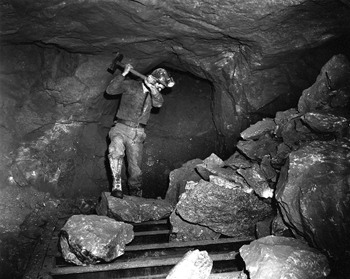
As a college student, I’m constantly juggling classes, assignments, and part-time jobs, and I often feel like I’m being pulled in a million directions. It’s exhausting, and I sometimes find it hard to keep up with everything. Beyond my studies, I want to be there for my friends and family, but it often feels like I’m barely keeping my head above water. Lately, I’ve been thinking a lot about how work and health are connected, especially as I prepare to step into the workforce. The transition to independence is daunting, and one of the biggest challenges I face is figuring out how to take care of myself amid all the chaos. Unfortunately, essential topics like nutrition, stress management, and work-life balance are rarely taught, leaving me to navigate them on my own.Reflecting on the history of labor in the United States, I realize that the fight for workers rights has been long and difficult. Over the years, labor movements have battled for fair wages, reasonable hours, and safer working conditions, paving the way for healthier workplaces today. But after reading “Made by the Work: A Century of Laboring Bodies in the United States” by Ed Slavishak, my perspective on the human cost of labor has shifted profoundly. Slavishak dives deep into the harrowing experiences of early 20th-century workers. It’s hard to fathom that laborers in steel mills and coal mines faced daily dangers and grueling conditions, with their bodies treated like mere tools for productivity. One statistic that struck me was that over 25,000 workers died every year from workplace accidents. That number is staggering and heartbreaking. It hits close to home for me because it makes me think about how easy it is to overlook the sacrifices of those who came before us, who were seen as expendable and pushed to their physical limits until they broke.

Sitting in my cozy dorm room, surrounded by textbooks and my laptop, I feel a mix of privilege and guilt. I belong to a generation that, for the most part, doesn’t have to face such dire conditions. It’s easy to take that for granted, especially when I’m so consumed with my own struggles. While my working environment is much safer, I can’t help but feel frustrated by how companies historically handled safety or neglected it entirely. They placed the burden of safety on workers, insisting that “the best safety device was a careful worker” (p. 152). That mindset is infuriating because it shifts the blame onto the very people who had little control over their situations.As Slavishak points out, corporate safety campaigns “shifted responsibility to avoid the costs of updating machinery or improving ventilation” (p. 152). This is maddening. It reminds me of the pressures I face in college. I often feel that I’m expected to power through exhaustion or even illness just to meet deadlines. I think about how many workers today might still feel that same pressure to sacrifice their well-being for the sake of productivity.Learning about unions and workers’ compensation laws has given me a profound respect for those who fought for workers’ rights. They understood that workers deserved to be valued for more than just their output, advocating for crucial things like life insurance and compensation for injuries. Slavishak notes how the insurance department of the Amalgamated Association of Iron, Steel, and Tin Workers directly asked its members, “What are your chances of living twenty more years? Can you afford to tempt fate?” (p. 153). That question resonates with me. It makes me think about the importance of community and looking out for one another in college. We’re not just isolated individuals scrambling to succeed; we’re part of a network that can uplift and advocate for one another. As I navigate my college journey and prepare for the future, I’m reminded that the fight for dignity in the workplace is far from over. It’s not just about securing a job; it’s about creating a work culture that values us as whole people, not just for our productivity. Reflecting on the struggles of past workers fills me with a sense of responsibility to carry their lessons into my own life. Balancing everything can feel overwhelming at times, but I know that by supporting each other, we can work toward a future where every worker is treated with respect not just for their labor, but for their humanity.
The Body at Work

“That the body plays a central role in work is perhaps an obvious statement, yet it is easy to lose sight of human labor in a capitalist system centered on service, global outsourcing, and automated assembly…laboring bodies experience ailments and annoyances that are often hidden because they are experienced in isolation” – Ed Slavishak

When the worker is asked
To complete the task,
The body slaves away
For a measly pay.

In the big blue store
With the bright blue vests,
17 year old
Ken Kaneki rests.

School then work,
Day and night,
Week after week,
He does everything “right”.

He’s the star employee,
The best on the team,
But what does that
Truly mean?

His feet are aching,
He can barely walk,
But yet to every customer
He must talk.

Work through the pain,
Keep up your pace,
And never ever
Let your smile leave your face.

7 miles a day,
He walks across the store.
Pulling carts, stocking cases,
And watching the door.

Up on the ladders,
With boxes half his size,
His balance unsteady,
And dust in his eyes.

Down on the floor scrubbing,
He’s on his knees.
His body is screaming
“Help me please!!”

Work through the pain,
Keep up your pace,
And never ever
Let your smile leave your face.

Now in the present,
His joints are weak.
And every now and then,
The future looks pretty bleak.

Countless hours spent
To prove your worth,
But where’s that “family” now,
When you are hurt?

You are replaceable
Like a cog in a machine,
And in the end,
Your efforts were unseen.

4 years in a place
That worked him to death
And now his sanity
Is all he has left.

With the job of 6
And the pay of 1,
After 4 years
He’s glad to be done.

But when he looks down
At his physical form,
He can plainly see
That it is worn.

His body shows signs
Of labor intensive times,
And he bears the scars of physical labor.

Now that he’s free,
He can clearly see
That the odds were never in his favor.

He must push on
In his tired state,
He must succeed
Before it’s “too late”.

Reality Check

In terms of bodies I wanted to talk to about both of our subtopics for the past two weeks. Reproductive and labor. Im honestly a little anxious to give birth as a black woman. Even though I’m not a having kids anytime soon lol there’s still that looking anxiety. I plan to be very vocal/opinionated during my pregnancy and birth ( as you all know I already am) and I honestly don’t think I want to have my baby at a hospital. I think I’d like to give birth at home with a midwife who still has a medical license in case something goes wrong. Hospitals are so depressing and I don’t want to give birth to a child in one. But also because there’s still that looming anxiety about if the doctors and nurses will dismiss any concerns of mine.

Continue reading

A Review of Flooring Materials at [UNNAMED MODERN ART MUSEUM IN POTOMAC, MD]

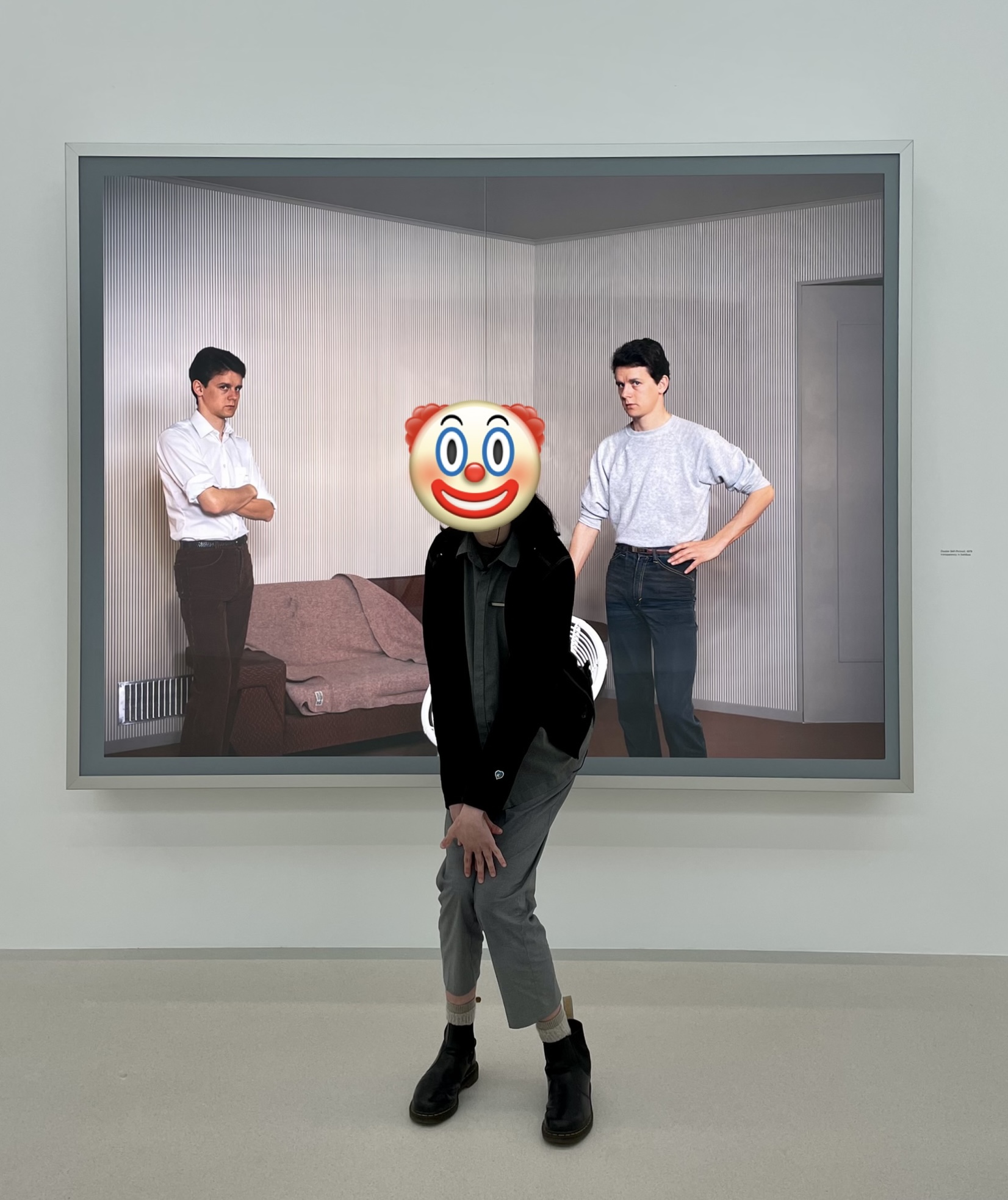
A person squatting in front of a large photograph. The photograph depicts to identical young men, standing around a chair and looking sternly at the camera. The person in front of the photograph is squatting as iff pretending to sit in the chair. They are wearing a gray uniform and a clown emoji obscures their face.
Your two identical fathers and I would like to have a word with you.
(The author and Jeff Wall’s Double Self-Portrait, 1979. The flooring in this image: terrazzo.)

Concrete
Most of the walls are made from concrete, pre-cast into panels and weathered outdoors in North Carolina. The floors of only two rooms are made of concrete: one exhibit room and the main loading dock. The loading dock is where we’d gather to hear the featured artists speak, our employee status granting exclusive access to the secrets of their practice. The sound would bounce off the walls and concrete floor so much that I had to strain to understand. The head curator once introduced us guides to a visiting artist as “walking, talking wall labels.” I’ll never forget the rage I felt in that moment.
6/10. Not especially comfortable nor remarkable.

Continue reading

“it’s not for everybody”

Please do not read if Military Sexual Trauma is a trigger along with suicide.

I joined the Army in 2018 on a whim. I dropped out of college twice, worked in a warehouse, didn’t have many friends, and felt as if I were doing nothing with my life. I became obsessed with my weight to the point I was restricting food and went to the gym for 3+ hours a day or even twice a day. I craved being worthy in the eyes of society. On a Saturday night, I received a Facebook message “ever considered the army?” What better way to be worthy than to wear a uniform that carries the most meaning in America?

In two weeks, I was gone. At the age of 20, I was headed to Basic Training at Ft Jackson, SC. I had no idea my life would be altered so drastically.

Within my first 3 weeks in basic training, I began my first Sexual Harassment/Assault Response and Prevention (SHARP) case. After my report and when other females in training heard, I was outcasted for “ruining someone’s life.”

Little did I know, that was only the beginning.

In total throughout my 3 years in the military, I experienced sexual harassment from 10 DIFFERENT senior enlisted NCO’s. I experienced one extreme case of stalking that finalized the end of my military career. The harassment coming from your superiors in a place where you’re already alone is manipulating and ignites internal gaslighting. You begin to feel like an object, not a human being. Is this all I’m good for in the military? I excelled in my job…why am I not seen for that?

The stalking put me in constant fear. If I knew he had kidnapped someone, it would be easier to know what to expect. If he assaulted someone, it would also be easier to prepare myself, as I know his plan. I didn’t have an explanation, I didn’t have a plan, I didn’t have a single clue of what and why. I couldn’t brace for anything. I asked for help from my command and was accused of having a sexual relationship with him. I lost it after that.

I was sent home from my first and last deployment early with a diagnosis of PTSD from Military Sexual Trauma. I medically retired. For about a year after my separation, I couldn’t hold a job, I couldn’t function as an adult, I was on a high risk list at the VA, I had nightmares/night terrors every night, crippling social anxiety, I got in verbal altercations everywhere I went, I couldn’t drive without getting in to a road rage incident, I still lived in constant fear. In June of 2021, I received a call from someone in my old unit at 0700. She told me the man who stalked me took his own life after his possessions were seized by the Savannah Police Department for explicit images of children. When officers went to execute the arrest warrant, they found his body.

The amount of apologies I received was disgusting. If only someone had listened to my claims. I was easily dismissed for being a woman in the military. It was “typical” in the eyes of men, as if we were making it all up for attention. I was shamed for asking for help, I felt invalid and wished I just kept my mouth shut. I blamed myself, not the other people for what they did to ME but what I did to ME. Would I still be in the military if I had just shut up? If I behaved in the man’s world, would I still have a career? I don’t feel pride from joining the military like one should. I don’t like to talk in depth about it because it feels like I didn’t get all of the body I entered the military with back once I got out. It wasn’t my body in the military, it was everyone’s property and I had no control.

Is it worker exploitation, or just high expectations?

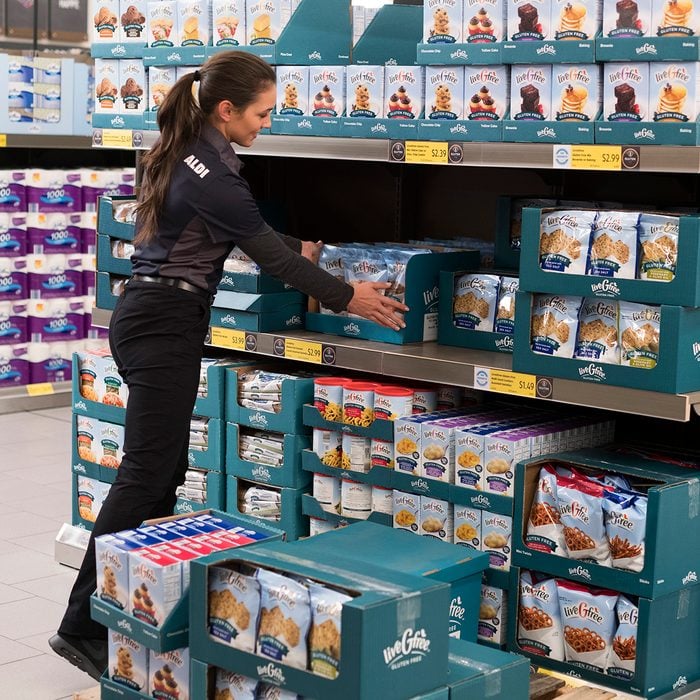
Stock photo of an Aldi worker placing boxes on the shelves with a smile.

I worked at Aldi for nearly two years before disability and injury forced me to quit, and take on several non-physical part-time jobs instead. Aldi runs on an extremely robust high-efficiency model that is designed to eke out every ounce of labor every worker has for every minute they are on the clock in order to keep their costs low and the customer’s costs low. In order for Aldi to be profitable, they must be exploitative.

Many Aldi employees will refute this statement because “Aldi pays more than minimum wage!” And yes, they pay just barely enough to be competitive in the local market they are located in – but only if you are comparing them to other grocery stores. The reality of the Aldi model is the job requirements are more in line with working at a warehouse, and warehouses on average pay quite a bit more than grocery stores as the understanding is that it is a difficult physical job.

Many customers also fail to understand how difficult the Aldi job is. The most common complaint we heard as employees was how lazy we were for getting to sit. This quote from querysprout best explains my feeling on that topic, “Letting cashiers sit down – it’s actually not a comfort thing (employees have described the work at Aldi as “backbreaking”), but rather, the company found employees could scan faster if they were seated.” We as customers praise and stand in awe of the Aldi model that allows us to get basic grocery goods for so cheap because they leave the goods in boxes, how revolutionary! In the next breath we complain that there’s never an employee around to ask questions to – the reason being Aldi staffs the bare minimum of employees at any given time to, again, maximize efficiency.

One of the most interesting facets in Aldi’s worker exploitation is how thoroughly prepared they are for worker injury. The job is intensely physical, the training for the physical tasks is minimal, and the expectation for worker speed and production is through the roof. It’s a breeding ground for serious injury, and the reality I knew working there was anyone who worked as a stocker was injured at least once in a year period. If they lasted more than a year, they typically were hurt at least once a year. I knew several people who had worked there for many years and all of them had received reparative surgery, or desperately needed it.

Aldi has a robust worker’s compensation insurance system, and it’s clear that they fork over a lot of cash for it. (I’ve had worker comp claims at other employers that were much less streamlined, in comparison.) Aldi will happily plan for you to be injured, pay for your recovery and for a short time out if needed, and then expects you to be back on the workhorse as soon as possible. Restrictions are heavily discouraged, though they do, of course, abide by them reluctantly when required to.

What happens if you just can’t come back to work right away? Scalia v. Aldi (2012) is an interesting case in which one employee was booted off of worker’s comp for taking too long to heal, and then promptly fired because she hadn’t worked in 12 months. The employee claimed that her firing was retaliatory for her injury on the job. (She didn’t win, which is hardly a surprise in the U.S.) The reasoning behind the decision came down to Aldi’s extensive policies around termination, worker’s comp, and time out, that enough logic loopholes existed in their policies that had existed before this termination to make it “not retaliatory,” though apparently only in a neutral sense.

What does that mean for you as a consumer, and for Aldi? Well, Aldi has absolutely abysmal employee turnover, akin to the rates of fast food industries. They are a ship with a mild leak that has been patched over and over with mixed success, and only time will tell if their model is truly successful in the long run. For you, I recommend asking yourself when you walk into an Aldi: Do the employees actually look happy, or do they look exhausted? Can you even find an employee?

Can you see my oppression?

For a couple of weeks, I have noticed something that has been circling my life, that something is oppression. Continue reading

How being a waitress made me buff

I’ve had a few jobs growing up and nothing has shaped my body like being a waitress. I worked at a Mexican restaurant and our most popular dish was fajitas. If you’ve never had fajitas you have to know they are served with two plates: an iron plate for the meats (or veggies) and then a separate plate for all of the sides. Being our most popular dish, I would often end up with a table of four customers that would all order fajitas. I was petite, and balancing four iron plates on one hand and a tray stand on the other proved to be a difficult task, especially when I had to squeeze through a crowded bar. I could do it, but I wasn’t as fast as the men I worked with. The men, being taller and stronger, were given sections with up to six tables, I was stuck with three. My lack of strength was affecting my income and I had to take action. I couldn’t make myself any taller but I could definitely get buff. I began lifting weights and practicing after hours with empty plates on a tray until I proved I was strong enough to be given more tables. I wasn’t as strong as the guys, but I could carry my own weight.