
Burnout, The Grind and My Activist Work: A Vent

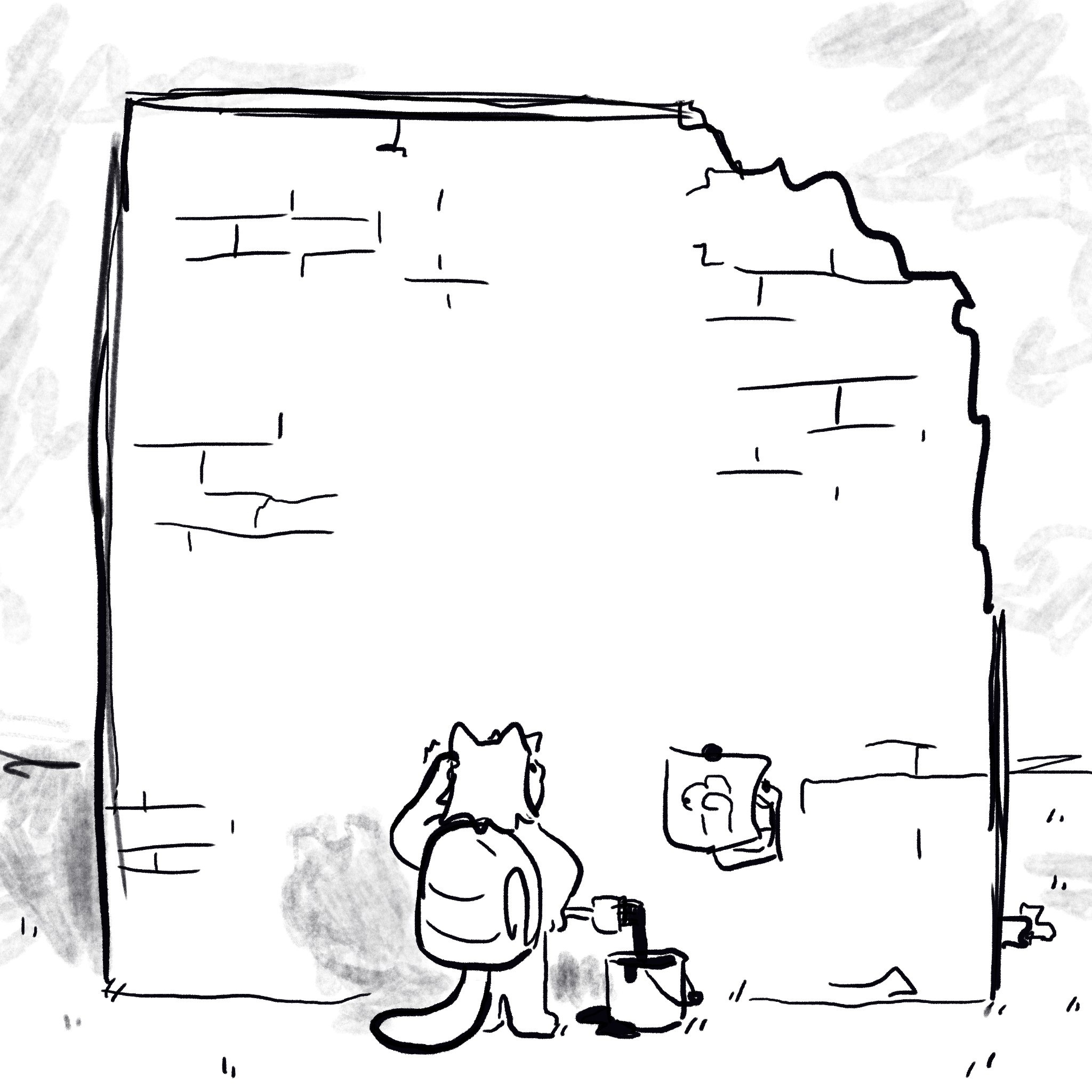
A quick sketch I made for this post. This is a very toned-down version of where I’m at. (photo ID: a black-and-white sketch of a small humanoid “snailcat” with his back, shell, and tail to the viewer, holding in one hand a paintbrush with black paint over a bucket while scratching his head with his other hand. he is staring at a brick wall, his shadow over it to his left and a couple of minimally detailed posters to his right.)

Whenever something big and horrible happens, one of the biggest coping mechanisms I have is to redirect any overwhelming crushing despair or anxiety I have about it into doing my part, and doing what I can. I’m an artist, so I know I can make art about it, and I’m a GWST scholar, so I know I can write about it.

That is, I would be able to. IF I DIDN’T HAVE SO MUCH WORK TO DO.

I am unemployed and taking 15 credits this semester, 3 of those including an (UNPAID!) internship where I have to produce 55 entire pages of full illustrations, 5 of which have animated components. I am 3 whole weeks behind on that work, and my timing should work out but it is going to be awful and crammed and I feel sick just thinking about how much catch-up I have to do. I’m not getting paid but it’s good work that I can use in a future portfolio, and it’s for a good cause (books suited to an older reader demographic while providing illustration and comprehension assistance for readers with cognitive disabilities). Meanwhile in my actual classwork I have a major final project with a deadline coming up alarmingly soon that I want to get perfect because it’s an analysis of a video game (ULTRAKILL) and topic (Jack Halberstam’s Queer Art of Failure) that I really care about. So I am already diverting energy into two interdisciplinary activist/GWST-related things I genuinely want to get exactly right. And I feel confident in saying that I am Burnt Out.

All of this was already stressful before, you know. WEDNESDAY NOVEMBER 6TH 2024.

My social media pages that day were full of posts encouraging me to get organized, make art, write thought pieces detailing my unwillingness to give in to the doom and roll up my sleeves. And I would love to participate in any movements that are mobilizing in the context of The Horror That Is Unfolding Before Our Eyes. I know I have the skill to contribute art and work beyond just sharing resources and mutual aid drives (though that is always helpful). And I know I shouldn’t hold myself to the standard of a “good” project being one that is always perfect and brilliant and revolutionary. But in times like this the pressure to make art that perfectly encapsulates the rage just adds to the crushing pressure of the world itself.

It’s a rage I fear I can’t put into words, and seeing all of the art and performance work in disability activist movements we’ve been looking at for class makes me feel like I have something to live up to. But that potential I have is shrouded by the labor required to survive, to get a job, to build a portfolio, to get a degree. And I am grateful that this is labor I can direct passion into, but man I wish it was easier. I wish I had time!!!!!!!

(all this being said, the first thing im doing once i have time is making a sticker with shadow the hedgehog holding the trans flag and saying a raw as hell quote from sonic ’06 so if thats something that interests you, keep an eye out!)


I Quit.

Why do we work ourselves the way that we do? Do I actually want to do my job or am I there due simply to societal expectation? How many jobs do I need to juggle to make a decent wage? Why am I told to work myself to death in order to “succeed”? 

Last week I quit a job for the first time ever. Sure, I’ve held many different jobs in the past, but I’ve always simply “moved on”, outgrown it, graduated; I’ve never just quit so suddenly. However, my work environment had become so toxic and taxing on my mental health, I had to leave. This was a really empowering experience if I’m being honest, but it has left me anxiously wondering and stressing. I haven’t been properly unemployed since I was about fourteen. Even though I’m a full time student now and my mental health has been suffering, I still am finding myself anxious about not having any income for an indefinite period. Though I know logically that I need the break and I will be okay if I take some time off, I feel anxious and somehow as though I am failing. 

This has led me to do a lot of reflecting. I feel such frustration at this system and society we have created for ourselves. Living as a full time student balancing classes, extracurriculars, and a social life is enough of a full time job by itself. Yet we live in a world where not having a consistent income is both damning and regarded as a disappointment. Why do we push ourselves to the breaking point every day, expecting the utmost effort and engagement no matter what? I can only dream of how much more productive and healthy we would all be if we simply prioritized our mental health and undertook a balanced, reasonable schedule. How long until I run out of gas money? When do I have time for job applications? Am I failing because I’m not employed while my friends are? What if we stepped back? What if we broke the cycle? What if we chose to prioritize ourselves instead of this toxic loop of waking, working, spending, sleeping, and repeating? Not to mention that emotional labor is interwoven between physical demands, in our jobs and lives. It is always simply expected. Don’t break down, don’t show weakness or frustration or exhaustion or anger. Be pleasant, be professional

What if we had universal healthcare? What if bills weren’t such a stressor? What if the cost of living didn’t grow exponentially faster than the average salary? 

How long until I’m too exhausted to function in this world anymore, until I have to quit? 

(in)visible labor

Okay, so, no judging, but my suite hasn’t been properly cleaned in weeks. My roommates and I have a schedule that we usually stick to, but this semester has been rough (and that’s an understatement), so things just haven’t been cleaned up as well as they could be.

To give you one idea: our trashcan has been full for a good while. To give you more ideas in way more detail than you’re probably okay with: the couch cover is all scrunched up, stray hair everywhere, there’s leaves and mud that have been tracked in from the outside on our floor, our poor little coffee table has crumbs and juice and tea stains on it- please don’t even get me started on our fridge. Half the time we even forget to turn off the living room lamp at night because we’re so tired… hey! I said no judging.

Today, I got up at 12:30pm and had a good, hard look at our suite and couldn’t stand it anymore. So for two hours I wiped down all the surfaces, took out the trash, cleaned our bathroom, cleaned the microwave, cleaned the sink, vacuumed, watered my roommates’ plants, and all in all just made our living space look more neat. So. Freaking. Tiring. By the end I was ready for a nap, but I knew I couldn’t because I had assignments due at midnight. I kept thinking, no wonder we share the chores; one person doing this all is too much, especially on top of all the homework and projects and midterms we all need to study for.

It reminded me of my mom. My mother juggles so many things at home: doing the laundry, wondering what to cook for breakfast, for lunch, for dinner, sweeping the floor, cleaning three bathrooms, the list goes on and on- all while also having a full-time job at work and a full-time job as a mother. So in the end, she has three full-time jobs, one being invisible or reproductive labor around the household. Invisible labor is I think the worst labor someone could be tasked with, because usually we aren’t even tasked with it directly; it’s simply expected of us. And because of that, no one really talks about how taxing this is on our bodies, or how we should be able to take breaks because of this work.

It’s sad and frustrating. I would argue that yes, knowing how to do basic tasks like washing the dishes and doing your laundry is necessary to living, but its such a different story when you’re doing it for more people than yourself. You take on the labor of other people, and it absolutely sucks when those people don’t even acknowledge it. My father is one of them. He expects my mother and I to do things for him, because that’s our “job” in the family hierarchy- and therefore never says please or thank you. I feel like whenever I do the dishes for him, or fold his laundry, he just sees right through me. Pretty annoying, if you ask me.

I’m lucky to live with people who are appreciative of each other’s contributions to our little makeshift household for the year. My roommates thanked me profusely and it felt good to be validated in that sense. I’m also lucky to be able to have a mother so great as my mom, who does so many things all at once. I express my gratitude via words, gifts, and physical affection, and when I’m home (which is rare nowadays, unfortunately), I do my best to help her in whatever way possible to alleviate her stress. Most importantly, I let her know that her labor is visible to me. Visibility is all some people are asking for, after all.

2 jobs, 1 degree.

2 jobs, 1 degree.

Where Do Women Belong in Places Like the Work Field?

Where Do Women Belong in Places Like the Work Field?

As a cis woman, I have personally worked in multiple jobs, primarily full of men. I gravitate towards more physical jobs, meaning I work with more men. Throughout my life, I’ve heard many phrases to try to put down a woman for expressing an opinion different from the male’s perspective. Some of the insults they use to try to shut up women are, “Go back to the kitchen where you belong.” or “Shut up and go make me a sandwich.” some men will even refer to women as objects like dishwashers. However, in the work industry, those two tasks of cooking and cleaning are dominated by men. While working in the kitchens over the years. I have had to work and train grown men twice my age. While instructing these grown men, I was constantly disrespected and was not listened to during instruction, which ended up causing safety problems. I was only treated with respect when the male manager noticed them actively ignoring and disrespecting me. He called them out and explained that I was well-trained in my job and that they needed to take me seriously since I played a role in whether they got to keep this job. During these experiences, I had men flat-out tell me that I don’t belong in the kitchen due to my gender and size, which is ironic because I’ve heard men tell me that I do belong in the kitchen. While working my shift, I had to listen to their opinions about my inability to get things done due to my body not fitting the standard for someone to work in the kitchen. I heard, “She is too weak to do this,” “She is too bubbly to work back here,” or “She is not going to make it long in the kitchen because she is too sensitive.” It made me feel like I needed to constantly prove to myself and my male coworkers that I was someone to be respected for my work ethic. I always worked the hardest, and my personality started to change to be more aggressive and louder for my male coworkers to listen to, but then I was labeled as a “bitch”. However, if I told my male coworker to do the same thing I did, he would be seen as “forward” and “direct.” It is just a simple example of how readings like Not Just the Reflexive Reflex and Throwing Like a Girl mention how we still have these situations where women are still faced with this issue that we are seen as somewhat less than compared to men because of the body women are born with and their potential capability to have children.

That Day in July

(content warning: sexual assault)

I still remember that day in July. It was at a weird time in my life. I had been back on hormones for a few months now, after having been off for way too long due to a bad combo of adhd and anxiety making my life much harder than it needed to be. Similarly I had been working for the past few months in a grocery store. It was a frustrating job but at the very least it paid me.

Continue reading

The Working Class and Sleep Deprivation

The face of an exhausted shiftworker is not unfamiliar to most: the half-opened eyes of a 7-11 employee, who drawls, “Good morning,” as they slowly move their sleepy arm to scan items. For many working class individuals, managing to secure 7-8 hours of sleep nightly is a constant struggle. Sleep deprivation and insomnia have a pervasive impact on those of lower socioeconomic status, resulting in numerous mental/physiological health risks and poor work performance. Sleep deprivation could be a potential factor that accounts for the near impossibility of escaping poverty. Continue reading