
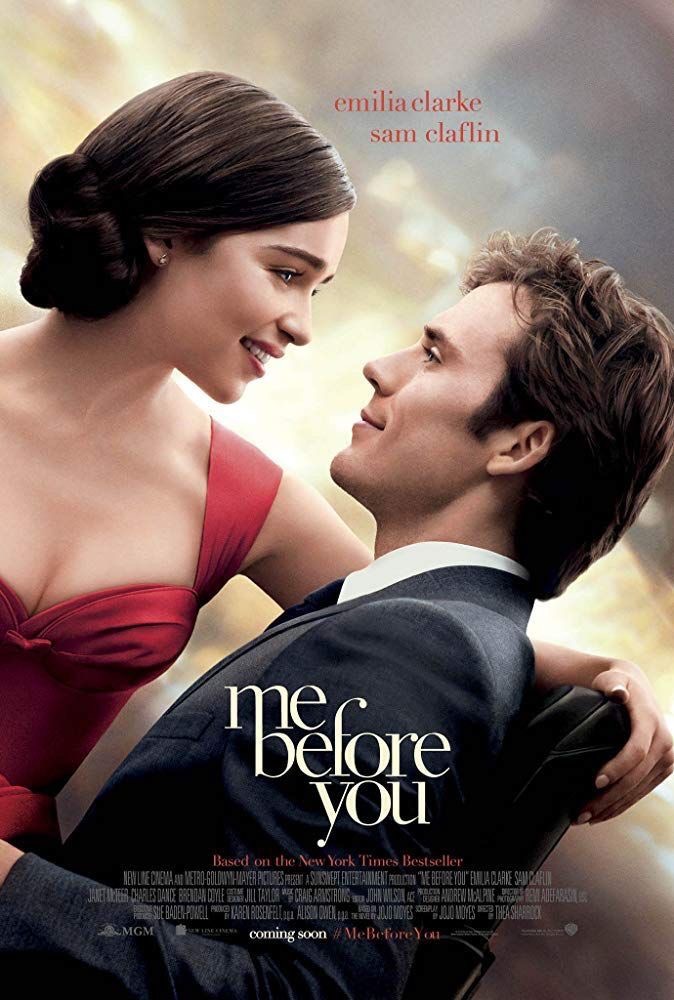
Me Before You: A Tragic Tale of Romance and Assisted Suicide 

When I first watched Me Before You, I felt like my heart was ripped out of my chest. The story follows Louisa “Lou” Clark who becomes the caregiver of Will Traynor, a man who was adventurous before becoming paralyzed after an accident. Will unfortunately faces many challenges both physically and mentally, leading him to choose assisted suicide despite falling in love, and I haven’t been able to stop thinking about this movie ever since. Recently I started to question, if it was romantic, or was it reinforcing the idea that a disabled life isn’t worth living? After reading Nicole Schroeder’s “Dying a ‘Good’ Death: Disability and the Assisted Suicide Debate” from the Disability Visibility Project, I started to see the story through a completely different lens.

Before I fully dive in, I want to fully paint the picture of this movie. Firstly, Will’s parents hire Lou to care for him after his accident two years in an attempt to raise his spirits. Lou’s unapologetic, positive personality slowly breaks through his bitterness, and they form a deep connection. After finding out he plans to go to Swtizerland for assisted suicide, Lou tries her best to change his mind by trying everything from taking him to concerts and a trip out of the country. But in the end, Will does not change his mind even after falling for Lou. The movie paints his choice as noble as a way of reclaiming control over his life and giving Lou a chance to live hers. The final scene shows Lou reading Will’s farewell letter in Paris, smiling through her tears. It’s meant to be bittersweet, but it also raises difficult questions about what “a good death” really means, and whether society offers disabled people real choices about living.

Nicole Schroeder’s essay completely reframes this debate. She argues that the real issue isn’t about whether people have the right to die, but it’s about why so many disabled people feel they need to. She writes, “those of us protesting do not want people to be in needless pain; instead we want resources other than death to alleviate suffering while people are still alive.” That line stuck with me because it exposes how the conversation around assisted suicide often ignores the failures that lead people to that point: lack of access to care, isolation, and social neglect.

In the film, Will isn’t shown receiving much support beyond Lou’s companionship and his personal caretaker, Nathan. Even with wealth, he seems completely alone in a world not built to include him. Schroeder highlights that in a “hyper-capitalist world,” assisted suicide can become a cheaper alternative to improving care and accessibility. It’s haunting to think about how Will’s decision might have been shaped not by genuine choice, but by a culture that sees disability as tragedy especially after losing the hyper-active life he once had. 

One of Schroeder’s most important points is that assisted suicide is often presented as a form of autonomy, when in reality, many disabled people are making choices under pressure. She shares that in Canada, nearly half of those choosing Medical Assistance in Dying (MAID) cite feeling like a burden or experiencing loneliness. That statistic immediately reminded me of Will telling Lou he didn’t want her to give up her life for him. What sounds selfless in a romantic story becomes more complicated when you realize how society teaches disabled people to internalize guilt for simply existing.

The movie’s emotional framing makes Will’s death feel inevitable, even “beautiful,” but Schroeder challenges that idea. She calls out how assisted suicide has “eugenics-centered roots,” meaning that the very systems allowing it have historically viewed disabled lives as less valuable. When I look back at Me Before You now, I can’t unsee this unfortunate pattern that tangles up love, care, and death into a message that equates disability with hopelessness.

When I first watched Me Before You, I can still remember myself tearing up during the beach scene when Will tells Lou that he is still going to Switzerland after she pours her heart out to him. Me and many fans of this movie are still heartbroken over what could’ve blossomed between Will and Lou. But now, I think the real heartbreak isn’t Will’s death….it’s that the story never gives him another option. Schroeder’s essay reminded me that true dignity doesn’t come from the “freedom” to die; it comes from having the support and resources to live fully. The film romanticizes Will’s choice, but if it reflected the realities Schroeder describes like underfunded care systems, social isolation, and ableist messaging, it might look less like empowerment and more like surrender to a world that failed him.

I still love Me Before You for its intensity and emotional honesty, but I see it differently now. It’s not just a love story; it’s also a mirror of how our society defines whose lives are worth fighting for.
What about the “right-to-live?”

I remember when Jahi McMath died—for the second time. 

Senior year of high school, I came across an article about Jahi McMath, a 13-year-old Black girl who was declared brain dead after her tonsils were removed. It was Jahi’s first surgery, and she was scared. She didn’t want to go through with it, but her mom convinced her it would make her life easier (Jahi had sleep apnea, and removing her enlarged tonsils was intended to help). After speaking with the doctor, Jahi consented to the surgery, and she was fine for about an hour afterwards.

Jahi’s blood vessels were unusually close to the surface of her throat; the doctor had noted this in his chart for her, but the post-op staff was unaware. So when Jahi started coughing up blood, they didn’t see it as the alarm that it was, although Jahi’s family did. They repeatedly raised the alarms for her, but no one listened until her heart stopped.

Jahi was declared brain dead; her brain had stopped functioning due to the massive blood loss. In California, brain death is legal death. But Jahi’s family didn’t accept that. Her mother, Nailah, was convinced Jahi was still alive; Jahi responded to some stimuli and questions. Nailah asked Jahi if she wanted to be taken off life support, and Jahi said no through physical movements her mother taught her.

In the long legal battle that followed, Nailah and her family were forced to flee the state with Jahi under threat of legal action and jail time. Nailah’s insistence that Jahi was alive, and refusal to take her off life support, violated California’s medical ethics, so they went to New Jersey, where families can reject the notion of brain death on religious grounds—Nailah technically “kidnapped” Jahi to do this. There, Jahi had at-home around-the-clock medical support from nurses and doctors who were willing to lose their medical license or be shunned from the medical community; the doctors that treated Jahi were treated as quacks by the medical community. In the view of the community at large, you cannot treat a body that is already dead, and although Jahi’s body was not dead, her brain technically was. The California hospital where Jahi had been declared dead consistently disavowed the McMath family’s efforts and actively disparaged them for “desecrating a body.” But they were wrong.

With consistent care, and rogue researchers willing to look into her case, Jahi was able to exhibit signs of life, brainwave activity, and even underwent puberty. In 2017, a neurologist at UCLA independently confirmed that Jahi was no longer “brain dead.”

Jahi died—for the final time—in June of 2018, not even six months after the New Yorker article was published due to internal bleeding from abdominal complications. Despite overwhelming evidence, the hospital that issued Jahi’s death certificate refused to ever accept Jahi’s recovery and overturn her death certificate.

In 2020, I, much like Jahi, was preparing to go into surgery to get my tonsils removed for sleep apnea, just as she had been. Her name haunted the back of my mind in the days counting down to my surgery, but I, just like Jahi, spoke with my surgeon and asked him how many times he had done the surgery, what the risks were, how long he had been a surgeon. I had the insight that a 20-year-old had and a 13-year-old didn’t, but we were in the beginning of a pandemic, in the middle of the shutdown, and my mom wasn’t even allowed in the waiting room with me. Though I was nearly certain I would be fine (my surgeon routinely did much more complex and precise surgeries, like removing tumors that had grown into the blood vessels of the throat), I was alone when I frantically pulled the anesthesiologist aside and had to shamefully admit that I had been taking quinine pills until yesterday morning, a stupid superstition I had bought into as a way to stave off a Covid infection.

Quinine, for those unaware, is an herbal supplement that used to be used as a “cure all” back in the days of the Black Plague and the Spanish Flu. It didn’t work back then, but I’m a big believer in the placebo effect, and I needed to take something to put my mind at ease. One of the side effects of quinine—that I didn’t know until the morning before my surgery when I actually read the bottle—is that it can thin your blood. This makes you a higher risk for surgery; you’re more likely to bleed uncontrollably because the blood is much harder to coagulate. The bottle said to stop taking quinine two weeks before surgery. Feeling like I was going to cry, and possibly even about to die, I waited anxiously to be taken back and prayed that I would wake up afterwards.

Obviously, I did, or I wouldn’t be writing this right now. But I’m aware how lucky I was, and am. Jahi’s case is in direct opposition to Terry Schiavo’s: Terry Schiavo was a White woman declared brain dead who the hospital refused to stop treating, whereas Jahi was falsely declared brain dead and refused further treatment. Jahi’s family noticed this too; they knew if Jahi had been White, she would have likely received the attention she needed, and even if she had still been declared brain dead, her family’s choices would have been respected. Having come after both of them, and being light-skinned myself, I know my family would have had the respect and space they needed to make whatever decision for me they felt was right if my surgery had gone wrong.

Still, it haunts me; Jahi’s story is barely told outside of fringe medical pieces, but Terry Schiavo’s is well-known enough to be casually referenced in feminist writings. Who gets the right-to-live? Who is allowed to die? Why are our bodies’ needs and wishes ignored depending on the kind of body we inhabit? I hope Jahi is resting peacefully now, but I carry the anger and fear of what was allowed to happen to her.

Existential crisis or OCD?

Tw: death, dying

For some time now I’ve been preoccupied with our human understanding of life or death. My thoughts consist of why am I here? Why are we all here? Where did we come from? Where do we go when we die? Is this all a simulation? I don’t want to die. I don’t know what happens when I die. I don’t know when I will die. I don’t want to die! These types of thoughts would fill my mind all day. I thought it was just some sort of existential crisis that would go away. But I was wrong. These thoughts have plagued my mind for almost a whole year now. I now know that what I’m suffering from is existential OCD. I have already been diagnosed with OCD and generalized anxiety disorder. So I have a lot of uncomfortable and disturbing intrusive thoughts. But they were never this focused on my existence in this world.

I started to realize this isn’t healthy and is honestly kind of scary. I would think about life and death until I would feel sick to my stomach. Sometimes I feel like the world around me isn’t real or like I am not real. I start to derealize. Sometimes I would go over the possible dying process until I was sobbing in tears trying to figure it out. And in the midst of this I would obsessively look for the answers to questions that could never be truly answered by anyone. This is what people with existential OCD do. To try and fix these obsessions we have, we compulsively look for solutions to make us feel better about life and death. I would search the internet, reading near death experiences thinking it would help. But its impossible to feel better. Because there are no answers.

But recently I learned that these are just thoughts. A misfiring in my head. And maybe I don’t have to fight them anymore. Maybe they can exist in my head while I continue to exist in the world I know. And maybe, just maybe, I won’t be so scared anymore because I’m allowing the thoughts to stay without giving them so much power. Letting them flow in and then flow right out without reacting. What I do know is, I would like to become more comfortable with the unknowns of this world.

We don’t talk about death

Whenever I feel fear or uneasiness I am no longer able to engage in discussions. I shut down.

Today in class when were discussing Trumpet, specifically the question regarding the smell of death in the room shortly after Joss’s death, I felt myself unable to pay attention. I tried to take notes to keep myself engaged or read along with the passages being read but my mind was scattered and I did not feel present.

Continue reading

I Know You Told Me I’m Healthy, But I Really Think You Should Check One More Time

TW: death, sudden death, mental illness
My body freaks me out. I’ve never really understood how to embody it properly, to feel right in it. I guess there is no wrong way to embody your body, but I have always felt confused and afraid of my own. There’s so much about it that I can’t know—so much that is left automatic, and so much that could go wrong—and that inability to really, confidently know if I am safe in my body has literally driven me crazy at points in my life.

Continue reading