The Muse’s Misfortune

The Muse’s Misfortune

The Muse’s Misfortune 

To be a muse is to be worthy. To be a muse is to be beautiful and talented, chosen and seen. To be a muse is to be exhilarated and exhausted, honored and objectified, proud and pornified. There cannot be one state of being without the other, so long as there is one being to perceive and one being to be perceived.

Read more: The Muse’s Misfortune

In some societies, perhaps, it is possible for a muse to exist without the constant fear and awareness of their own and another’s presence. In patriarchal and sexist cultures, however, the muse faces an internal and external threat of surveillance, and therefore sexualization. “(Patriarchal and sexist) society defines woman as object, as a mere body, and… are in fact frequently regarded by others as objects and mere bodies” (Young, I. “Throwing Like a Girl: A Phenomenology of Feminine Body Comportment Motility and Spatiality,” p. 153-154). For feminine muses, they “learn to live out (their) existence in accordance with the definition that patriarchal culture assigns to (them, and) are physically inhibited, confined, positioned, and objectified” (152). The definition becomes internalized, which then manipulates and forces women into being more feminine- more submissive, docile, small, quiet. “Women often approach a physical engagement with things with timidity, uncertainty, and hesitancy… (They) lack an entire trust in (their) bodies to carry (them to their) aims. There is… a double hesitation here. On the one hand, (women) lack confidence that (they) have the capacity to do what must be done… The other side of this tentativeness is… a fear of getting hurt… (They) often experience (their) bodies as a fragile encumbrance, rather than the medium for the enactment of (their) aims” (143-144). The subordination of feminine beings is at the root of patriarchy, and it grows as more minds and bodies accept the notion that feminine and masculine categories cannot intermingle. The stronger the patriarchy becomes, the more ‘natural’ it seems that feminine bodies are weaker than masculine bodies. In reality, women “have more of a tendency than men to greatly underestimate our bodily capacity,” as well as the relentless pressure of being perceived as a muse, which results in under-performance.

Embodiment in the Digital Age

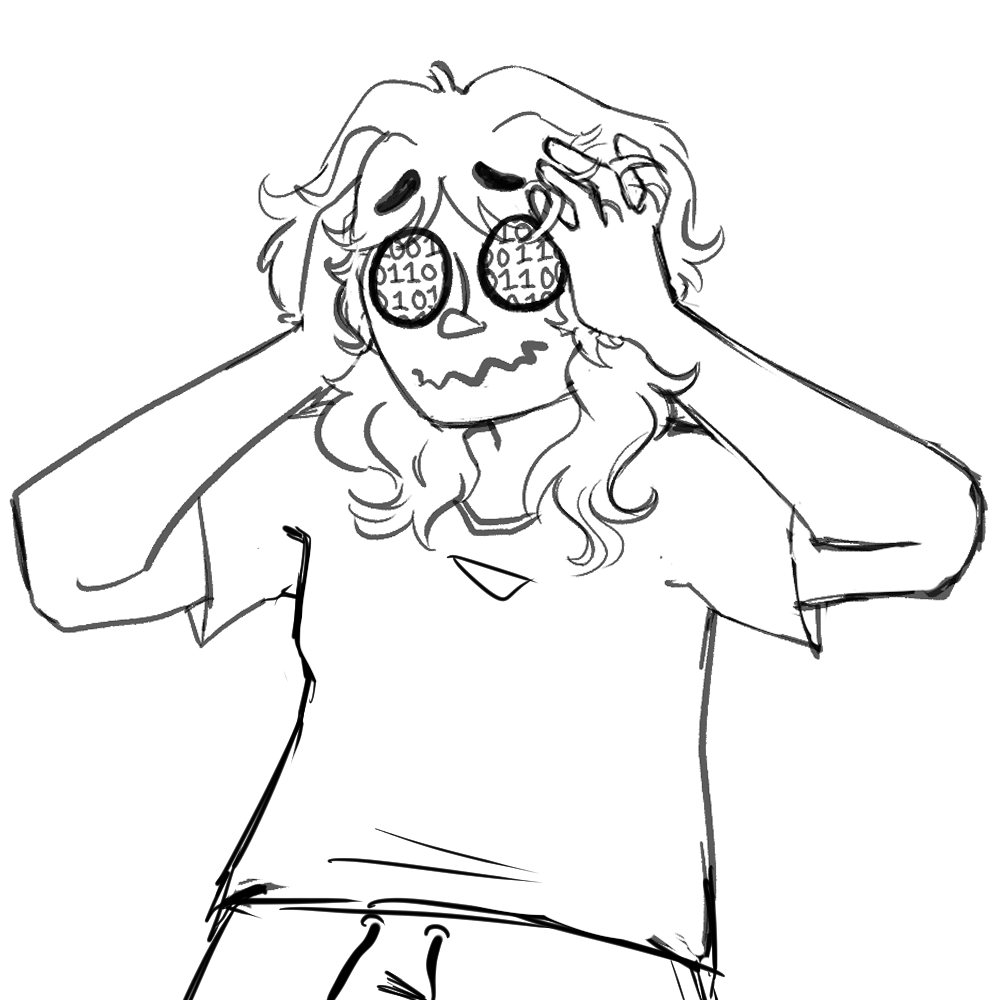
A quick self-portrait doodle I did today that describes my feelings regarding the ever-increasing presence tech has in our lives.

A nih.gov article from 2013 states that an ideal amount of screen time for the average adult should be no more than 2 hours per day. That figure just 11 years later feels completely impossible to achieve, almost like a funny joke. I could hit those 2 hours, 4 times over just working on one school assignment. I have a much more robust and stable social circle online compared to any friendships I’ve managed to foster in real life. My new car’s speedometer and tacometer are both on a digital screen. I can’t even lower my daily screen time when I’m driving. Something about that is kind of terrifying to me.

Continue reading
Hoe Phase

Hoe Phase

Why is it that when men sleep with multiple women or have multiple partners that its empowering and applauded, but when women decide to experiment and embrace their sexuality they’re shamed? Growing up I’ve seen the different ways that sexuality has a huge double standard. But I feel like as long as both partners are being safe and considerate, why does it matter who sleeps with who? It’s not like it effects anyone else’s life other than the ones involved, but yet someone always has something to say.

Girls are always told while growing up if you have multiple partners throughout your life time that you are of lesser value then someone who has waited to save themselves for marriage or someone that has slept with only one or two people. But in reality, just because you haven’t had as much experience it doesn’t make you any different than someone who has lots of experience. Sometimes women feel the need to experiment with their bodies, just like men do. Women just want to feel pleasure, just like men do. 

This generation of young adults are completely shifting the views on sexuality and what is now considered ‘normal’ and ‘acceptable’ and it’s amazing. But let me say this, no im not promoting people to sleep around, catch unnecessary bodies and to be unsafe because there are still things to worry about such as disease and unwanted pregnancy. All im saying is stop demonizing women that also enjoy sex and don’t want commitment. There are now female artists that talk about their sex life in their music, such as Nicki Minaj, Megan the Stallion, and Sexy Redd. But it’s not just about sex, it’s about female empowerment, it’s about women being able to express what they like and what they don’t like.

2 jobs, 1 degree.

2 jobs, 1 degree.

What about the “right-to-live?”

I remember when Jahi McMath died—for the second time. 

Senior year of high school, I came across an article about Jahi McMath, a 13-year-old Black girl who was declared brain dead after her tonsils were removed. It was Jahi’s first surgery, and she was scared. She didn’t want to go through with it, but her mom convinced her it would make her life easier (Jahi had sleep apnea, and removing her enlarged tonsils was intended to help). After speaking with the doctor, Jahi consented to the surgery, and she was fine for about an hour afterwards.

Jahi’s blood vessels were unusually close to the surface of her throat; the doctor had noted this in his chart for her, but the post-op staff was unaware. So when Jahi started coughing up blood, they didn’t see it as the alarm that it was, although Jahi’s family did. They repeatedly raised the alarms for her, but no one listened until her heart stopped.

Jahi was declared brain dead; her brain had stopped functioning due to the massive blood loss. In California, brain death is legal death. But Jahi’s family didn’t accept that. Her mother, Nailah, was convinced Jahi was still alive; Jahi responded to some stimuli and questions. Nailah asked Jahi if she wanted to be taken off life support, and Jahi said no through physical movements her mother taught her.

In the long legal battle that followed, Nailah and her family were forced to flee the state with Jahi under threat of legal action and jail time. Nailah’s insistence that Jahi was alive, and refusal to take her off life support, violated California’s medical ethics, so they went to New Jersey, where families can reject the notion of brain death on religious grounds—Nailah technically “kidnapped” Jahi to do this. There, Jahi had at-home around-the-clock medical support from nurses and doctors who were willing to lose their medical license or be shunned from the medical community; the doctors that treated Jahi were treated as quacks by the medical community. In the view of the community at large, you cannot treat a body that is already dead, and although Jahi’s body was not dead, her brain technically was. The California hospital where Jahi had been declared dead consistently disavowed the McMath family’s efforts and actively disparaged them for “desecrating a body.” But they were wrong.

With consistent care, and rogue researchers willing to look into her case, Jahi was able to exhibit signs of life, brainwave activity, and even underwent puberty. In 2017, a neurologist at UCLA independently confirmed that Jahi was no longer “brain dead.”

Jahi died—for the final time—in June of 2018, not even six months after the New Yorker article was published due to internal bleeding from abdominal complications. Despite overwhelming evidence, the hospital that issued Jahi’s death certificate refused to ever accept Jahi’s recovery and overturn her death certificate.

In 2020, I, much like Jahi, was preparing to go into surgery to get my tonsils removed for sleep apnea, just as she had been. Her name haunted the back of my mind in the days counting down to my surgery, but I, just like Jahi, spoke with my surgeon and asked him how many times he had done the surgery, what the risks were, how long he had been a surgeon. I had the insight that a 20-year-old had and a 13-year-old didn’t, but we were in the beginning of a pandemic, in the middle of the shutdown, and my mom wasn’t even allowed in the waiting room with me. Though I was nearly certain I would be fine (my surgeon routinely did much more complex and precise surgeries, like removing tumors that had grown into the blood vessels of the throat), I was alone when I frantically pulled the anesthesiologist aside and had to shamefully admit that I had been taking quinine pills until yesterday morning, a stupid superstition I had bought into as a way to stave off a Covid infection.

Quinine, for those unaware, is an herbal supplement that used to be used as a “cure all” back in the days of the Black Plague and the Spanish Flu. It didn’t work back then, but I’m a big believer in the placebo effect, and I needed to take something to put my mind at ease. One of the side effects of quinine—that I didn’t know until the morning before my surgery when I actually read the bottle—is that it can thin your blood. This makes you a higher risk for surgery; you’re more likely to bleed uncontrollably because the blood is much harder to coagulate. The bottle said to stop taking quinine two weeks before surgery. Feeling like I was going to cry, and possibly even about to die, I waited anxiously to be taken back and prayed that I would wake up afterwards.

Obviously, I did, or I wouldn’t be writing this right now. But I’m aware how lucky I was, and am. Jahi’s case is in direct opposition to Terry Schiavo’s: Terry Schiavo was a White woman declared brain dead who the hospital refused to stop treating, whereas Jahi was falsely declared brain dead and refused further treatment. Jahi’s family noticed this too; they knew if Jahi had been White, she would have likely received the attention she needed, and even if she had still been declared brain dead, her family’s choices would have been respected. Having come after both of them, and being light-skinned myself, I know my family would have had the respect and space they needed to make whatever decision for me they felt was right if my surgery had gone wrong.

Still, it haunts me; Jahi’s story is barely told outside of fringe medical pieces, but Terry Schiavo’s is well-known enough to be casually referenced in feminist writings. Who gets the right-to-live? Who is allowed to die? Why are our bodies’ needs and wishes ignored depending on the kind of body we inhabit? I hope Jahi is resting peacefully now, but I carry the anger and fear of what was allowed to happen to her.

Existential Ballet

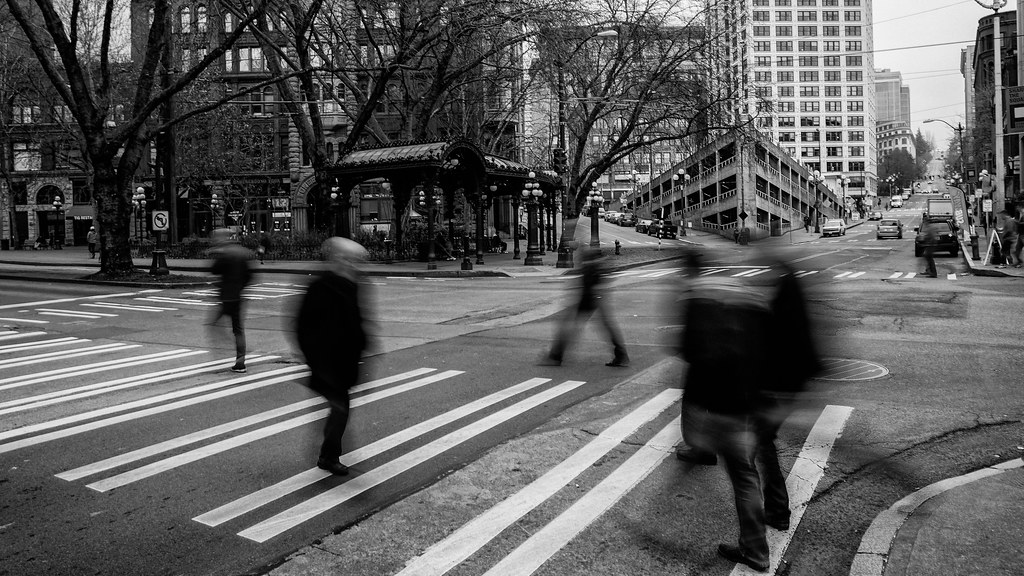
Black and White Stock Photo of busy pedestrians in an urban city.

Bent, Bashed, Broken… I am nursing my own wounds.

I am stretched out wide but still I am shrunken & overlooked.

Sitting on a throne above the heads of many yet I look each of them in the eye.

I wipe their tears & I hear their cries.

They all want to know the secret of my dances.

Why choose to survive when oppression’s vice grip breaks my bones?

Why does my heart continue its dances?

How do I keep up when the earth never stops spinning while dancing rewinds the clock on my face?

The dances that define my divinity burn within a soul that sings the songs & rule the time.

In that time, wherever I stand that space is mine.

It’s there where the dances are done, & in that space my soul’s songs are sung.

Spinning and Swirling I reach high with hopes of experiencing a new feel & don’t worry, I will.

A remarkable existence if I must say.

An adaptive sway for the intimate encounters that pass by my way.

These are the same dances done by the fire’s flames.

I waltz the same waltz that puddles waltz when it rains.

My tears are called resilience & my beads of sweat are named endurance.

You can master the secret of my dances. Watch me give you reassurance.

The messages might escape you but it’s not of your choosing.

The secret to my dance, is to just keep moving.

A monstrous matryoshka

As I had read Susan Stryker’s article on trans rage and the comparison of Victor Frankenstein’s unfortunate monster, I found myself following each word closely. I had so rarely seen anyone talk so openly about the pains and sorrows that are hidden about transgender identity. The discussion in class presented an extremely important point on who is allowed to show and vocalize strong negative emotions like rage and pain. As a person of color, as a queer and transgender individual, my permission of showing these emotions has been quite small, but looking further inward I know that there are other reasons I am not one to show these emotions. For my last post I call upon Stryker’s voice of these negative emotions and a monstrous identity, but not for my transgender identity, but one I am coming to terms with existing within me. I open up the physical patchwork body of mine to see inwards, within the darkness I see a cage chained to the ground. Moving closer I can hear the rattling of anger, I peer inside the cage to see a gnarled and patched up figure, teeth unnaturally pointed and sharp objects partially embedded in its body. I instinctively know these objects were brandished weapons with the purpose of subduing and killing this figure, but they have failed. This figure was human once and I can’t help the sadness I feel seeing what has become of them.

“What happened to you?” I ask cautiously.

The pause feels deafening.

“I’d think you’d recognize us, not many come back from the war of trauma unscathed.”

It’s said that what doesn’t kill you makes you stronger, but no one should be forced to be this strong to the point of being caged in fear.

As an echo to the original article, my comparison of monstrous identity in regards to trauma is not one to be used against all who have trauma. This is my sole reclamation of my past and should never be used against individuals who do not wish to do the same. This post will include raw calls to mental health happenings in response to traumatic experiences. Though there will be no details of happenings, there are insinuations of abuse on varying levels.

Continue reading

Excerpts from my investigation into disability on campus

The following is a series of excerpts for an article that I wrote for The Retriever that was published on Wednesday. (Below is from my original draft, some changes have been made in the final version for newspaper formatting.) If these tidbits interest you, you can find the whole article in print on campus now!

UMBC, I have a challenge for you.

Administration, Student Disability Services, and Facilities all tout the campus accessible routes map as the end-all, be-all solution for disabled students navigating campus. My challenge for you is this:

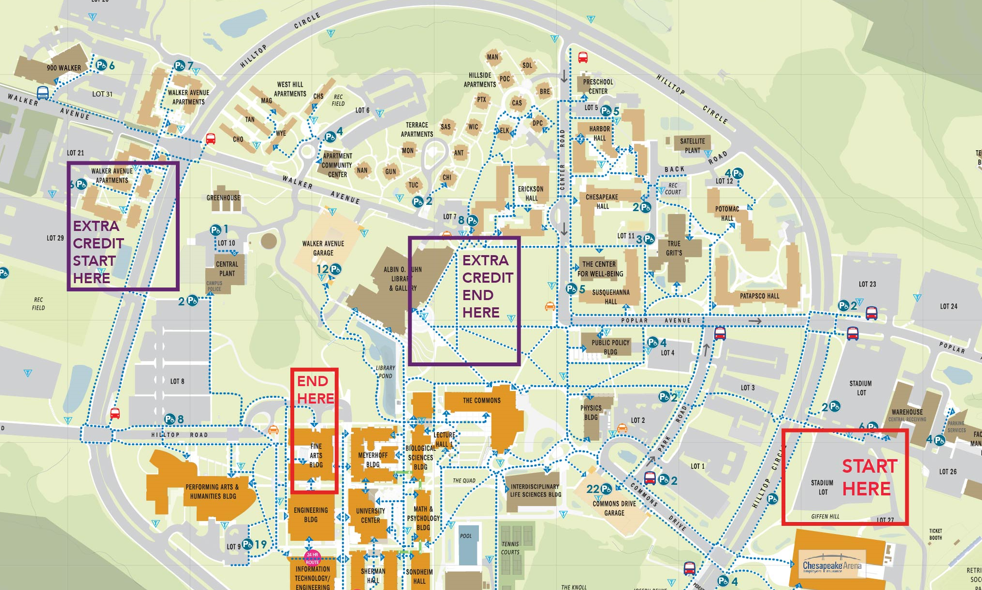
Make your way to the stadium lot, and then walk to the Fine Arts Building using only routes labeled as accessible. You are not allowed to use stairs, though you may use the short cuts available through buildings via elevators.  (The elevator short cuts are labeled on the map below.) For extra credit, start at the top of the hill near the Walker Apartments and go to the library.

I have marked the destinations for you below. The full map is available here: https://about.umbc.edu/files/2021/09/2021-UMBC-accessible-routes-map.pdf

A map of the UMBC campus.  The original overlay is a set of dotted lines indicating accessible routes.  A second overlay has been added demarcating "start here" and "end here" routes of particular difficulty.

While you are walking, focus in on your body. Ask yourself: What would this walk be like if my calves were screaming in pain? What if I struggled with balance and were prone to tripping on uneven surfaces and could fall?  What if I were using a walker right now? What about a non-motorized wheelchair?

What about crutches, or a lower-limb cast? When you arrive at your destination, take a note of the time. How long did it take you compared to using the stairs? Did you have to use a new route compared to your ordinary routine?


It was disclosed to me by several students that after they met all of the (stringent and privilege-laden) requirements to receive an accommodation appointment with SDS, they are told they will be unable to get the accommodations they need. In addition, it has also been reported to me that these meetings are often negative in nature with the student seeking accommodations being met with derision and/or hostility for their accommodation requests. One student, who wishes to remain anonymous, reported being “refused note-taking assistance because they needed to ‘learn how to take notes themselves,’” as well as being refused alternative text formatting as that is up to the teacher and “they cannot do anything about it.” The student accurately pointed out that both of these accommodations are among the published list on the SDS website. Another anonymous student trying to receive accommodations was told, “I know migraines can hurt sometimes but that doesn’t mean you can miss class.”

Many of the interactions that were shared with me have a common thread that is heard all too often by the disabled community: “You’re just not trying hard enough” or “It can’t be that bad”. The implications that we are lazy, that we haven’t developed strategies to succeed in our classes, or that we are somehow exaggerating our health problems are not only outdated ways of thinking about disability but are also extremely harmful.  The reality of our lives is that it frequently is “that bad,” and that we wouldn’t be asking UMBC for help if we hadn’t already exhausted all of the resources available to us as individuals.  To hear these words from the people put in place to help us succeed is equivalent to lifting us up only to kick us back down. UMBC is not the only institution in Maryland struggling with this problem, as this article (https://www.jhunewsletter.com/article/2021/08/disability-isnt-taken-seriously- at-hopkins) written by a graduate student at Johns Hopkins details out. Laurel Maury was awarded accommodations by JHU but found that her professors refused to use them (even under threat of legal action) and some went as far as to bully her for having them. Maury’s struggle echoes many of the sentiments that have been expressed to me by current UMBC students.


To my fellow disabled students: You are not alone, you have a voice, and your voice deserves to be heard.

untitled thoughts

Floating Steven Universe GIF - Find & Share on GIPHY
steven universe drifts away into a canopy of yellow stars and a pink and blue sky

Lately, I’ve been realizing just how challenging it is to recognize my own harmful habits and ways of thinking, interrupt them, and embark on a healing process.  Although something like this has happened several times in the past, it only took a few deadlines and assignments to launch me into a spiral of over-analysis, self-criticism, anxiety, avoidance, and distraction.  All the while, I felt powerless to stop this process, and I really hate that!  

You see, what I had been struggling with up to that point was a couple papers, a presentation, replying to emails, doing weekly readings and assignments; all pretty mundane tasks, but ones that can feel like mountains with impossible summits some weeks.  Even so, as I start to slip and fall behind, one part of my brain reassures myself that I’ll catch up on everything “over the weekend,” no problem, without the need to ask for help or communicate in any way.  Another part is already recognizing the warning signs, pointing out my flaws, and criticizing myself on where I need to do better.  The most destructive side deals with all this noise by shutting down completely. Sleeping in until 3pm, skipping meals and classes, being anxious to leave my room, neglecting self-care, and raking up my screen-time on Genshin to do nothing but avoid, avoid, avoid, avoid has indicated there is a bit more than academic stress below the surface.   

Continue reading