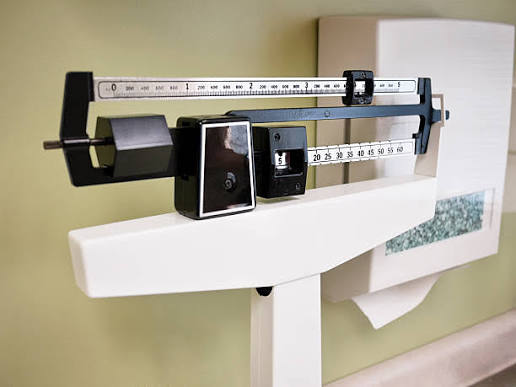
Every doctor’s appointment I’ve ever had starts the same way: shoes off, step on the scale, wait for the number. Then comes the math, height and weight run through a formula, and out pops a category that somehow gets to speak for my whole body before I’ve said a word.
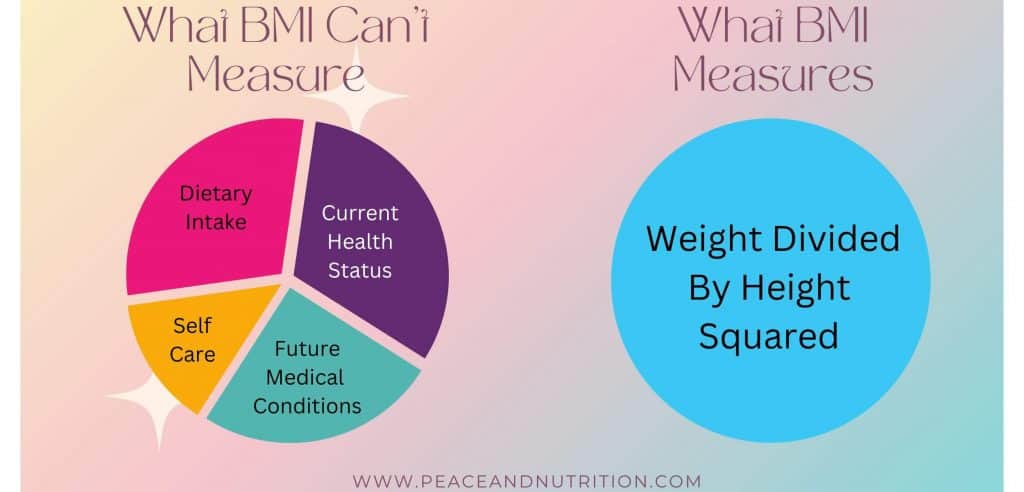
That “formula” is BMI, and what I didn’t know until I started digging into it is that it was never built for this. It came from a Belgian mathematician, not a doctor, who was trying to describe the “average” person across a population. It was never meant to size up one individual. It only really became a go-to health screening tool in the 1970s, which means we’ve been leaning on a very old idea for a very personal question.
What gets me is everything it can’t see. BMI can’t tell muscle from fat, where weight sits on the body, or how someones heart, blood sugar, or sleep are doing. Someone can land in the “overweight” category with perfect bloodwork while someone in the “normal” range struggles with nobody checking. In 1998, the cutoff for “overweight” was lowered, and millions of Americans were reclassified overnight without a single body changing. I started thinking about BMI as a photo taken from too far away. It’s fine for a crowd, but useless for a face. It gives you the outline but completely skips the person, and then we act like the outline is the whole story.
So why do we keep treating it like a verdict or something thats so final? I think its because a number is easier to read on paper than a person.
And until that changes, a lot of people will keep walking out of appointments feeling measured, but not heard.
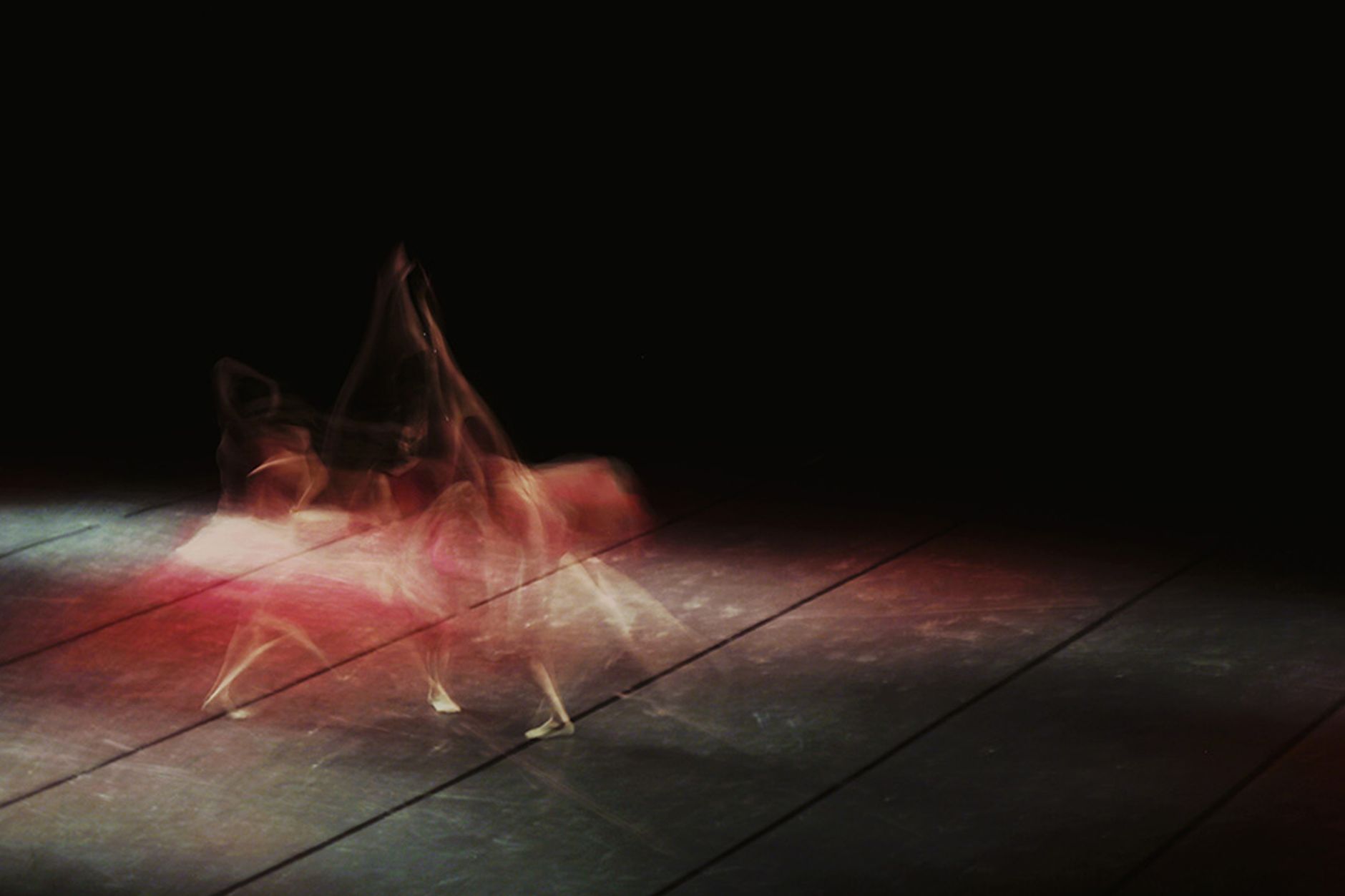
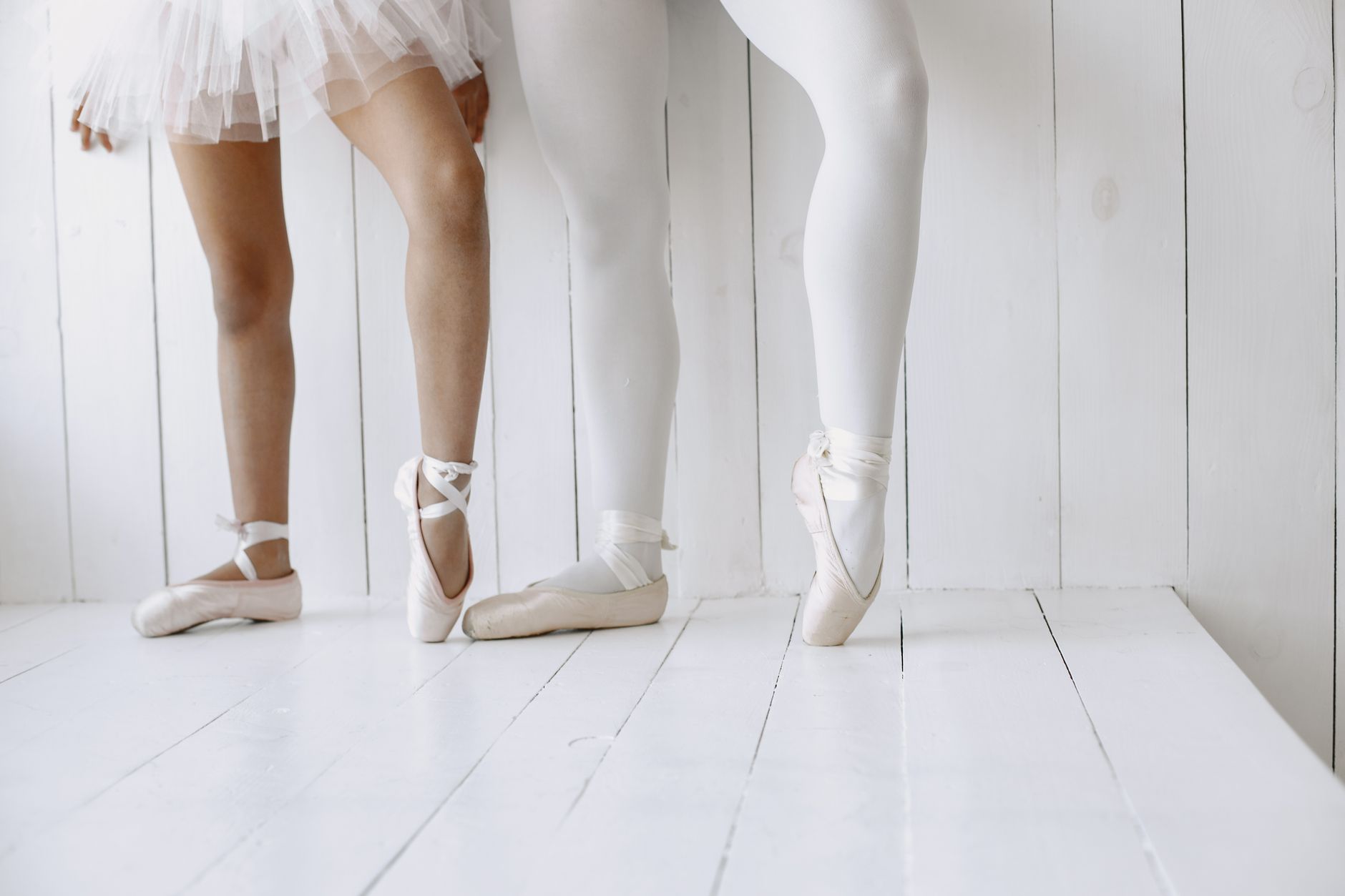
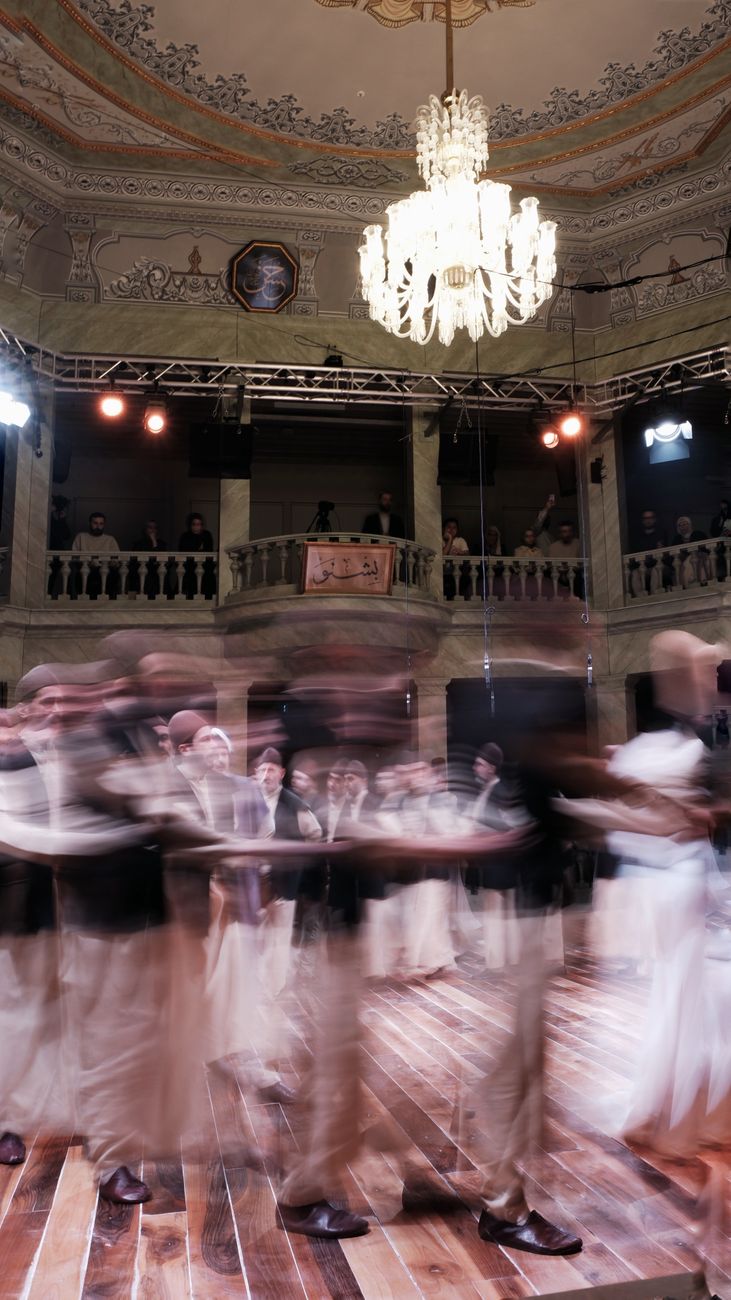
Picture dancers behind a pop star at a concert, they are moving as one. They have matching outfits, hair styles, and builds. Different images of them may conjure given the minds of each individual, especially given their identity. From a more dominant Western perspective, one may think of people who are relatively skinny, muscular, and occasionally of different body types. There may be a semblance of diversity scattered through the row of dancers, but this can be infrequent depending on where you look. This is a pattern that shows up at concerts or more generally, stage performances. This isn’t a criticism on a singular performer or production but rather a reflection of the music industry and what dance as an art form and how it has taught people what to define as a “good” dancer. Dance fundamentally treats symmetry, synchronicity, and sometimes looking identical while dancing in tandem as the way to achieve “true” performance. This belief doesn’t appear from out of nowhere. Dance in classical forms awards a limited body ideal and the industry just keeps rebuilding it.
Me in the back, my sister to my side, my brother to my front, and my older sister at the head of the table.
The same seating arrangement had been done by me and my siblings for years at dinner, for as long as I can remember. So a few years ago when my father started yelling about our seating arrangement we all stared at him in bewilderment. He was adamant that my brother and older sister switch. Me and my siblings shared glances that said,
“It’s a chair.”
“Is he serious?
We promptly ignored him for the following days. At least we did, until he angrily came downstairs and stood there yelling until my sister and my brother changed places.
Okay.
He was serious.
I can’t say I was truly surprised. My parents have values based in Catholicism and their idea of “Nigerian culture”. Through this, I was taught many things that a woman should be, how they should dress, speak, act, present themselves. As I grew older and began to think for myself more, I thought I had grown out of that mindset, the “ideal” presentation of femininity. However, through various readings in my Gender and Women’s Studies courses, particularly Throwing Like A Girl by Iris Marion Young, I realized I don’t exist nor was raised outside of society. Though it is possible to not fit into society’s expectations, so much of my physical body has been shaped by my womanhood, squishing inside of myself as a man spreads his body wide while sitting down or shuffling out of the way when a man is walking in the same direction as me. There is a lack of confidence instilled in me I wasn’t aware of. I realized then that many people refer to femininity as a presentation, an act. While true, I also see it as a body, not in an aesthetic way but one that is formed through others words and actions. Women are not taught to be fast, not told they can be big, shown it is not right to be strong. So they shape their bodies, mold them, transform them anew. To be slower, to be smaller, to be weaker. Words echo in their ears, words like,
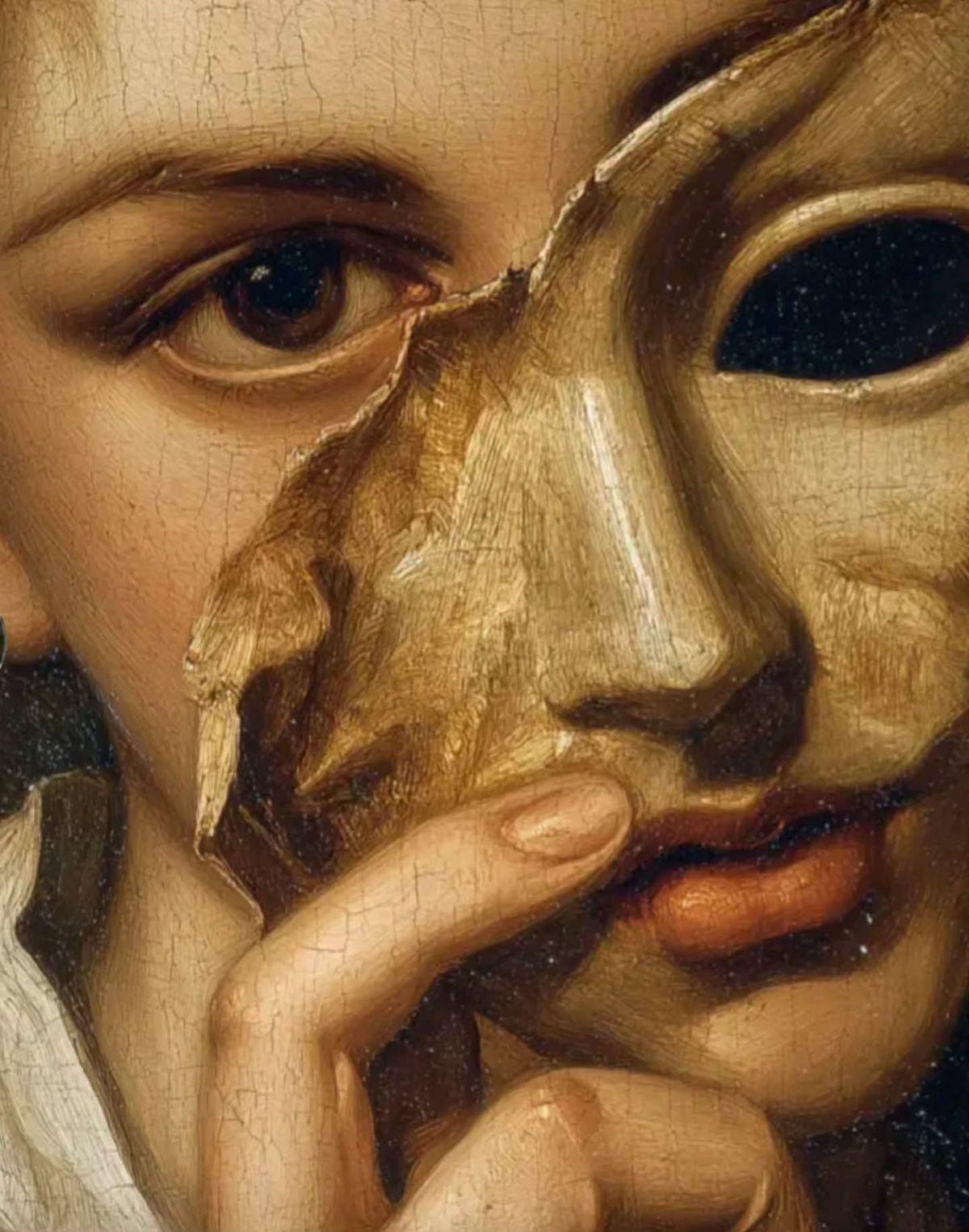
The image portrays an old oil painting displaying a figure holding up a broken mask to their face.
In our earlier lessons within class the question of “are we our bodies?” was discussed. Of course the general response was no, we aren’t. Our bodies are a vessel for our minds, they carry our dreams, fears, beliefs, personalities, and so much more. However, if people are so much more than the body why does it seem like it is such a determining factor in our lives?
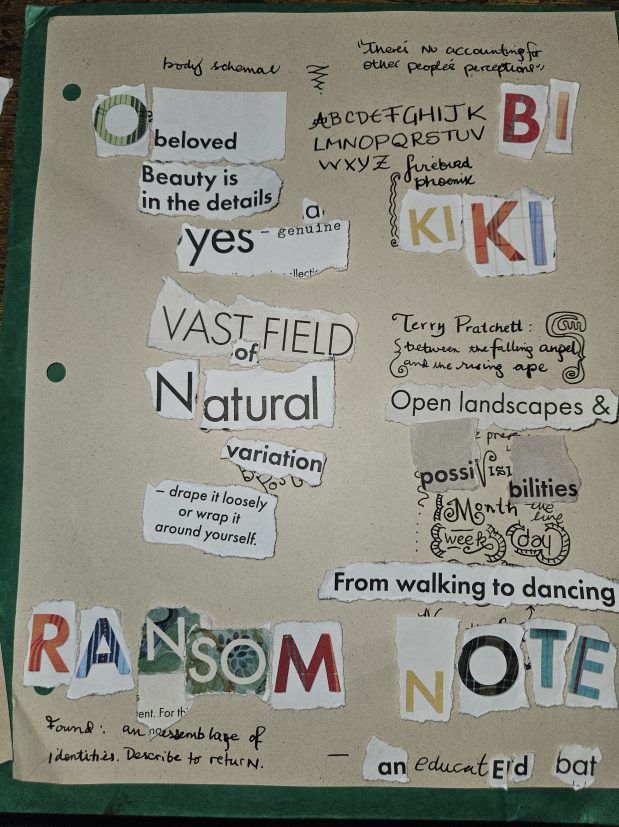
Each person lies within the spectrum of natural human variation, both unique and within a widely-diverse continuum of bodyminds. As this is the case, nothing seemed more appropriate for discussing body schema and the intersection of identities than a literal assemblage piece — layered and gathered letters, words, and phrases. All of the magazine lettering was torn from a single fashion catalog and was completed in one sitting, laid over the handwritten notes I had so far taken for this post.*
I would love for this to be all I wrote about it, but as it’s academic work and also because alt-text is access, there will be unpacking.
In “Throwing Like a Girl,” Iris Marion Young defines femininity as “a set of structures and conditions which delimit the typical situation of being a woman in particular society as well as the typcial way in which this situation is lived by the women themselves.”
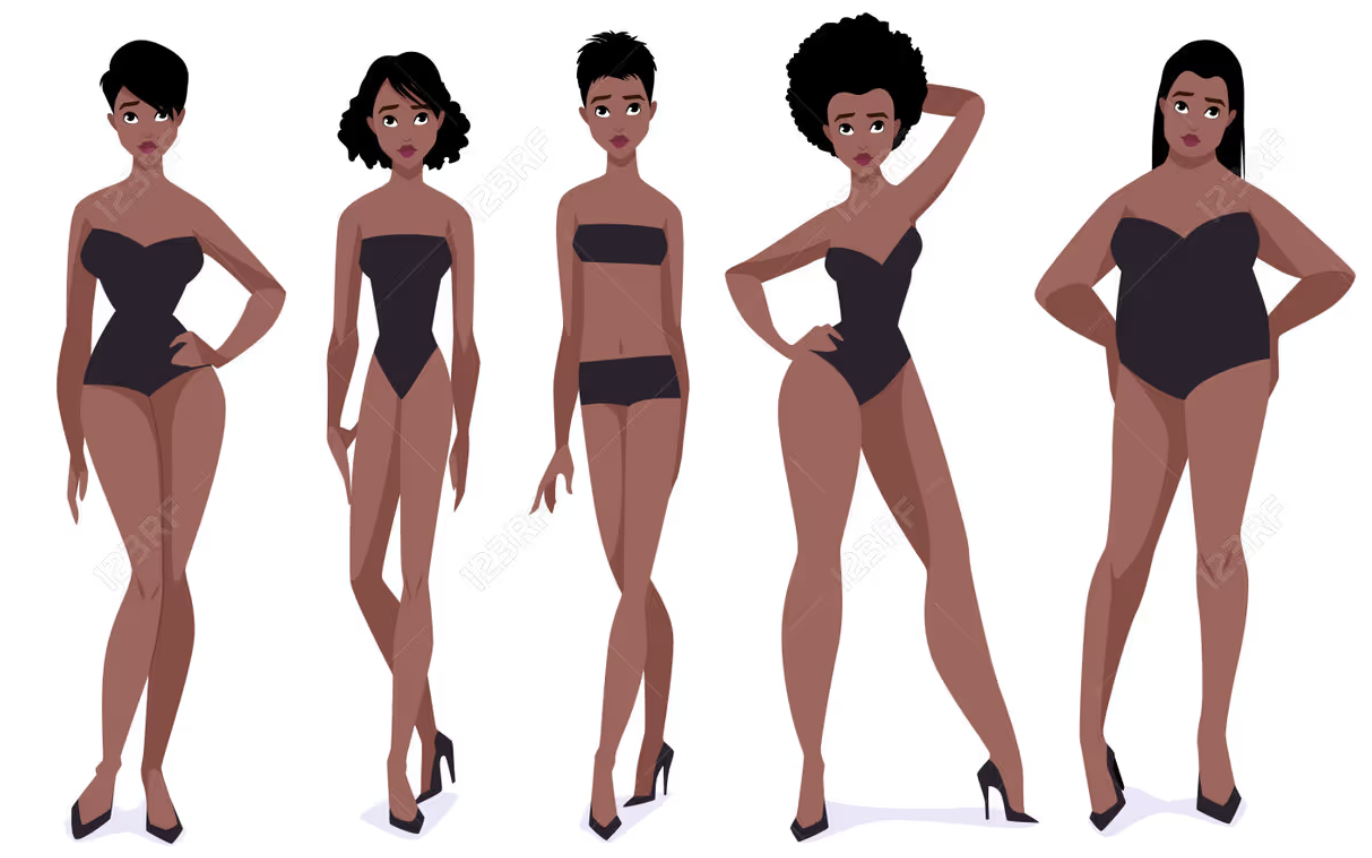
I really began to think about how femininity is shaped by structures and conditions, but also how women in various cultures may experience and utilize these conditions. I also began to think about my experience as a skinny black girl and how my body is viewed and discussed based on the audiences age. I was stuck in between two expectations. My younger peers would make comments about growing my glutes to achieve the “slim thick” figure. At the same time, older women will tell me to enjoy my skinniness (as if there was a timer on my body) because the day was coming when I’d be in their position; Reminiscing of the slimness they once had. Both comments are different, but they both make me think about how my body is being measured against expectation of how a woman’s body should look like. I question the root of where did the expectations come from and at what point did they change? The ideas of what a black woman is supposed to look like has influenced how I see my own body. To the point where I start to ask myself, “well which side of the spectrum should I strive to be on?”
Young’s definition helped me see that these experiences are not just a desire to look a certain way. It is a larger social condition that is shaped by what other think black women’s bodies should look like. The pressure to be “thick,” gain weight, and enjoy my body before it changes all shows how femininity can shape the way women understand and experience their own bodies.
TW//mentions of SA, porn addiction, objectification
One thing that really stood out to me in Throwing Like a Girl is how Iris Marion Young criticizes bioessentialism, which is the idea that men and women behave a certain way because it’s just “biology”. She shows how people explain things like throwing differences as natural, when they’re really learned through social expectations. It is similar to how people perform worse due to the stereotype threat, which is when minority groups tend to underperform on tests because they believe that they are not capable of performing well, leading to a self-fulfilling prophecy.
I think that same logic of “inherent” or “biological” behaviors can be applied to how men justify watching porn by saying “men are visual creatures”, which is not based in fact at all. That phrase is so harmful because it makes it seem like objectifying women is unavoidable, instead of something that men are choosing to participate in.
Porn is extremely dehumanizing because it turns people, often women, into objects meant to be looked at, not individuals with complex life experiences who have their own agency. Young talks about how women are taught to experience their bodies as something to be watched and judged, rather than as something they fully control. Porn takes that even further by reducing women to their body parts and presenting sex as something women exist to provide. It trains people to see women’s bodies as products rather than as a part of an intimate and sacred human interaction.
The idea that porn allows people to “buy” consent is disturbing on its own as well. Consent in porn is always available and detached from real emotional or physical consequences. Sometimes consent can even be depicted as NOT freely given, and disrespected, as part of r*pe fetishes. Humans were never meant to have instant and unlimited access to sex like this, and pretending that it’s just “natural male sexuality” ignores how artificial and extreme this level of access actually is. The harm doesn’t just affect the person consuming porn, it impacts the women in it, who are often exploted, and women in the modern dating world that have to deal with unrealistic expectations and porn-driven violence and entitlement.
Just like Young argues, bioessentialism isn’t harmless. It is used to excuse behavior that causes real harm by making it seem inevitable, and vanishing accountability for those who are engaging in them. Saying “men are visual creatures” works the same way as saying “girls throw like that”. It hides socialization behind biology.
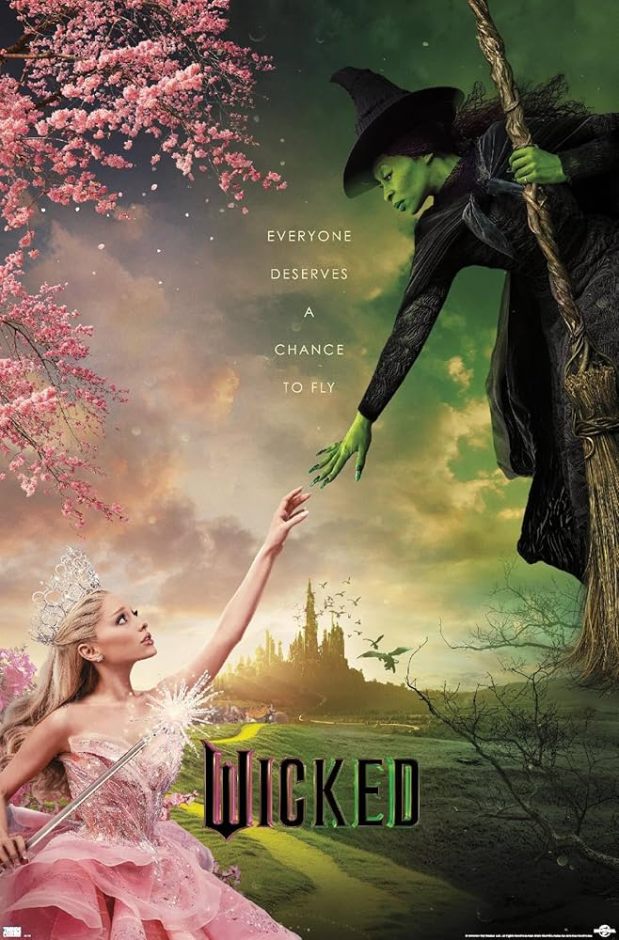
You don’t have to watch Wicked to know its famous line—“No one mourns the Wicked”—which basically means that some people aren’t worth grieving. This kept echoing in my head when I heard that both lead actresses of the Wicked: For Good film recently tested positive for COVID.
According to a recent Guardian article, “Both Grande and Cynthia Erivo tested positive for Covid during the filming of the first movie, temporarily delaying production. Erivo reportedly contracted the virus days before shooting the climactic first-act number Defying Gravity, while Grande tested positive before filming the song “Popular.”
The same article notes that during the current press tour Ariana Grande again tested positive, forcing her to miss several events.
That news made me think of Mia Mingus. In her blog “You Are Not Entitled to Our Deaths”, Mingus challenges the idea that disabled or sick bodies are disposable and that those lives aren’t worth protecting or grieving. After reading this blog and our discussion in class, it made me remember hearing about the Wicked news. It made me realize we’re acting like COVID is just a production hiccup, an inconvenience to filming or press tours, rather than the ongoing threat which is killing and disabling countless people. The fact that both leads got sick, during filming and promotion, yet the media and public reaction centers on delays, missed appearances, and disappointed fans speaks volumes.
There’s something horrifyingly Wicked-like about how illness is framed now. If someone masks, they’re “paranoid.” If they don’t appear for a photoshoot or premiere, fans complain. When someone gets COVID, the conversation is about wasted money on promotion, fan backlash over missed premieres, or travel delays , but rarely about health, recovery, or the toll illness takes. The framing treats sickness as a hiccup, not as human suffering. It treats the sick body as a burden to the show, not as a person in need of care.
“Grande’s positive test was the latest hiccup for the full-court Wicked press blitz that has seen the cast hop continents by the day. Due to flight delays, Grande was unable to make the premiere in Brazil, triggering fan backlash she also addressed on her Instagram.”
That is exactly the kind of abled entitlement Mingus warns about: a culture that assumes certain bodies can and should be sacrificed for convenience. Under this logic, “the show must go on,” regardless of who gets hurt. The Wicked cast situation isn’t just celebrity news, but it’s a reflection of a larger societal pattern where health, disability, and our shared vulnerability are minimized, ignored, or erased entirely.
What’s even worse is how normalized this erasure has become. COVID has become “another thing,” something to power through so cameras and promotions stay on schedule. Workplaces expect people to show up sick. Students are told to push through fevers. Long-term effects are brushed off as “just fatigue.” Public health infrastructure? Largely forgotten. Masks, ventilation, testing are all optional. People who get sick frequently or live with chronic conditions are expected to adapt or be pushed aside.
Mingus doesn’t just name this as negligence, she instead frames it as violence. When we treat care as optional, when we prioritize productivity over people, when we mourn canceled premieres more than lost lives, we are making a statement about whose lives matter. We’re deciding who gets protection, who gets grief, and who doesn’t.
We shouldn’t act like the pandemic is over. We need to stop shrugging when someone gets sick, framing illness as inconvenience, or acting like the only thing that matters is the show going on. Production, entertainment, or convenience is not more important than actual human lives. Because if we care at all about disability justice, about valuing every life, then we can’t pretend the pandemic is done. We have to mourn the sick. We have to fight for care. And we have to stop believing the myth that pushing on by ignoring risk, ignoring illness is normal or acceptable.
“If you don’t respect yourself and you don’t demand what you believe in for yourself, you’re not gonna get it.” -Judy Heumann
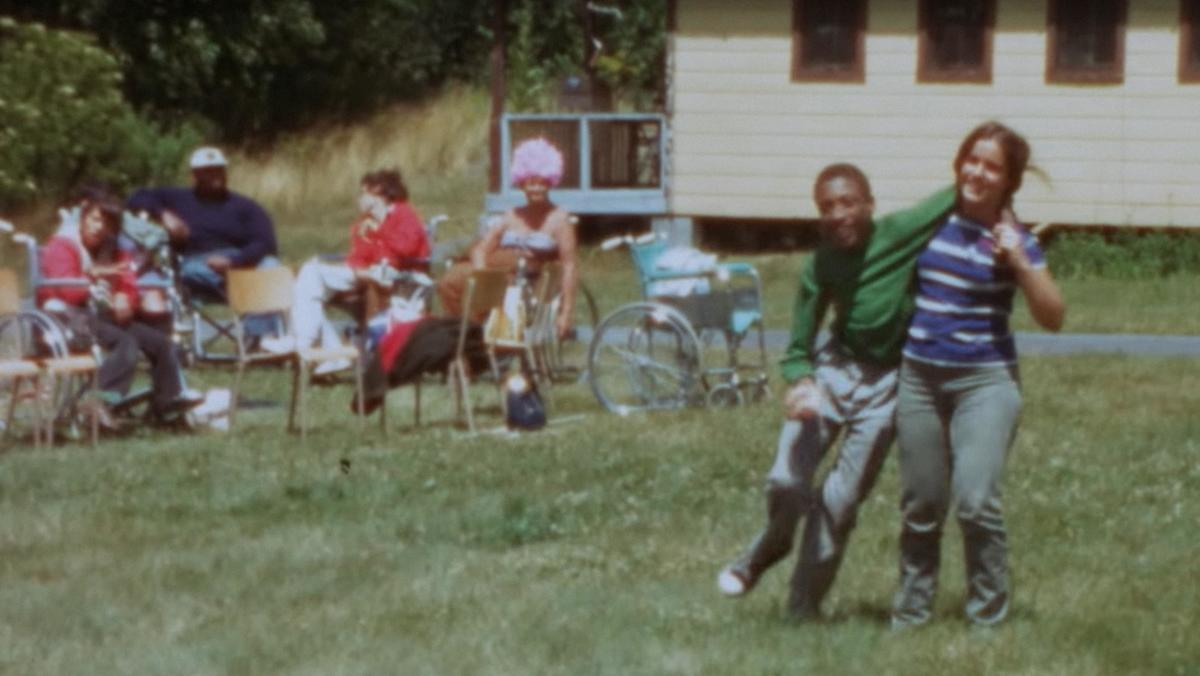
A photo taken at camp Jened. In the foreground to the right are two people, one of which supports the other via an arm slung around the neck. In the background are four figures sitting in wheelchairs.
An accepting environment is the backbone to an unfractured society. For marginalized communities, the opportunity to exist wholly – to present as you wish to without masking, trying to fit in, to just be without fear of discrimination or worse – is few and far between. Camp Jened was a safe space to meet other people who knew the struggle of living in a world that is majorly inaccessible; some campers even stated that it felt like a second home to them. For Woodyard, it was one of exposure, a different way of living than he’d known in Alabama. LeBrecht explained feeling as though he had to fit into a world that wasn’t made for him. O’Toole told about how she would pretend to be able-bodied, hiding her cane under the couch. The weight of masking’s burden remains unknown until you no longer have to pretend. Only once that weight is removed do you realize the damage its done, yet how freeing it feels to live without it.
Heumann, explaining how she took special education classes that were in the basement of her school, stated that “in some way, even when we were that young, we knew that we were all being sidelined”. Similarly to Heumann, I also took special education classes in high school. My experience with them was quite frankly horrible and my teacher brought students to tears multiple times due to a short temper with questions regarding the material. Jened was empowering: an environment curated specifically with those cast to the sidelines in mind, encouraging them to raise up their bat and knock able-bodied expectations out of the park. A topic discussed amongst the campers in the film was parents. One camper expressed distaste for her parents’ overprotectiveness, and another raised that many parents often wish to conceal the disabledness of their child out of fear. The coddling you face as a disabled person is endlessly frustrating, and when you speak out about it, you’re likely to be told that “well, it’s coming from a place of love, so you can’t be mad”. A parent should of course protect their children, but there is a line between protection and infantilization, and too often does it cross the line into the latter.