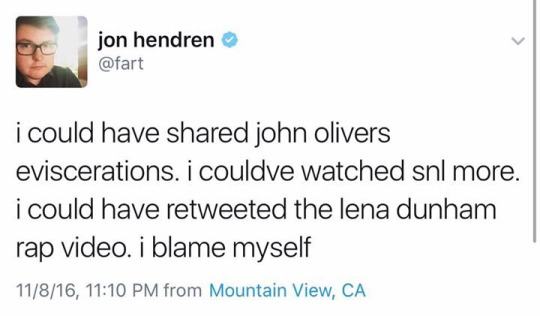
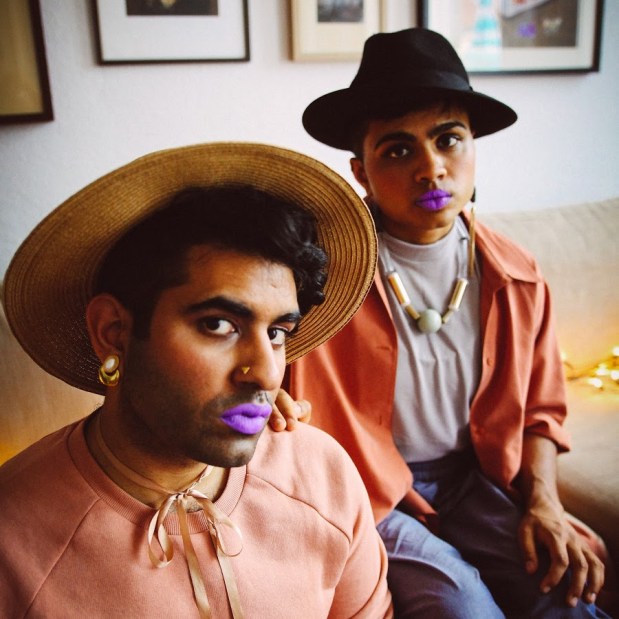
Have you ever seen a content creator who is trying to find an outlet? Next, you may go into the comments to write something nice and supportive, seeing others doing the same. Your heart warms as you read these messages to scroll further and see a hateful comment. You see replies that are validating them. It makes you realize there really are people who take their time to put down people instead of clicking not interested in moving on with their day. You even go ahead and click on their page to see that there is nothing posted. Someone is hiding behind a screen, doing nothing productive.
I’ve always thought being a content creator takes a lot of courage, no matter if you’re page is about sports, politics, gender identity, mental health, etc. People are making content to connect, relate. All the people I personally know who make content do it to show others that there are other people like them. Whenever you see someone who posts something that you relate to, you like it, and it kind of brings a sense of community. You see all these people on the internet who also relate to what you may be going through, what you believe in, and it can heal some insecurities of maybe being a “freak” or “too different.”
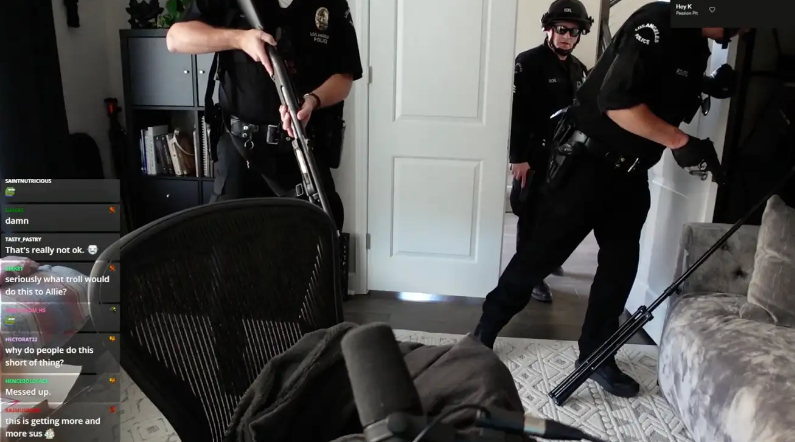
In “Nonbinary: Memoirs of Gender of Identity,” one specific chapter from Jeffery Marsh titled “Life Threats” really made me think about this concept; the courage to be seen on as big a platform as social media is. You are putting yourself out there, making yourself visible to all types of people, knowing that you have a chance of facing backlash that can just blow up in your face. Those same people who may write those hateful comments might have enough passion to even put you in danger. A specific example that comes to my mind is when streamers get “swatted.” They take this extreme step to prank them even though it is not a prank and is a traumatic experience. Especially because the people who are calling the police on them don’t really know what they’ve experienced and what toll it could take. These streamers are spending quality time entertaining people just to be put in danger.
I wanted to talk about my family friend’s son named Shaun. I’ve known Shaun for a while, he was really young when I met him, I was still young however, in my middle school years I was still learning things. Shaun, along with his brother Stefon were autistic. Whenever it came to the family parties I would be the one to watch over them and keep them company since I was still young and couldn’t be a part of the adult or even the teenage conversations. Shaun was an interesting kid, although he didn’t communicate verbally with words, I felt like I could still understand him and what he needed. I felt like I could understand his emotions.
Shaun would always get in trouble for breaking things, but I knew it was him just stimming because that was one of his habits. I remember during a Christmas party he grabbed one of the ornaments from the tree and smashed one to the ground, and then another, several times until he was stopped by his mother. Shaun got in trouble with his mother. I felt bad for him, I knew he wasn’t doing it to make anyone mad, yet his mom did get mad at him for doing it anyway since it wasn’t his house. She looked defeated, like she didn’t know how else to help him whenever his behavior would get worse. She looked tired too, like she was doing everything she can to just enjoy her time at the party and also watching her boys making sure they didn’t break anything or do something dangerous. My parents loved Shaun and his brother, my dad always made an effort to let Shaun be seen, playing with him, making jokes and funny faces. Whenever Shaun was with me, I tried my best to entertain him, to make him feel heard. He always had a fascination with my hair (back then I used to have hair that would reach the floor I had to keep it in a braid since it was so long, I’m not kidding haha) so every time we sat in a room to calm him down he would touch it and slowly begin to settle. The way he felt my hair and stared at it gave me a sense of comfort knowing that I was there with him making sure he was okay. He would hum the majority of the time, whenever he wanted something he would hum in a pattern and point at the object that he wanted. Shaun never had good focus either, after touching one object he would go onto the next and then the next. Shaun’s mom works with other children who are autistic, whenever she would come to these parties, she would bring books for them to read, I would read the books to Shaun and his brother. Shaun was always mesmerized by the images in the books, he would hum and point at the characters. He always made me feel like whatever I was doing was helping him and that gave me a deep sense of reassurance.
Sean was very excited about noises but more specifically with car keys. Whenever it came to these parties or Mass services because we do services in different people’s homes, Shaun would actually find people’s keys and take them and play with them because he loved the sound of the jingling. My dad didn’t care, he would give Shaun his keys so he could be happy and play with them. Of course he didn’t know any better because he didn’t understand the ownership of somebody’s property. I always felt like the adults who would get their keys taken away wouldn’t truly understand how happy it made him. They would just get a little frustrated because of the fact that their property was taken away from them. I definitely think being in middle school and being exposed to that environment where somebody has a disability made me confused at first because back then I didn’t know the true meaning of autism and the levels and how there’s a spectrum. I only got to see the behaviors and patterns of somebody with it during that time, but now being an adult and learning more about autism and neurodivergence I slowly start to understand Shaun and his behavior. He just wanted to be understood because of his different way of thinking. Unfortunately due to family issues in the past I haven’t seen Shaun in a while but I hope right now since he is older that he’s getting the proper care and going through a more suitable way of teaching for him to understand. I really do think Shaun is a good kid.
I just feel like people are always afraid to try to communicate with people who have this disability because they don’t understand the way autism works and the levels of the spectrum. Every time I see a child with autism, or introduced to someone, I am never afraid to interact or learn from them, because with Shaun, all I ever did was make him feel heard and safe, and I want to do that for every other boy or girl who has autism. Society likes to put this negative connotation and label of people with disabilities which to me is just undermining their true potential and power, I learned a lot from Shaun and my other experiences after that, and seeing how their minds think and interact made me open my eyes to a whole different concept of learning and understanding. I learned more patience, I learned to really slow down my “normal” thinking and try and fit their perspective into my life. Doing that type of thinking really does open up your mind to a lot of ideas and thoughts. I am thankful for Shaun and the way I made him feel comforted and cared for, that’s something I won’t ever forget. I do know his parents were really good when it came to teaching him, but just like Shaun and other kids who have it I hope the world is able to see that there is nothing wrong with them they just have a different perspective which isn’t and shouldn’t be seen as a negative thing.
The following is a series of excerpts for an article that I wrote for The Retriever that was published on Wednesday. (Below is from my original draft, some changes have been made in the final version for newspaper formatting.) If these tidbits interest you, you can find the whole article in print on campus now!
UMBC, I have a challenge for you.
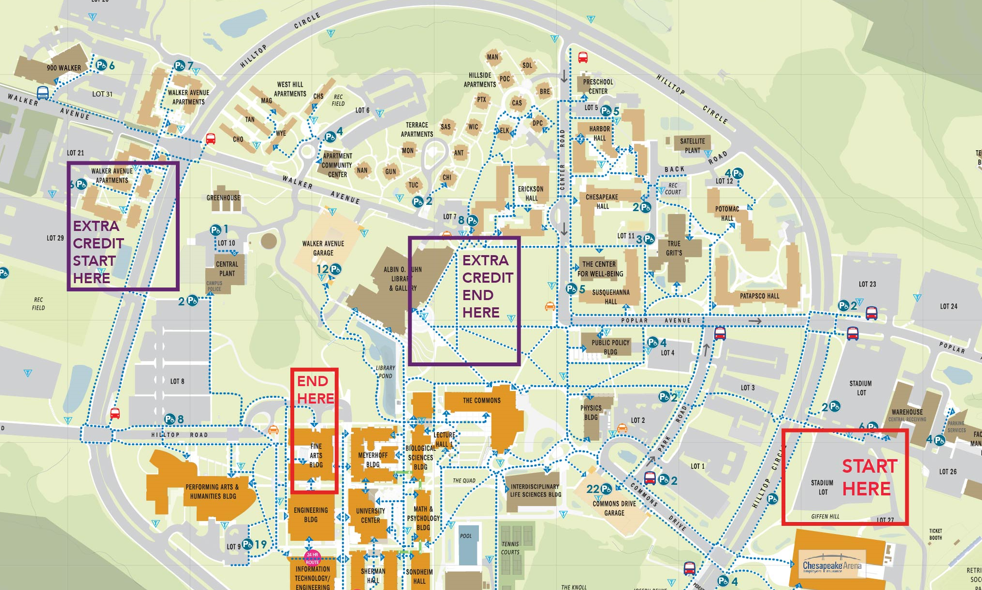
Administration, Student Disability Services, and Facilities all tout the campus accessible routes map as the end-all, be-all solution for disabled students navigating campus. My challenge for you is this:
Make your way to the stadium lot, and then walk to the Fine Arts Building using only routes labeled as accessible. You are not allowed to use stairs, though you may use the short cuts available through buildings via elevators. (The elevator short cuts are labeled on the map below.) For extra credit, start at the top of the hill near the Walker Apartments and go to the library.
While you are walking, focus in on your body. Ask yourself: What would this walk be like if my calves were screaming in pain? What if I struggled with balance and were prone to tripping on uneven surfaces and could fall? What if I were using a walker right now? What about a non-motorized wheelchair?
What about crutches, or a lower-limb cast? When you arrive at your destination, take a note of the time. How long did it take you compared to using the stairs? Did you have to use a new route compared to your ordinary routine?
It was disclosed to me by several students that after they met all of the (stringent and privilege-laden) requirements to receive an accommodation appointment with SDS, they are told they will be unable to get the accommodations they need. In addition, it has also been reported to me that these meetings are often negative in nature with the student seeking accommodations being met with derision and/or hostility for their accommodation requests. One student, who wishes to remain anonymous, reported being “refused note-taking assistance because they needed to ‘learn how to take notes themselves,’” as well as being refused alternative text formatting as that is up to the teacher and “they cannot do anything about it.” The student accurately pointed out that both of these accommodations are among the published list on the SDS website. Another anonymous student trying to receive accommodations was told, “I know migraines can hurt sometimes but that doesn’t mean you can miss class.”
Many of the interactions that were shared with me have a common thread that is heard all too often by the disabled community: “You’re just not trying hard enough” or “It can’t be that bad”. The implications that we are lazy, that we haven’t developed strategies to succeed in our classes, or that we are somehow exaggerating our health problems are not only outdated ways of thinking about disability but are also extremely harmful. The reality of our lives is that it frequently is “that bad,” and that we wouldn’t be asking UMBC for help if we hadn’t already exhausted all of the resources available to us as individuals. To hear these words from the people put in place to help us succeed is equivalent to lifting us up only to kick us back down. UMBC is not the only institution in Maryland struggling with this problem, as this article (https://www.jhunewsletter.com/article/2021/08/disability-isnt-taken-seriously-at-hopkins) written by a graduate student at Johns Hopkins details out. Laurel Maury was awarded accommodations by JHU but found that her professors refused to use them (even under threat of legal action) and some went as far as to bully her for having them. Maury’s struggle echoes many of the sentiments that have been expressed to me by current UMBC students.
To my fellow disabled students: You are not alone, you have a voice, and your voice deserves to be heard.
First, let me just say that TikTok is a great platform for people to speak out on what seems like small moments in their lives but are ultimately extremely impactful: few other platforms expect you to produce 60-second vignettes of information with little further context, but TikTok allows and almost requires the person behind the camera to get to the point very quickly.
To summarize the video that does not have captions (not all creators in all countries have access to that feature yet): This person is deaf and was raised in a hearing community. They started a new job, and were surprised and overwhelmed when they walked in on their first day and everyone in the office was wearing clear, see-through masks, meaning they would be able to lip read. Their first reaction was to feel gratitude for what felt like a gesture of kindness and welcome, and that they feel seen as a person.
I want to take what this person almost said and bring it a step further. This creator felt gratitude, felt welcomed, and felt seen, and they felt these things because their workplace had done what could be argued they are legally required to do in order for them to be functional in their job. While clear masks may not be spelled out as an accommodation in the ADA, it definitely became necessary during COVID-19 for the deaf community in order for them to be safe, but also to participate in society. Providing clear masks to what is presumably an office would not be considered undue hardship as it would be only slightly more expensive than providing ordinary masks to the workforce. An office with a mask mandate is most likely providing their employees with masks, so an office with a mask mandate and a deaf employee would then be legally required to provide clear masks to their workforce.
I will reiterate: This person felt gratitude because their employer did what they were legally required to do to accommodate their disability and did it promptly so the accommodation was in place when they started their first day of work.
As a member of the disabled community this tells me that the bar is on the ground. It may even be buried, and we are then overwhelmingly grateful when someone unburies the bar and hands it to us. It may still be covered in dirt and we may have a new worm friend but it’s been so long since some of us have seen the bar that we accept it as-is.
Can we even conceptualize what it would look like if every disabled person was given their accommodations on their first day of work? What would it look like if in an interview we could just hand a list to our potential employer and it wasn’t a factor in the hiring decision but simply part of their resume? What if everyone was required to submit a list of accommodations and workplace preferences as a part of their application, and it was simply accepted as standard and a best practice in hiring? What if these were accepted as necessary and automatic requirements as long as they fell under ADA guidelines and did not cause undue hardship to the employer, and thus every employer automatically provided them?
Let’s take this thought experiment one step further. What comes next? What does disability acceptance look like in a world where each individual’s needs were met to the furthest extent possible?
This may take some creative thinking on our part, but I think it’s possible to imagine. I personally can imagine an office where wheelchairs were equally as common as chairs. I can imagine that one person may be at a treadmill desk (there’s always at least one fitness enthusiast in an office) and another desk may be empty most of the time, as its owner largely worked from home. I can imagine that transcription of recorded virtual meetings would be as automatic as meeting notes, and that it would be an expectation that the office would rotate through who took on that job just like we do note-takers. I can imagine that this office would throw out traditional concepts of what a work day would look like, and what work production would look like, and that each individual would be allowed to work and produce work in a way that best suited their personality, lifestyle, neurodivergences and sleep schedules.
These ideas, though, still linger within the realm of accommodation. Is it possible to get even more outlandish in our conceptualization of disability in the workplace?
I can imagine a workplace where a disabled person has been promoted several times. I can imagine a workplace where when someone schedules a happy hour, they take into consideration locations that would be functional and welcoming for every member of the team, which may mean having drinks at a quiet restaurant instead of a loud, difficult-to-navigate bar. I can imagine that at the desk of the person who works from home, there is a prank hidden in the drawer for that person to find from a coworker who is thinking of them whether they’re physically there or not, and doesn’t care how long it takes them to find it. (Who doesn’t enjoy the long game?) I can imagine a scenario where every team member is appreciated for their social contributions to the team, and that for some people that may mean not eating lunch in the cafeteria, but may look like them tracking everyone’s birthdays and sending out celebratory emails to everyone. I can imagine that people with disabilities are treated like people and are accepted in all contexts of the word and are welcomed not only on the surface of being able to do their work adequately, but are welcomed as a human being joining a collective enterprise.
When the bar for disability accommodation is buried underground, acceptance and equity for disability is buried along with it.
If anything has debunked the mind-body split for me, it’s living with OCD. My obsessions are felt as deeply as they are thought. Every day I physically feel my compulsions begging for my submission. In resisting them, my body is flooded with a deep, gnawing unrest.
The normalization of perfectionism convinced me that my OCD was good for me. I looked good on paper – but I see no paper in my skin, my blood, my brain, my bones. I have learned that to save this body, I cannot give everything my best. “Just right” can never be achieved so long as I am the judge. The goalpost moves too quickly to register.
I often find that mental illness and queerness aren’t addressed properly or constructively when talked about together. So often the public at large would have us believe that queerness is a result of mental illness or that mental illness is the result of queerness exclusively. With this in mind, the queer community will often push back on society’s behavior by talking about the two exclusively from each other, frequently ignoring all the ways mental illness intersect. That’s does not go to say that queerness is the result of mental illness or vice versa at all, but rather it shouldn’t be ignored that many people in the queer community go through both because of the way society has constructed and reacted towards queerness. For example, queerness has often been perceived as a deviant thing, it has historically been punished and worked against in a variety of ways. Continue reading →
There have been interesting parallels between our class discussions around queer crip time and my current life. This has only become more obvious post election as I scramble to rework my five-year plan. I am not sure how much to share because while I am a very open person there are some aspects of my life that I prefer to keep private.
Being a part of a university really showed me the importance of having your own “space.” I mean I always knew that it was nice to feel like you were part of a group of friends or whatever but I didn’t realize the impact and the importance of this. By space I mean a place that you feel safe, valued, heard, welcomed, accepted and so on. Its only in college that I really understood the profound difference it makes in peoples lives to feel included in something or to feel a sense of belonging, even if its only in one small group of people who share your interests. Continue reading →
I am a nonbinary trans woman. Within the first year of being out as transgender I was constantly plagued with people asking “When are you going to go on hormones?”, a question which has & still does annoy me to this day.
The dialogue that every trans person must, or should, inherently want to seek medicalized transition, is a deeply flawed & even toxic viewpoint to hold.