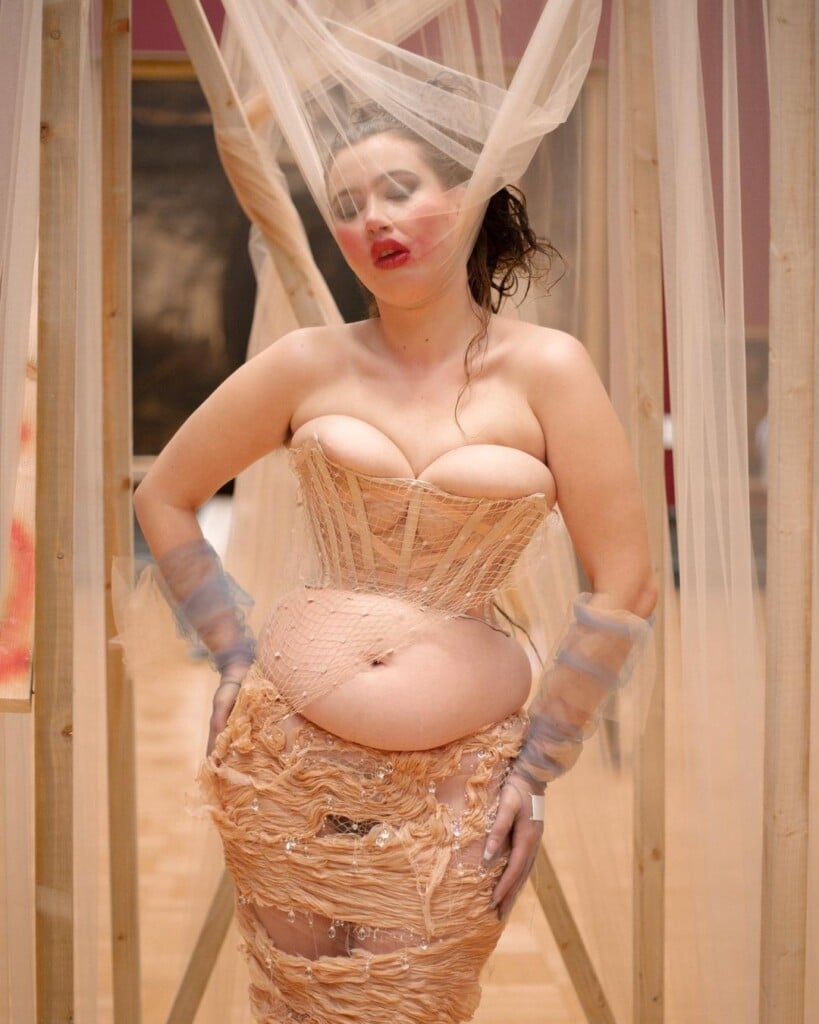
The image above features Michaela Stark on display at the Milan Fashion Week in 2024. Michaela is an Australian “body-morphing” artist currently located in London, who has made several headlines for her ‘Panty’ clothing line, which consists of lingerie and undergarments geared for “all bodies.” She perfectly captures the ways in which our clothing shapes and defines us, and never the other way around. I found Michaela in a sea full of Instagram models, body dysphoric rhetoric, and promotions of every possible procedure to fix every possible flaw of the body, media we consume every single second. Her work was eye-catching, shocking, and…normal.
What is possibly normal about contouring the body in such outrageous ways only to be put on display? Exactly. And yet it has been normalized in every other context by labels. The thin bodies we have shoved down our throats (while completely dismissing our own) are fit to be morphed and changed however need be, whether that be through soft shapewear or restricting corsets. Thin bodies are the ideal, and they must be accompanied by hairless and flawless skin. There mustn’t be a blemish in sight, a wrinkle to see, a stretch mark to grieve. Michaela Stark does this same thing, but we know it’s different. Except we know it’s not different but media has told us it is and so it must be. We all share the burden of having a “broken” body, the only difference is whether your body was born “broken” or conditioned into being “broken.” We all have something we must be desperately fixing at any moment.
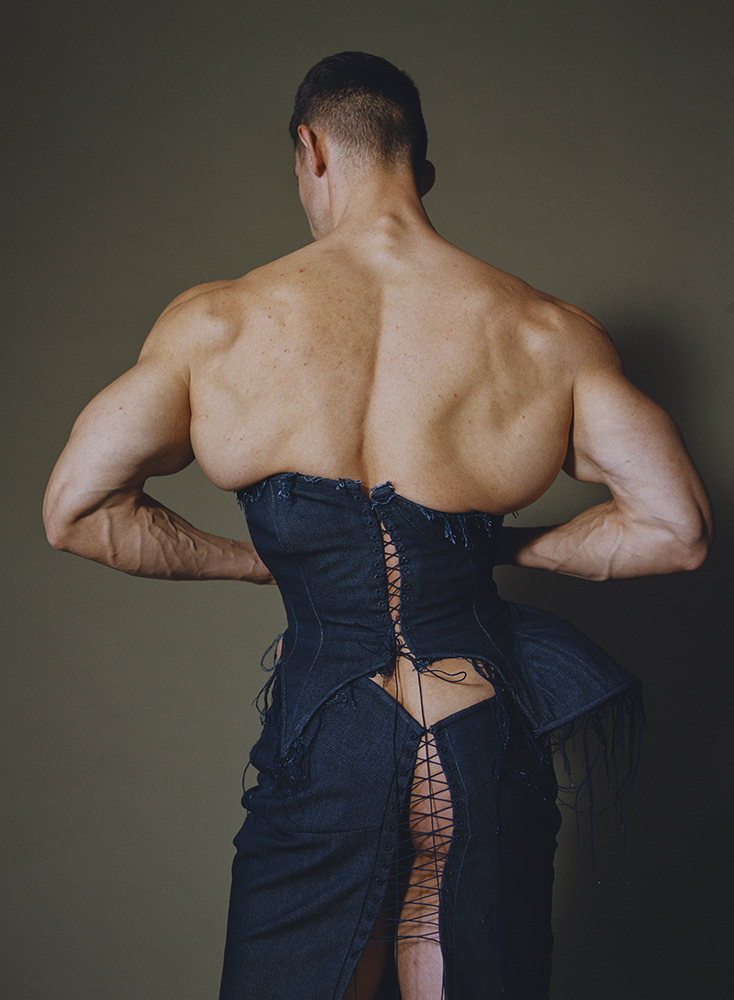
And even through political, social, and public statements that individuals like Michaela Stark make (whether that be through voice or body) where is the representation for men? Society holds tight to how a woman should be, and perhaps we are given some lenience because our bodies are meant to change (not by much though, don’t get ahead of yourself) through the natural processes of pregnancy and birth (yes, I know how demoralizing that is to women anyway), but men don’t get this recognition because it’s socialized to us that they don’t need it. A man’s body should only change for the better: gaining muscle, growing taller, being smarter, stoic. Women are the clay that is never left untouched, always malleable in another person’s hands. Men are the statues, the pyramids, never to fall or be broken down. And a statue should NEVER change. Who knows what waits for you when you don’t identify as either of those things.

My point is that labels are damning, the same way our bodies are socialized and conditioned to be damned. Whether you learn this through the words of Stryker’s My Words to Frankenstein, the sociological concepts of Patricia Collins, or the memoirs in Duane and Rajunov’s Nonbinary, we need no explanation for how this affects us. Through personal experience, we already know. The next step is how we break down these labels that separate us from our bodies, and innovators like Michaela Stark are a perfect example of such. It’s also critical we nip this body-dysphoric-rhetoric in the bud, right at the source: by teaching our children to evolve and grow for their own personal empowerment and not to fit social code. Our girls must know courage and strength the same way our boys receive it. Our boys must know emotion and compassion the way our girls receive it. Most importantly, I think, is instilling these traits as good qualities of a person, rather than subjecting them to a gender binary that supports no one.
Michaela Stark represents a movement of bodies, and in that name we must assume this includes EVERY BODY. If we wish to combat the social construct of the body as its ingrained in our everyday reality, let us begin with abstract thinking.
Sources (and/or more to read):