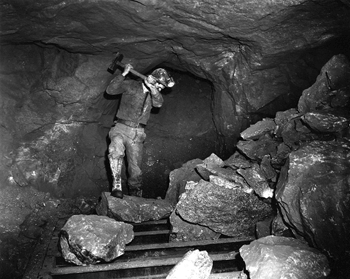
As a college student, I’m constantly juggling classes, assignments, and part-time jobs, and I often feel like I’m being pulled in a million directions. It’s exhausting, and I sometimes find it hard to keep up with everything. Beyond my studies, I want to be there for my friends and family, but it often feels like I’m barely keeping my head above water. Lately, I’ve been thinking a lot about how work and health are connected, especially as I prepare to step into the workforce. The transition to independence is daunting, and one of the biggest challenges I face is figuring out how to take care of myself amid all the chaos. Unfortunately, essential topics like nutrition, stress management, and work-life balance are rarely taught, leaving me to navigate them on my own.Reflecting on the history of labor in the United States, I realize that the fight for workers rights has been long and difficult. Over the years, labor movements have battled for fair wages, reasonable hours, and safer working conditions, paving the way for healthier workplaces today. But after reading “Made by the Work: A Century of Laboring Bodies in the United States” by Ed Slavishak, my perspective on the human cost of labor has shifted profoundly. Slavishak dives deep into the harrowing experiences of early 20th-century workers. It’s hard to fathom that laborers in steel mills and coal mines faced daily dangers and grueling conditions, with their bodies treated like mere tools for productivity. One statistic that struck me was that over 25,000 workers died every year from workplace accidents. That number is staggering and heartbreaking. It hits close to home for me because it makes me think about how easy it is to overlook the sacrifices of those who came before us, who were seen as expendable and pushed to their physical limits until they broke.
Sitting in my cozy dorm room, surrounded by textbooks and my laptop, I feel a mix of privilege and guilt. I belong to a generation that, for the most part, doesn’t have to face such dire conditions. It’s easy to take that for granted, especially when I’m so consumed with my own struggles. While my working environment is much safer, I can’t help but feel frustrated by how companies historically handled safety or neglected it entirely. They placed the burden of safety on workers, insisting that “the best safety device was a careful worker” (p. 152). That mindset is infuriating because it shifts the blame onto the very people who had little control over their situations.As Slavishak points out, corporate safety campaigns “shifted responsibility to avoid the costs of updating machinery or improving ventilation” (p. 152). This is maddening. It reminds me of the pressures I face in college. I often feel that I’m expected to power through exhaustion or even illness just to meet deadlines. I think about how many workers today might still feel that same pressure to sacrifice their well-being for the sake of productivity.Learning about unions and workers’ compensation laws has given me a profound respect for those who fought for workers’ rights. They understood that workers deserved to be valued for more than just their output, advocating for crucial things like life insurance and compensation for injuries. Slavishak notes how the insurance department of the Amalgamated Association of Iron, Steel, and Tin Workers directly asked its members, “What are your chances of living twenty more years? Can you afford to tempt fate?” (p. 153). That question resonates with me. It makes me think about the importance of community and looking out for one another in college. We’re not just isolated individuals scrambling to succeed; we’re part of a network that can uplift and advocate for one another. As I navigate my college journey and prepare for the future, I’m reminded that the fight for dignity in the workplace is far from over. It’s not just about securing a job; it’s about creating a work culture that values us as whole people, not just for our productivity. Reflecting on the struggles of past workers fills me with a sense of responsibility to carry their lessons into my own life. Balancing everything can feel overwhelming at times, but I know that by supporting each other, we can work toward a future where every worker is treated with respect not just for their labor, but for their humanity.