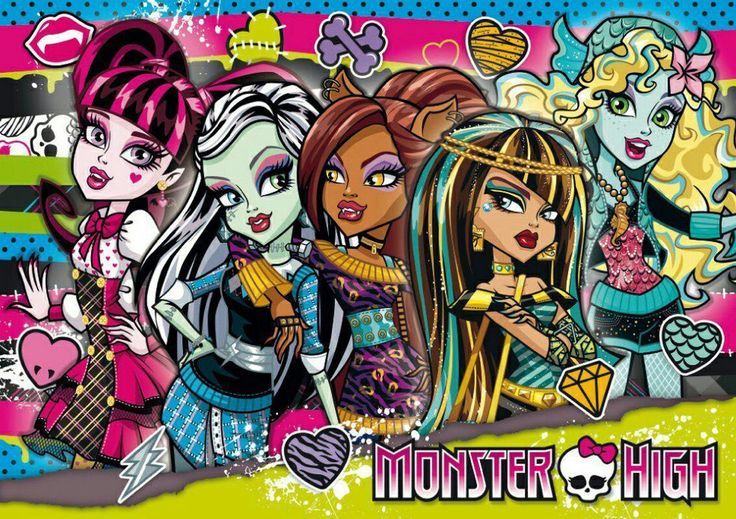
I was completely infatuated with the Monster High franchise growing up. Bed sheets, pajamas, shoes—whatever it was, I probably had it. My parents never quite understood the whys or hows, and neither did I until I reached young adulthood and still found myself rewatching the movies for comfort.
I think part of me has always been drawn to the idea of something different, such as monsters themselves. There was something surprisingly comforting about characters that were so incredibly different from each other. Whether they had fangs, stitches, or scales, they still were able to exist wholly as themselves without those differences diminishing their existence. They had friends, lovers, and full lives. They could exist without having to conform to someone else’s expectations. Looking back now, I realize my attachment to Monster High was more than just the fashion and interesting stories. I saw something in these characters I desperately wanted for myself: to accept and embrace every bit of myself, monster and all.
Something that I deal with on a fairly frequent basis from my family are expectations that are not privy to my knowledge. I have the habit of doing the same to them and feeling justified in doing so without even thinking. This is a habit that many people have towards those who are close to them but it’s fair to say that we all hold it for each other as well. We have an idea of what the “right thing” is and oftentimes judge others and treat them differently for it. But what about when that “right way” only exists in your head.
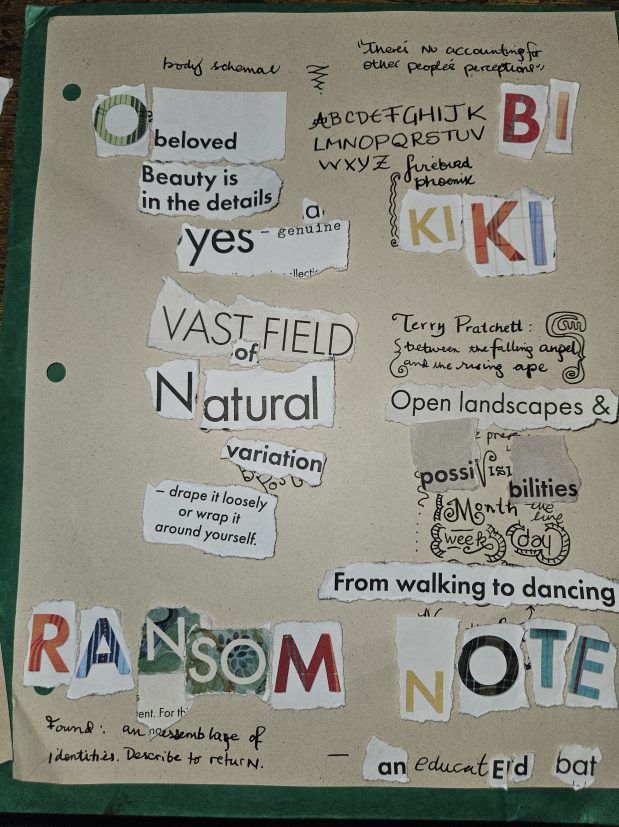
Each person lies within the spectrum of natural human variation, both unique and within a widely-diverse continuum of bodyminds. As this is the case, nothing seemed more appropriate for discussing body schema and the intersection of identities than a literal assemblage piece — layered and gathered letters, words, and phrases. All of the magazine lettering was torn from a single fashion catalog and was completed in one sitting, laid over the handwritten notes I had so far taken for this post.*
I would love for this to be all I wrote about it, but as it’s academic work and also because alt-text is access, there will be unpacking.
I walk in a room and I don’t know who to sit next to. There’s a black girl who looks kind but also like she may hate me. There’s a white girl who looks fun but also like she may hate me. There’s a boy who’s cute but he may hate me. A room full of people but they all may hate me. Maybe a universal experience but racial acceptance is a game in my head. Who’s going to accept me for who I am and what I look like? There’s a divide between black and white, but what about the people who are neither? My dad’s side of the family doesn’t think I’m “asian enough”, my mom’s side of the family simply tolerates me, black people think I’m white washed. White people think I’m too ethnic, people act surprised I speak english but people are also surprised I don’t speak Chinese. So what does life look like when you don’t have a “safe” side. It looks like backhanded compliments, fear from everyone, surprised when people DO like you, and a lot of days spent looking in the mirror wondering how you can fit in. Code switching? I live it, but I never know which code to default back on because who I am is not truly accepted, I always have to do my best to fit in.
Throughout various abhorrent efforts to dehumanize any given particular group, the question of what is deemed ‘natural’ has often been present. The concept of ‘naturalness’ is made to be synonymous with ‘goodness,’ ‘correctness,’ and any term that denotes a certain level of social acceptability or praise. Yet, the definition of ‘natural’ does not indicate some infallible or permanently held state of being. Rather, it is an ever-changing term, constantly adjusting to new norms and technologies as our society changes.
Reading Sandy Stone’s “The Empire Strikes Back: A posttransexual manifesto” felt like stumbling upon a secret I didn’t know I needed. One quote stood out to me, almost as if it were waiting for me to see it: “This paper…is about morality tales and origin myths, about telling the ‘truth’ of gender.” Stone is talking about the stories society tells us,stories that claim to be the “truth” about who we are, even when those truths don’t fit us. For trans people, these stories are often used to deny their identities or paint them as something artificial. But the idea of being trapped in a story that isn’t your own? That resonated deeply with me. I’ve lived my whole life caught in a story that I didn’t write. It’s the one that tells me I’m not enough. Not pretty enough, not confident enough, not “worthy” enough. I don’t even know when it started. Maybe it was growing up surrounded by images of perfection I could never reach, or hearing the subtle ways people praise others for what I always felt I lacked. Over time, I internalized it. It became my “truth.” Stone’s words reminded me that these stories aren’t real, they’re constructs, born from societal expectations, comparison, and insecurity. They’re myths, handed down to us as if they’re fact. And just like Stone argues for trans people to reclaim their narratives, I feel like I need to do the same for myself. But that’s easier said than done. When I look at others, I see their beauty, their confidence, their ease. I convince myself they’re everything I’m not. I’ll scroll through social media, comparing myself to images of people who seem flawless, wondering why I can’t see myself that way. I’ve spent years trying to measure up to a standard I never set and every time I fall short, it reinforces the idea that I’m not enough. What Stone helped me realize is that the only person who can rewrite my story is me. I don’t have to accept the idea that my worth depends on how closely I resemble someone else. My value doesn’t come from meeting some impossible standard, it comes from being me. That’s not to say it’s easy. Some days, I catch a glimpse of my own reflection and think, “Maybe I’m not so bad after all.” But other days, the old voices creep back in, whispering that I’ll never measure up. It’s a slow process, unlearning the lies I’ve believed for so long. But Stone gives me hope. If it’s possible to challenge something as deeply rooted as society’s myths about gender, then it must also be possible to challenge the myths I’ve told myself about who I am. It’s not about becoming someone else, it’s about learning to see myself clearly, without the noise of comparison and doubt. I’m not there yet, but I’m starting to believe I can get there. Little by little, I’m learning to let go of the story that says I’m not enough. And in its place, I’m beginning to write a new one: one where I see myself as whole, just as I am.
Many people have better views on gender stereotypes, but obviously we know better than to not categorize people. Growing up in a traditional immigrant household the gender norms are even more distinct. I was told to not do sports, and only do activities that were more “feminine”. I believe that while stereotypical views about gender norms are deeply embedded in our society, they often begin from childhood.
In high school, I heard the rumors. I knew that I was not the epitome of femininity. It was not the first time I had to evaluate what being a woman meant to me.
It started in 3rd grade, with the best friend of my best friend, who asked why I had a mustache. I didn’t think I had one, but suddenly it was all I could see. Only boys had mustaches—but I was a girl. When I went home, I begged my mom for help. We spread pink Nair on my face and I locked myself in the bathroom where no one could see me washing away my insecurity.
But that wasn’t enough (spoiler: it never is), so in 4th grade, my crush told me my new haircut made me look like a boy—but I was a girl. The “teasing” didn’t stop until my hair had grown past my chin again. I still flinch when I pull my hair too far back and see the more masculine features of my face.
In high school, I’d had enough of hiding behind long hair and getting chemical burns underneath my nose. I decided I would try to stop caring—or at least appear to stop caring. I shrugged off the barbed comments about my face from classmates, refusing to give a reaction, even if it made me think no one could ever love a face like mine. Even if it shook my femininity to the core, even if I began to think my own face was ugly, I refused to cave.
Then the pandemic hit, and I had more time on my hands than before. I had a coworker who identified as nonbinary, and I started to wonder what that would mean. I shrugged off “woman,” which had caused me problems for so long, and I tried on something different.
But gender is weird. I found myself somewhere in between the two, sometimes feeling like nothing but a person inhabiting a body, and at other times like I was more of a woman than I’d ever been (occasionally, I even reveled in my masculinity). But the more scrutiny I put my identity under, the more it seemed to move. Like my gender, my identity is fluid. When I shook off the weight of performing femininity, my biggest insecurity became nearly null. If I don’t have to identify as a woman, then it’s not an insult for someone to point out the ways in which I don’t perform as a woman. Rather, it can signal to others that my identity is not what they assume it to be. Most importantly, it is a (much needed) reminder to myself that I decide what I want my body to look like—not others.
♥ ♥ ♥
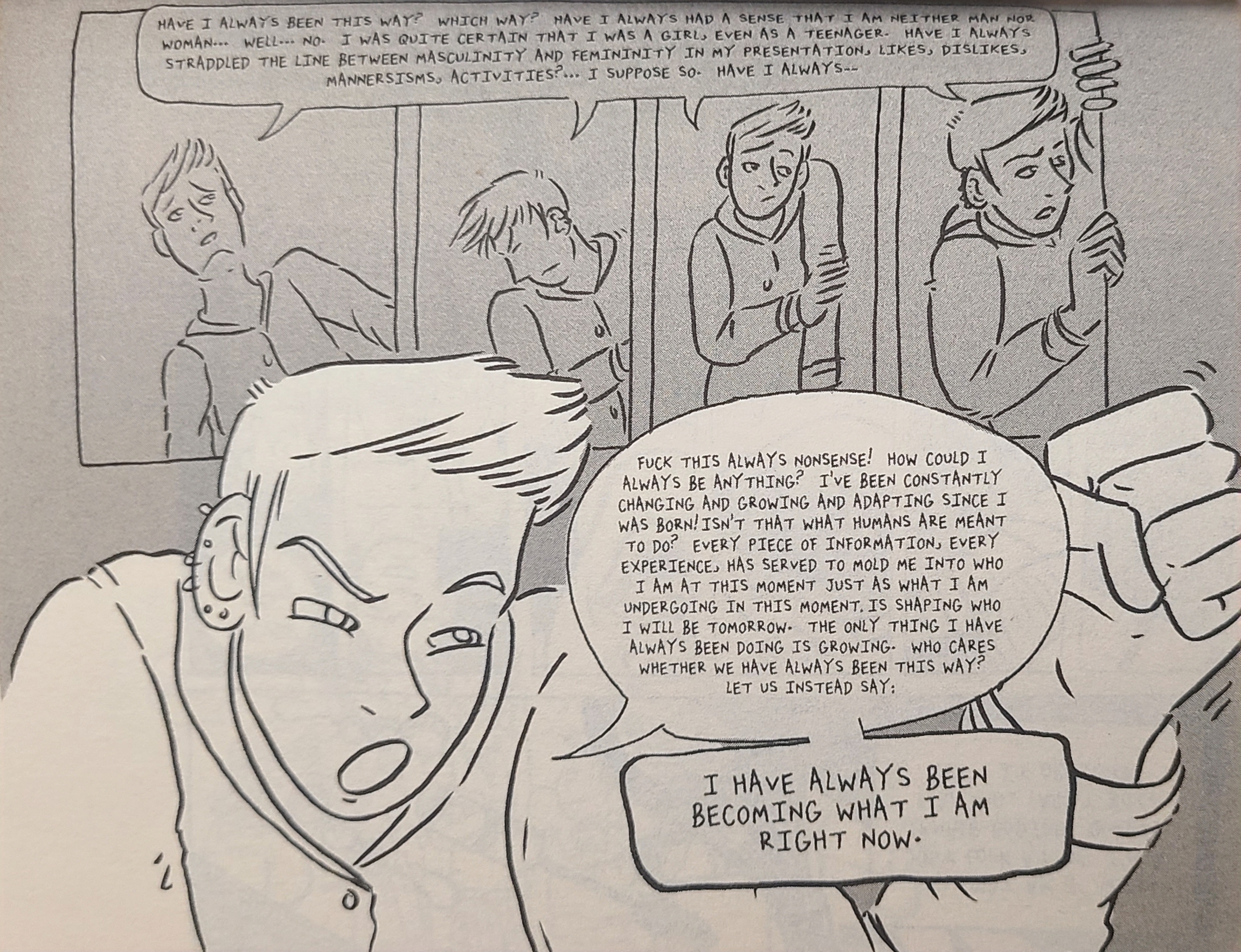
ALT TEXT: An image excerpt from “Gender Outlaws: The Next Generation” page 177. In background: Grayed out images representing an insecure internal monologue. They are saying: “Have I always been this way? Which way? Have I always had a sense that I am neither man nor woman… well… no. I was quite certain that I was a girl, even as a teenager. Have I always straddled the line between masculinity and femininity in my presentation, likes, dislikes, mannerisms, activities? …I suppose so. Have I always…”
The internal monologue is cut off by the person in the forefront, saying, “Fuck this ALWAYS nonsense! How could I always be anything? I’ve been constantly changing and growing and adapting since I was born! Isn’t that what humans are meant to do? Every piece of information, every experience, has served to mold me into who I am at this moment just as what I am undergoing in this moment is shaping who I will be tomorrow. The only thing I have always been doing is growing. Who cares whether we have always been this way? Let us instead say: I have always been becoming what I am right now.”
There’s a struggle at the very heart of my experience as a trans person. The struggle of trying to navigate a society that heavily reinforces the gender binary in ways that most cis people don’t even think about, while also trying to do away with this outdated notion. A prevailing notion on how one does gender is through their performance. Our appearance & the way we use our body signify to others what gender we are. There is nothing in one’s very nature that makes her a girl, it is how she’s been taught a girl looks & behaves that determines her performance as such. I’ve discussed gender in the abstract, but how does it apply to me? How do I experience gender? Well, I am a demigirl, an identity within the non-binary umbrella where I am a girl, but also partially outside the gender binary. Despite this, in circumstances where I have to interact with mostly cishet people, I desire, but do not achieve, to present as femme as possible, to only be seen as a girl, as I don’t trust the general society to grasp that nuance. If someone even for a fraction of a second thinks that I’m a guy, it’ll create gender dysphoria. So if I’m basically trying to present as a girl, this in a way could be perpetuating the gender binary, by erasing the non-binary aspect of my identity in my presentation. But then how does one present as non-binary? There is a misconception that non-binary inherently means androgynous, because you are neither a boy nor a girl, you must not lean towards looking like either. This just creates a gender trinary, which I feel like is only an improvement from the gender binary in superficial ways. It allows for the expansion of gender in so far as it doesn’t mess with the existing structure too much. In other words, as long as it doesn’t challenge the patriarchy. But then, how do I do my part in transforming society such that the general notions of gender match how diverse it actually is? The only satisfactory answer I’ve been able to come up with is for others to be educated about the nuances of gender. After all, I don’t feel that same pressure in queer, especially trans, spaces. In those circumstances I know I’m around people who have the same or similar enough experience & knowledge of gender that I don’t feel obligated to live up to gendered pressures that are thrust upon me. When I’d go visit my ex-boyfriend, or my ex-girlfriend before that, who are both trans, I knew it wouldn’t matter if I didn’t feel up to looking as femme as I could manage, as they’d still see me as the gender I am. So through my experience with other trans people I know it is possible to live in a society that doesn’t require strict adherence to gendered stereotypes. But I can’t really give a presentation on gender to every passerby on the street, so all I can really do is wait, & until then, hope I’m seen as a girl.
As I had read Susan Stryker’s article on trans rage and the comparison of Victor Frankenstein’s unfortunate monster, I found myself following each word closely. I had so rarely seen anyone talk so openly about the pains and sorrows that are hidden about transgender identity. The discussion in class presented an extremely important point on who is allowed to show and vocalize strong negative emotions like rage and pain. As a person of color, as a queer and transgender individual, my permission of showing these emotions has been quite small, but looking further inward I know that there are other reasons I am not one to show these emotions. For my last post I call upon Stryker’s voice of these negative emotions and a monstrous identity, but not for my transgender identity, but one I am coming to terms with existing within me. I open up the physical patchwork body of mine to see inwards, within the darkness I see a cage chained to the ground. Moving closer I can hear the rattling of anger, I peer inside the cage to see a gnarled and patched up figure, teeth unnaturally pointed and sharp objects partially embedded in its body. I instinctively know these objects were brandished weapons with the purpose of subduing and killing this figure, but they have failed. This figure was human once and I can’t help the sadness I feel seeing what has become of them.
“What happened to you?” I ask cautiously.
The pause feels deafening.
“I’d think you’d recognize us, not many come back from the war of trauma unscathed.”
It’s said that what doesn’t kill you makes you stronger, but no one should be forced to be this strong to the point of being caged in fear.
As an echo to the original article, my comparison of monstrous identity in regards to trauma is not one to be used against all who have trauma. This is my sole reclamation of my past and should never be used against individuals who do not wish to do the same. This post will include raw calls to mental health happenings in response to traumatic experiences. Though there will be no details of happenings, there are insinuations of abuse on varying levels.