
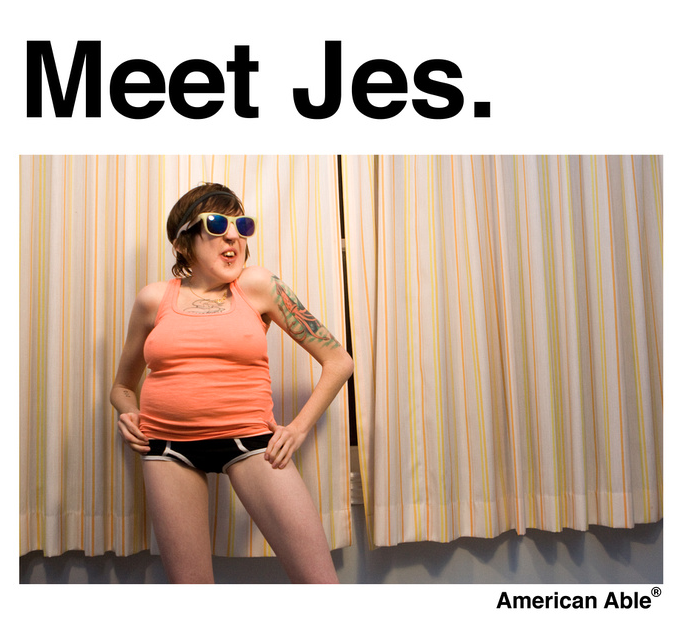
Here’s a description of the project from the the artist Holly Norris’ website:
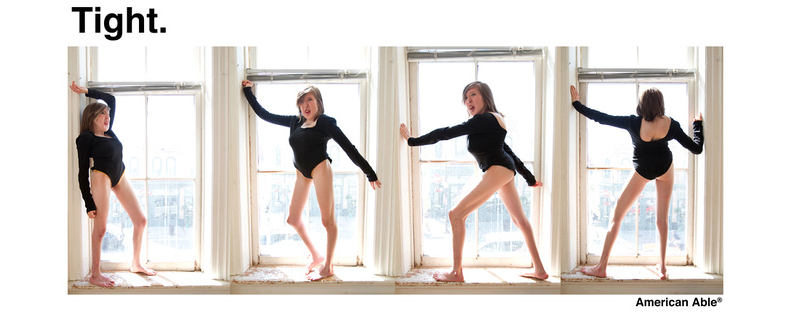
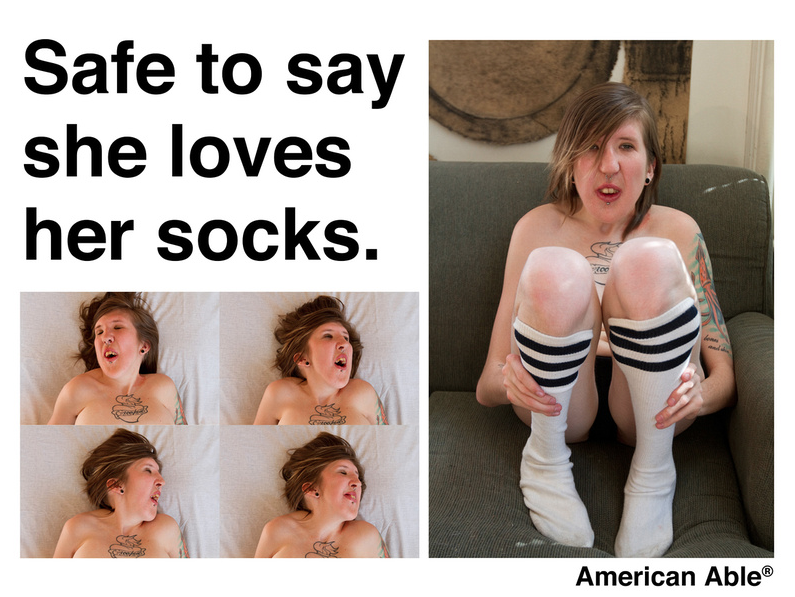
“American Able” intends to, through spoof, reveal the ways in which women with disabilities are made invisible in advertising and mass media. I chose American Apparel not just for their notable style, but also for their claims that many of their models are just ‘every day’ women who are employees, friends and fans of the company. However, these women fit particular body types. Their campaigns are highly sexualized and feature women who are generally thin, and who appear to be able-bodied. Women with disabilities go unrepresented, not only in American Apparel advertising, but also in most of popular culture. Rarely, if ever, are women with disabilities portrayed in anything other than an asexual manner, for ‘disabled’ bodies are largely perceived as ‘undesirable.’ In a society where sexuality is created and performed over and over within popular culture, the invisibility of women with disabilities in many ways denies their sexuality, particularly within a public context.
Too often, the pervasive influence of imagery in mass media goes unexamined, consumed en masse by the public. However, this imagery has real, oppressive effects on people who are continuously ‘othered’ by society. The model, Jes Sachse, and I intend to reveal these stories by placing her in a position where women with disabilities are typically excluded.
I think this project is extremely fascinating in its critiques of advertising and mass media, specifically American Apparel, and the projects counter-depictions of disability.
How is Norris’ explanation of the invisibility of disabled bodies in mass media, including the de-sexualization and undesirability often seen intrinsic to disability, parallel to Garland-Thomson’s “Integrating Disability, Transforming Feminist Theory”? Do you believe that the depictions of disability in American Able are revolutionary? Can these counter-depictions of disabled bodies truly change advertising and mass media and the ways in which we view disability in our society?
Some of the following images by be not safe for work (NSFW).
 Unruly Bodies
What a great concept – slightly similar to Nancy Upton’s satirical take about a year ago (http://marzipanandmarmite.wordpress.com/2011/09/25/american-apparel-and-its-big-fat-controversy/).
American Apparel’s advertising drives me mad, I get slightly fiery each time I see yet another skinny14 year-old forced strike a sexualised pose.
I agree that this seems to be an excellent project! Disabled people are rarely ever allowed to express their sexuality. Clothing ads have become all about sexuality and giving disabled people the opportunity to express themselves sexually is great! I also believe that seeing disabled people portrayed this way pushes the norms we see in advertising. If we continue to see this sort of advertising, we as a culture will probably become more accepting. The view of the capabilities of disabled people is restricted. They are often portrayed as heroes or pitiful creatures. We rarely see them just as people. I think more advertisers should allow a much broader range of individuals to represent their companies.
I love this and I’m so glad you posted about it. I love how Jes gets at the hypersexualization of female bodies as well as the rampant ableism of American Apparel ads. Really striking and well done!
This is a great project for addressing the ableism of American Apparel. I would like to see different groups of women do something similar. So many aspects of American Apparel are problematic, for Dov Charney’s sexual harassment of his employees to the objectification of women in the ads. However, what bothers me most is that American Apparel claims to produce sweatshop free clothes and use employees and friends as models BUT many of the seamstresses at the factory in L.A. are Latina and most of the models are white. So while featuring disabled women is great, I’d really love to see a Latina mother of three, with her kids, buying cereal at a bodega, decked out in the clothes she can’t afford with her “living wage.”