
The following is a series of excerpts for an article that I wrote for The Retriever that was published on Wednesday. (Below is from my original draft, some changes have been made in the final version for newspaper formatting.) If these tidbits interest you, you can find the whole article in print on campus now!
UMBC, I have a challenge for you.
Administration, Student Disability Services, and Facilities all tout the campus accessible routes map as the end-all, be-all solution for disabled students navigating campus. My challenge for you is this:
Make your way to the stadium lot, and then walk to the Fine Arts Building using only routes labeled as accessible. You are not allowed to use stairs, though you may use the short cuts available through buildings via elevators. (The elevator short cuts are labeled on the map below.) For extra credit, start at the top of the hill near the Walker Apartments and go to the library.
I have marked the destinations for you below. The full map is available here: https://about.umbc.edu/files/2021/09/2021-UMBC-accessible-routes-map.pdf
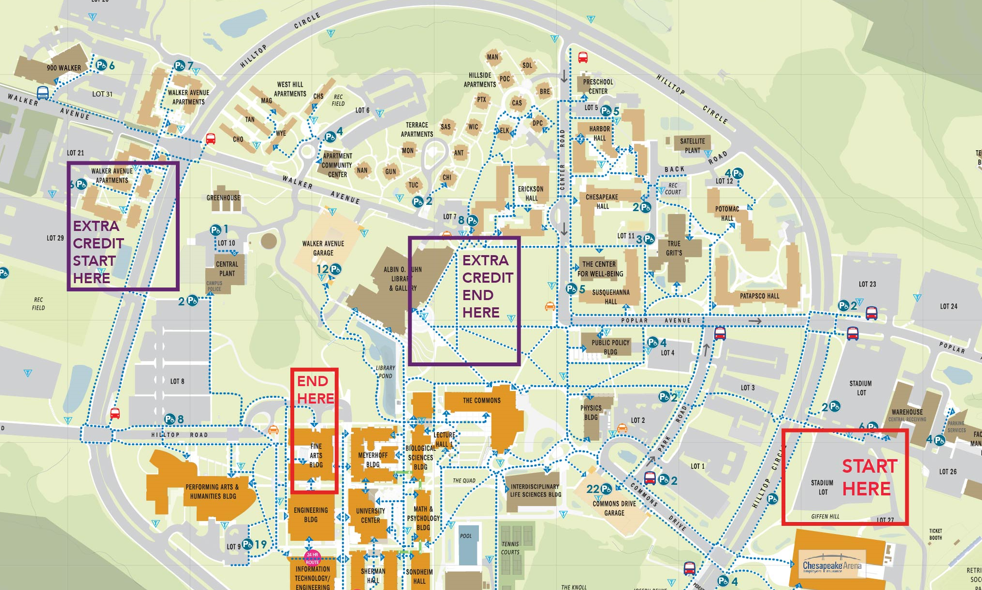
While you are walking, focus in on your body. Ask yourself: What would this walk be like if my calves were screaming in pain? What if I struggled with balance and were prone to tripping on uneven surfaces and could fall? What if I were using a walker right now? What about a non-motorized wheelchair?
What about crutches, or a lower-limb cast? When you arrive at your destination, take a note of the time. How long did it take you compared to using the stairs? Did you have to use a new route compared to your ordinary routine?
It was disclosed to me by several students that after they met all of the (stringent and privilege-laden) requirements to receive an accommodation appointment with SDS, they are told they will be unable to get the accommodations they need. In addition, it has also been reported to me that these meetings are often negative in nature with the student seeking accommodations being met with derision and/or hostility for their accommodation requests. One student, who wishes to remain anonymous, reported being “refused note-taking assistance because they needed to ‘learn how to take notes themselves,’” as well as being refused alternative text formatting as that is up to the teacher and “they cannot do anything about it.” The student accurately pointed out that both of these accommodations are among the published list on the SDS website. Another anonymous student trying to receive accommodations was told, “I know migraines can hurt sometimes but that doesn’t mean you can miss class.”
Many of the interactions that were shared with me have a common thread that is heard all too often by the disabled community: “You’re just not trying hard enough” or “It can’t be that bad”. The implications that we are lazy, that we haven’t developed strategies to succeed in our classes, or that we are somehow exaggerating our health problems are not only outdated ways of thinking about disability but are also extremely harmful. The reality of our lives is that it frequently is “that bad,” and that we wouldn’t be asking UMBC for help if we hadn’t already exhausted all of the resources available to us as individuals. To hear these words from the people put in place to help us succeed is equivalent to lifting us up only to kick us back down. UMBC is not the only institution in Maryland struggling with this problem, as this article (https://www.jhunewsletter.com/article/2021/08/disability-isnt-taken-seriously- at-hopkins) written by a graduate student at Johns Hopkins details out. Laurel Maury was awarded accommodations by JHU but found that her professors refused to use them (even under threat of legal action) and some went as far as to bully her for having them. Maury’s struggle echoes many of the sentiments that have been expressed to me by current UMBC students.
To my fellow disabled students: You are not alone, you have a voice, and your voice deserves to be heard.
 Unruly Bodies
I think about this all the time, like why are there stairs in some areas that could easily have ramps? Why is there broken elevators for days at a time? Why are all the direct paths from walker to main campus steep hills? Why don’t any of the apartments have elevators? And if someone was forced to live on the bottom floor they are way more likely to have bugs and rats. At this point ableism is so deep in the ground of UMBC I don’t know how it could change. Not to mention disability services for mental disorders. A bad flare up can knock someone out for days. Even with notes and a hospital letter, SDS has told me that there is nothing they can do retro actively and it’s all up to the discretion of professors. Basically if your not in perfect health for 16 weeks straight and your professor doesn’t care, the semester is gone. Even if the professor does care a lot of classes require attendance either to understand material, or to get in class participation. I had one professor who recorded all in person lectures, and also had videos with transcript that were required before class. Sure attendance was still required, but if I couldn’t help but miss a day it wasn’t the end of the world. But that takes a lot of extra work and isn’t possible for every class. It makes me miss lock down when every class was online, recorded and easy to get to. But also nothing compares to an in person class where questions are easier to ask and there isn’t lagging.