Wear and Tear

A stack of books with an apple on top and a basketball behind the stack. All three item are placed on a desk with a dark backround.

Our discussion about the bodies in athletics really spoke to me because if people knew the intense physicality it takes to play these sports, there would be an uprising. I have recently become aware of the world of collegiate women’s basketball, and it’s wild. It starts with a basic mandatory schedule. This includes 3 hours of practice, an hour of weights, and 2 hours of study hall daily, with one “Off Day” a week. The coaches make these schedules without input from the players, and players are expected to build around them. Players also have to participate in mandatory community service events scheduled by coaches. The university uses these bodies to prove they benefit the community. However, if the team returned from playing an away game the night before, they may not want to attend a 3-hour service event starting at 8 am. The lack of autonomy on a day-to-day basis feels like some sort of new-aged forced labor.

On top of that, a toxic mentality exists in the community of “proving that you want to be here” for the coaches to play one in a game. If they play, they can produce and prove they are valued enough to be invited back to the school and continue their job and education. However, if we break down what it means to “prove you want to be here,” it means exhausting your body beyond its means. With these tiresome schedules, it is implicitly expected for a player to fit extra workouts into their schedules and become straight-A students to show that they are mature enough to manage a work-life balance. Players are physically and mentally exhausted at the end of each day, and it seems impossible to do it all. They do this all while being paid an almost laughable amount of money. The person that I know plays basketball gets paid $500 a month in the cost of attendance money, which amounts to about $2.88 an hour. $2.88 an hour is nowhere near the federal minimum wage of $7.25 an hour, and this does not include programs that do not get paid.

A student with a stack of books in one hand an a soccer ball in the other. They appear to be choosing whether to pursue their education or their sport.

Most of the time, payment is treated as a privilege and not a right when programs complain about the rigor of their jobs. Almost as if to say, “Be quiet and behave because you get paid.” This would be a different response if the team’s racial makeup were not majority black. To pull concepts from Theresa Runstedtler’s article, there is a long history of black bodies being used and abused for white entertainment and profit, starting with slavery, transitioning into sports like boxing in the 19th and 20th centuries, and transforming into our current athletic industrial complex. These systems are so successful only because black bodies are at the bottom. There is something about black bodies working to the bone for very little that sits right with the American spirit. 

I’m not sure what this means for sports. I say this as a die-hard Ravens fan who finds community and city pride in talking football, especially when I am not in Baltimore. But it is impossible to deny the complex into which I feed: the sports industry, like most things, is built in a pyramid, and the bottom is being pushed beyond max capacity.


Neurodiversity and Race

Neurodiversity and Race

Neurodiversity can be defined as differing in mental or neurological function from what is considered typical. Neurodiversity can take many forms, like ADHD, autism, dyslexia, and Tourette syndrome, just to name a few. Thinking differently has many advantages, like better pattern recognition, creativity, stronger observational skills, and more. Unfortunately, neurodivergence does not exist in a vacuum. People are perceived by society through social constructs like gender, sexual orientation, socioeconomic status, and more. In this post, I explore the intersectionality of race and neurodiversity, focusing on Black people in the United States. 

The stereotyping around neurodiversity shows itself in assumptions of intelligence and capabilities. Stigmas include low intelligence, carelessness, lack of ability, and behavioral issues. In school, neurodivergent children are segregated from the other students by learning in different classrooms. When combined with the structural inequalities around race, it could be a deadly unification. White children are twice as likely to receive a diagnosis compared to black children. Teachers in wealthier, whiter schools are more likely to recognize neurodivergent behavior. When paired with stigmas around black people being trouble-makers in society who deserve the punishment they receive, it is not surprising that Black children are punished harsher for behavior that may be signs of neurodivergence. This ties right into the school-to-prison pipeline, which are the policies and practices that push our nation’s school children, especially our most at-risk children, out of classrooms and into the juvenile and criminal justice systems. This phenomenon shows itself in disproportionate punishments given to black and brown children, especially for boys. Black and brown children are constantly looked at as deviant or “bad” children who deserve to be punished in school and grow up to be overly policed by law enforcement in society.  

I’ve seen this first-hand with my brother. We lived in a majority non-black neighborhood, and it was very apparent that teachers did not have a lot of experience with children. My brother always showed Attention Deficit Hyperactivity Disorder (ADHD) tendencies, something that the school was made aware of each year. He was always in trouble for something, whether it was talking back or playing too rough. The teachers were generally white women who did not understand him. Punishments were always suspensions, which never matched with what he did. The problem with suspension is that the student misses school time, which leaves the student behind in classwork. They also go on your school record and can affect your chances of getting into your first-choice colleges, getting jobs or internships, etc. In high school, he was officially diagnosed with ADHD, and the school issued a 504 plan, a plan developed to ensure that a child who has a disability identified under the law and is attending an elementary or secondary educational institution receives accommodations that will ensure their academic success and access to the learning environment. For my brother, he needed small breaks where he could walk around the hallway, headphones, and his personal space. To put it simply, he just needed to be left alone, which seems like something so simple but was proven so hard to comply with. Some teachers understood this dynamic; he may not look like he’s paying attention, but he is. However, some teachers could not let it go. Constantly being reprimanded for having his headphones in, not being allowed to get up and leave when he needs to, etc. 

In the fourth grade, my brother was in art class and called this girl’s artwork ugly. The girl said, “So is yours,” they both proceeded with the rest, not considering the interaction. The art teacher overheard this interaction and reported him to the principal, where he was later suspended for bullying. When my mom caught wind of what was happening, she contested with the principal, who would not budge, a couple of administrators in the school system, and then the superintendent of Howard County Public Schools. She was met with the same stubborn and prejudiced mentality that a conversation overheard between two students warranted a three-day suspension. It wasn’t until my mom hired a lawyer, built a case, and threatened to sue the school that the suspension was overturned. The process took a year of constant back and forth with the school system and another six months to correspond with a lawyer. It is not lost on me that not everyone can spend 18 months in a battle with the school system over one suspension, and it makes me wonder how many other children were punished unfairly but did not have the resources to hold the school system accountable.

Family photo of Elijah McClain wearing red plad shirt and black glasses.

Lastly, I want to shed light on Elijah McClain. Elijah was a 23-year-old massage therapist who loved to play violin for stray cats. When the police harassed him, he notified them that he was autistic, but the Aurora, Colorado Police Department still murdered him. These practices and procedures aren’t just humiliating; they take the lives of the innocent.

Your Body is Never Good Enough

Your Body is Never Good Enough

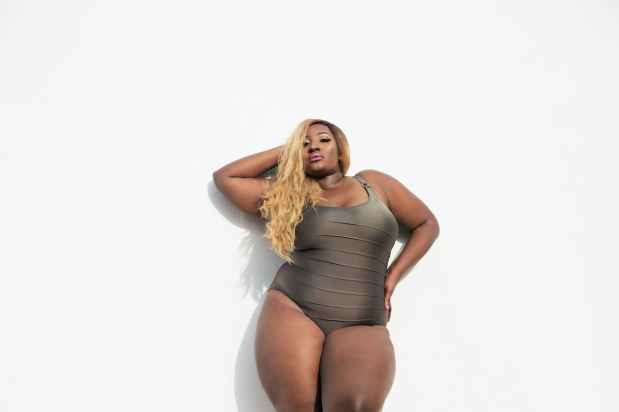
In class, we were talking about how social media creates body standards. However, I kept thinking about how my social media wants you to be big in the right places. I see social media rewards bigger people who collect fat in their thighs, butt, and chest. It simultaneously punishes people who contain fat anywhere else. I, myself, only go to the gym to build the body I want, not for health and definitely not because it makes me happy. I see this in conversations with my friends. Everyone wants a bigger butt and a smaller stomach. I see it in how clothes are made today. Certain clothes that are stretchier in the butt and tighter in the waist to force an hourglass figure. There is so much emphasis placed on having a curvy figure, and it does not look as nice if you don’t have that figure. I see it in models promoting different things and celebrities that people admire. It seems like they all have BBL bodies. BBL stands for Brazilian Butt Lift when a plastic surgeon takes the fat from your midsection and puts it in your butt. All celebrities have plastic surgery, but it shapes the body expectations of those without. Some celebrities, like Lizzo, promote body positivity, but she does not exist in a vacuum. Many try to shame her for who she is, and although it speaks volumes when she ignores them, it continues to be herself; sometimes, other voices are louder.

So just to recap, you must have a big chest, a big butt, and a tiny waist, all while being under 150lbs. If you work out in the gym to build this body, you will be muscular, which isn’t feminine. If you get plastic surgery, you lose because you paid money to change your body. All in all, you can’t win.

Affirmative Action is Gone and it’s White Supremacy’s Fault

I am not going to lie. I did not know what to write about for this blog post. We discussed race, phenomenology, and the relationship between other races and Black people. The term racial triangulation was tossed into the conversation, and I mentioned something about affirmative action. Dr. Kate had said something to the effect of “That is a great blog post,” so here I am. Welcome to my book report about how racial triangulation is to blame for why the Supreme Court ended affirmative action. 

“Racial triangulation” was coined by Dr. Claire Jean Kim, an American political scientist. I will heavily rely on her journal, “The Racial Triangulation of Asian Americans,” for this post’s majority, if not all. Racial triangulation “occurs by means of two types of simultaneous, linked processes: (1) processes of ‘relative valorization,’ whereby dominant group A (Whites) valorizes subordinate group B (Asian Americans) relative to subordinate group C (Blacks) on cultural and/or racial grounds to dominate both groups, but especially the latter, and (2) processes of ‘civic ostracize’ them from the body politic and civic membership” (Kim, 1999, p. 107). White supremacism makes the stereotypes and societal standings for both Black and Asian people, then pit each community against the other. Most importantly, white people see “each racial group as a fixed cultural-biological entity…” (Kim, 1999, p. 109), or these stereotypes follow each racial group and will never change. Before the Civil War, Chinese immigrants in California were not subjected to slavery so that California could be a free state in the Union but were seen as a source of cheap and plentiful labor. Asian Americans were seen as temporary guests and not citizens, meaning they were not entitled to a political opinion. They were subjected to the same discrimination as black people in California. However, racial discrimination against Asian Americans was not enforced consistently, and they were seen as having a culture and intelligence that Black people did not. As workers, Asian Americans are more appealing because they are more controllable and less demanding than black people. For these reasons, Asian Americans were seen as better than Black people but not good enough for White people.

But what does this have to do with affirmative action? After the Civil Rights Movement, schools had to integrate, and colorblindness was how to deal with race. In reality, colorblindness is just a way to mask the current racial inequity and continue white supremacy. Instead of using biology to justify racism, white supremacy insisted that “certain cultures” are better at leading society than others. Moreover, because Asian people are seen as having some respectable culture, they become the model minority, something others should look up to but never good enough to be “White.” In the 1980s, Asian American application rates to Ivy League schools increased, but acceptance rates did not. Asian Americans claim schools are only meeting their racial quotas and preserving their schools’ traditional whiteness. White conservatives took the momentum against affirmative action. They twisted the narrative: affirmative action turned into a program that benefited Black and Brown students and unfairly discriminated against Asian American students. Thus, it turned into a Black and Asian issue; while White conservatives side with Asian Americans against black demands, they can appear as sticking up for what is right and un-racially motivated. 

I guess my point is that nothing is unintentional. That everything happens exactly how it is designed to. In the beginning, there were two races (Black and White), and when a new third option presented itself, it fell in line with the white supremacist system.

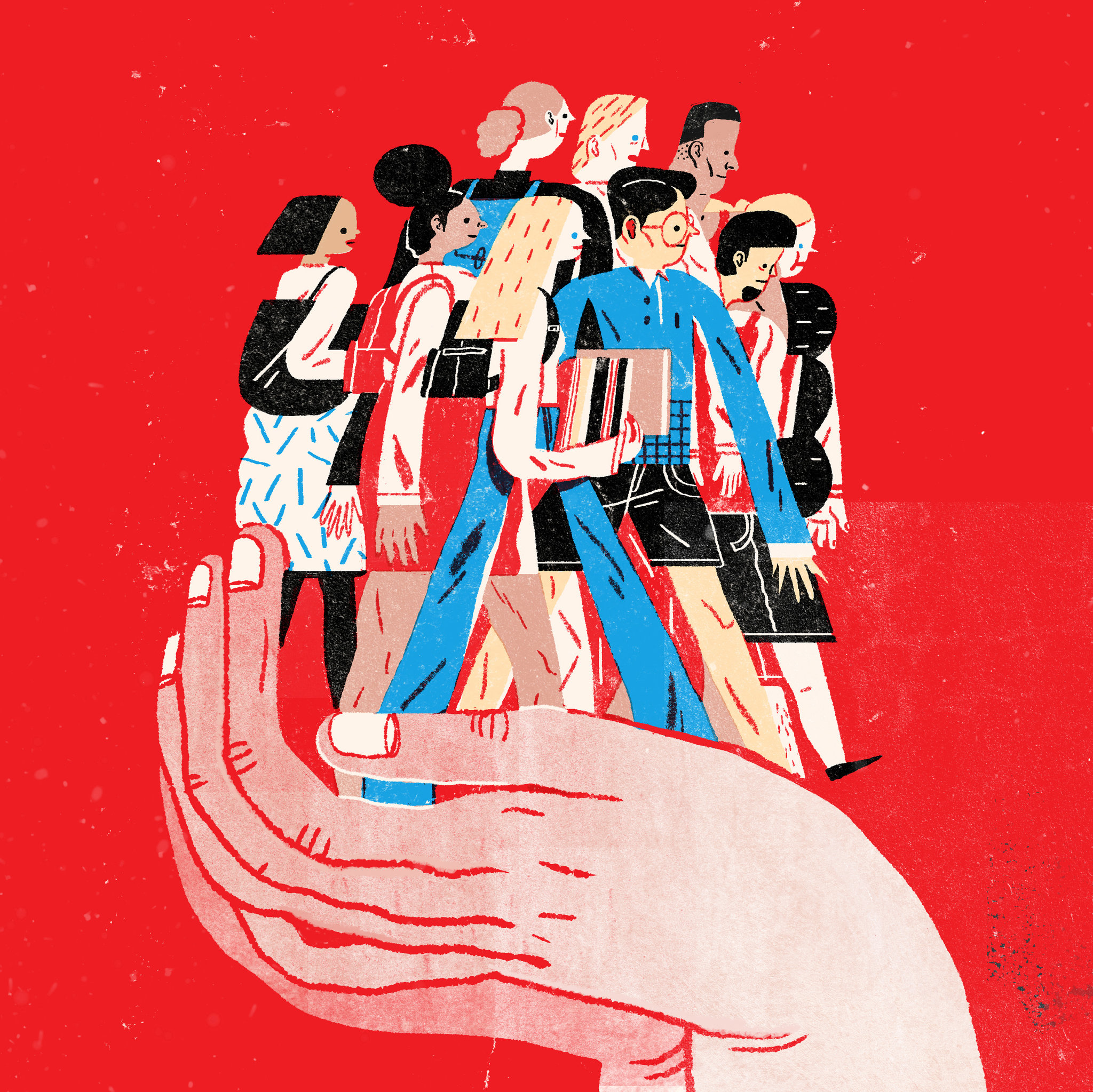
Image from the New York Times opinion piece titled "Affirmative Action Survives Again." It shows white hands holding several multiracial students carrying backpacks and holding books.