
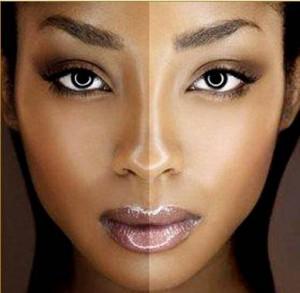
 I remember hearing about skin lightening over a year ago. I recall being surprised that such a practice even existed, but in retrospect, perhaps I should not have been. The media seems to purport an overwhelming amount of imagery that caters to those with white/light skin (but that’s a topic that may be for another blog post).
Skin bleaching uses chemicals or natural products to lighten skin, and is common in communities of colour. Thus, it is apparent why the practice is problematic: it erases the very aspect of color from people of color.
Interestingly enough, a model who works in Mumbai stated, “obviously what you don’t have is what you want. The Western world, they go in for tans. They want to get a little brown touch to themselves. They think that’s hot…so, what we think over here, since we are brown-skinned people, white is hot.” So, does skin bleaching merely exemplify that people can never be satisfied with their bodies, and that they will always engage in different forms of embodiment in order to change their natural states?
Or, is there a more grim truth?
Lightening the skin can actually be traced back to colonization, when white skin was often preferred. Furthermore, it has been said by psychologists in an article that consumer demand (I assume they are referring to demand for skin bleaching, as the aforementioned article revolves around the topic) can be traced to perceptions that lighter skinned or white people are more sexually desirable, etc. The aforementioned insights appear to indicate that there is a standard of beauty that is playing out here, one that holds that white skin as favorable. Thus, it seems as though skin bleaching is a product of racism.
While thinking about skin bleaching, a few questions came to mind. What if people were to dye their bodies a color that no one was born with (i.e. purple)? What may reactions to that body modification be? Would the modification be considered a product of racism, as it involves a divergence from natural skin color? Also, are there any other forms of body modification that are a product of racism?
 Unruly Bodies
There are so many other forms of body modification rooted in racism! The first thing that comes to my mind is the idealization of caucasian hair. Many Black women change their hair to look straight and long. Also, there is Asian Double Eyelid Surgery in which the eyelids are made to look more like that of a caucasian person’s. These two examples of body modifications adhere to Eurocentric beauty ideals. I know what you mean, when I first learned that African American’s have used bleach to lighten their skin, it seems terribly unsafe and it blew my mind. But really, how surprised can we be? The racial hierarchy has been incredibly powerful in the history of the United States and it seems that the African Americans who did gain power seemed to all be lighter skinned. Beauty is in the eye of the beholder…but the idea of beauty is evaluated within a social context.
I feel like almost all body enhancement or reduction can be linked to a particular ethnic superiority. The person that came up with the idea of women gluing lashes onto their own most likely saw an ethnic group that had theses features that they wanted. Getting a bigger breast or but to look more curvacious. The list goes on and on. But I think it can go both ways. African American/ Black are encouraged to become lighter while Caucasians are encouraged to tan and have a “Mediterranean” look. Either your breast are to small or too big. There is always a problem that the people selling these products optimize on. Heaven forbid we love ourselves what would happen to all the thousands of beauty products?
Being a part of the African American community, I have been around people who partake in skin lighting regimes. In my opinion, blacks that are perceived to be mixed or have some European or Hispanic lineage are treated better than dark skinned people. This notion drives darker skinned people to hate the skin they live in because fairer skinned people are typically awarded with more social and economic advantages. The social construct that we live in allows people to measure their beauty by their skin tone which frightens me because some people will do to dangerous lengths to achieve a lighter complexion.