
This post could be triggering for people who struggle with body image.
Or maybe not. That’s the question.
My Body Gallery first appeared on the internet sometime around August 2011, judging by the number of posts written about it on other websites during that time (see: Jezebel, The Hairpin, NY Daily News, Yahoo, and more). The basic idea is that women upload pictures of themselves and then categorize them based on their height, weight, pant size, shirt size, and perceived body type. Other women can then search the site by their height and weight, and to see what that looks like on other women. According to the website, the point is to allow “other women to see that the world is not a place of cookie cutters,” because women “are all different in our body shape and size as well as our place in our journey to loving our bodies exactly as they are, not as we (or others) think they should be.”
Initially, though I recognized that the site obviously had its problems, and that it could be difficult and triggering for people who already had a history of or an inclination to compare themselves to others, I found the site interesting. It could be helpful for people who have an “ideal” weight to see that their ideal might be different in reality. There are not a lot of people of my height and weight, on this website or otherwise, especially considering the number of people that uploaded pictures for, say, 5’5″ and 120 pounds. I like knowing that there are other people who look like me (and, notably, all of the people in that category appear to be white). If sleeves are never long enough and pants are rarely made in your size (and, when they are, they’re never labeled “regular”), or if you have to order your shoes from a niche company who makes them large enough, or you have to shop in a “special” store, or you’re always hitting your head or ducking, or you’re not tall enough to ride the roller coasters, it can be comforting to know that you’re not the only one. But good luck if you’re 5’5″ and 360 pounds. Apparently, there is no one else like you.
So that, then, is one of the problems. Even if the site continues to exists for several more years, even if people continue to submit their pictures to it by the thousands, it will never encompass the entirety of bodily experience. It is possible to search for any weight by an interval of ten pounds between 100 and 500 pounds. That’s a decent range, but there are not many people in the larger or less frequent categories. They are possibly the people who would benefit most from knowing that there are others with similar bodies. On the other hand, seeing that there are no pictures in your category- but plenty that are 5’5″ and 120 pounds- only reenforces those feelings of deviance.
Then there’s the fact that the pictures are almost entirely of white people, which in part reflects the general whiteness of representation on the internet.
And the fact that, even though women are not “cookie cutters,” they’re still trying to categorize women into categories of weight, and more tightly into categories of “body type,” which is apparently limited to pears, apples, bananas, and hourglasses. I have never personally met anyone shaped like a banana. If you do identify as banana-shaped, I certainly don’t want to deny your experience, but I imagine it would be hard to stand, and harder to walk (Have you ever tried to stand a banana up? All you get is bruised bananas.).
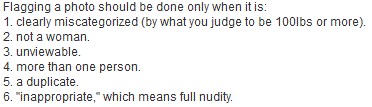
Are people uploading pictures of dogs?
And then there’s the thing that bothers me most. This site is for “real women.” The is an alarming amount of shaming of skinny people within the “body positivity” movement, and plenty of dialogues that replace current beauty standards with other beauty standards- for example, that “real women have curves.” Worse, the site appears to be only for women, and since whether or not a picture is of a woman is decided by how other members “judge” it, I worry that the site is only for ciswomen.
So, what do you think? Is this more helpful than harmful? Do you plan to upload your picture?
 Unruly Bodies
Thank you for addressing the tendency to shame skinny women within communities that claim to preach “body positivity.” If REAL women have curves, are women with less noticeable “curves”, not real women? If curves are in any way related to hormone levels or genetics, would any site claiming to empower the diversity of men’s bodies claim “real men have big dicks”?
I defiantly think there is a disparity between curvy women and women who are deemed as skinny. I think that one issue is that many ‘curvy’ women also happen to be over weight and pushed to be skinny. Also ballerinas, dancers, models etc are continually told to be skinner. This is one cause for anorexia. So I believe one cause for the ‘real women have curves’ derives from this phenomena. But I think the better push would be to give all women of all body types the confidence and ability to love their body. The rhetoric of the phrase ‘real women have curves’ is problematic because like ‘cocoirie’ said what if a women doesn’t have curves does she then not qualify as a ‘real women’?
This is a really interesting phenomenon – I had never heard of it! It seems that a lot of “well-meaning” body image projects can be problematic like this one, such as the “real women have curves” campaign. Many “real” women don’t have curves!
It sounds nice to have a website where women can see other women who look like them… but as in all the examples you state, exclusion is still prevalent. The prevailing whiteness of this website is particularly striking.
I agree with Eva – this site is really interesting. I’ve seen other “body positive” websites and blogs (e.g. http://fuckyeahbodypositive.tumblr.com/) that involve people submitting photos, but from my experience these images are not sorted or categorized. Posts on these sites typically include a photo and a small blurb or story from the person submitting. Here is an example I found on fuckyeahbodypositive: “figuring out how to feel fantastic in this body took a long time. but now i can say, with pride, that it’s home. it’s all mine. and i LOVE it.” While not all of these posts exude confidence, most of them provide a context. This is absent in My Body Gallery and I think that is also problematic. I can understand the desire to compare bodies, but I think because there is not a context for the photos, it becomes confusing as to what comparing sorted and categorized bodies results in. It’s also interesting to think about how embodiment come into play. Are the bodies on My Body Gallery embodied? What about the images with black bars across particular body parts? I’m curious as to how the people posting and looking at photos feel. Clearly this is subjective, but I wonder if it is empowering for some people.
I think this is invigorating for woman who are curious to see what other people see in a safe forum. Body image issues are common among most women. Many of us never overcome the self-consciousness. But being able to see someone, who doesn’t look like Angelina Jolie or a skinnier copy is empowering. Searching my own height and weight combo, I found woman with curves, others with flat abs. Some with large chest, others with more modest endowments. It amazing how I categorized my pant size to mean a certain body type, but in actuality, its just a generic number that varying body types identify themselves with.
Thanks for explaining your experience. That makes a lot of sense.
I tend to float through a lot of body positivity/fat acceptance (FA) circles and am actually surprised that I’ve never run across this! It reminds me of a project Kate Harding (a fat activist and founder of the blog Shapely Prose) did a number of years ago. She wanted to create a visual image of what BMI categories actually look like, so men and women posted their pictures on a flickr group, including their height, weight, and BMI category. Like this set, it is enlightening, not only for what each category looks like, but also how limiting BMI can be.
Thanks for sharing this. I was genuinely surprised by the people that were considered “obese” or “overweight” or “morbidly obese.” The overweight people look completely “normal” to me. Interesting.