
Self-Diagnosis

According to a “recent study,” conducted by a company that maintains an online self-diagnostic tool and then misinterpreted by some website on the internet, “1 in 4 British women has misdiagnosed themselves on the Internet.”  Mind you, this wasn’t just posted on any old internet, it was posted on the Internet, so it’s totally legit, guys.  I believe it.  (By the way, Jezebel has some commentary that, while not problem-free, tickles the funny bone.)
This blog needs more color, so here's a rainbow.

Regardless, it raises some important questions about the role of diagnosis and self-diagnosis.  When overused or used irresponsibly, self-diagnosis on the internet can lead to a lot of unnecessary worry.  It’s an especially big problem in a culture that does not openly discuss bodies or illness, making it difficult to determine what is “normal” and “abnormal” for a body to do.  Female bodies, disabled bodies, older bodies, trans bodies, and non-white bodies, in particular, are susceptible to this kind of worry.  If your body was never “normal” to begin with, how can you possibly know if something is wrong?  If your body has always been strange or mysterious or untrustworthy, when does it cross the line from weird to dangerous, or sick?

I don’t have exact answers to these questions.  I do know, however, that since the majority of people cannot afford to see a doctor every time their body aches or something leaks, and since most female, aging, disabled, trans, and non-white bodies (to name a few) are not given serious consideration in the doctor’s office, the internet is an important diagnostic tool.  Several years ago, for reasons I can’t remember, I found a diagnosis for myself on the internet, and it was a major turning point.  As far as I knew, this was the way that I had always been, but at that time, I started to realize that it wasn’t the way that I would always have to be. It didn’t change my anxiety, but just having a name for it allowed me two conceptualize the phobia and my personality as two separate things.

These people stared at this x-ray for hours before realizing that it was blank.

When I later filled out an inventory or questionnaire, I hit every one of the symptoms.  But I never would have known that these were symptoms without coming across that page on the internet.  How could a doctor have possibly diagnosed me if I never expressed that anything was wrong?

Of course, my story might be unusual, and it might be somewhat unique due to my class privilege.  Still, I maintain that the internet should have a place in diagnosis, since no doctor can ever know a person’s body better than the person themself.  What do you think?  Does self-diagnosis cause more harm than good?  How can the internet be used or changed to improve diagnosis and available medical information?
A Strange Kind of Mirror

This post could be triggering for people who struggle with body image.

Or maybe not.  That’s the question.

My Body Gallery first appeared on the internet sometime around August 2011, judging by the number of posts written about it on other websites during that time (see: Jezebel, The Hairpin, NY Daily News, Yahoo, and more).  The basic idea is that women upload pictures of themselves and then categorize them based on their height, weight, pant size, shirt size, and perceived body type.  Other women can then search the site by their height and weight, and to see what that looks like on other women.  According to the website, the point is to allow “other women to see that the world is not a place of cookie cutters,” because women “are all different in our body shape and size as well as our place in our journey to loving our bodies exactly as they are, not as we (or others) think they should be.”

Initially, though I recognized that the site obviously had its problems, and that it could be difficult and triggering for people who already had a history of or an inclination to compare themselves to others, I found the site interesting.  It could be helpful for people who have an “ideal” weight to see that their ideal might be different in reality.  There are not a lot of people of my height and weight, on this website or otherwise, especially considering the number of people that uploaded pictures for, say, 5’5″ and 120 pounds.   I like knowing that there are other people who look like me (and, notably, all of the people in that category appear to be white).  If sleeves are never long enough and pants are rarely made in your size (and, when they are, they’re never labeled “regular”), or if you have to order your shoes from a niche company who makes them large enough, or you have to shop in a “special” store, or you’re always hitting your head or ducking, or you’re not tall enough to ride the roller coasters, it can be comforting to know that you’re not the only one.  But good luck if you’re 5’5″ and 360 pounds.  Apparently, there is no one else like you.

So that, then, is one of the problems.  Even if the site continues to exists for several more years, even if people continue to submit their pictures to it by the thousands, it will never encompass the entirety of bodily experience.  It is possible to search for any weight by an interval of ten pounds between 100 and 500 pounds.  That’s a decent range, but there are not many people in the larger or less frequent categories.  They are possibly the people who would benefit most from knowing that there are others with similar bodies.  On the other hand, seeing that there are no pictures in your category- but plenty that are 5’5″ and 120 pounds- only reenforces those feelings of deviance.

Then there’s the fact that the pictures are almost entirely of white people, which in part reflects the general whiteness of representation on the internet.

And the fact that, even though women are not “cookie cutters,” they’re still trying to categorize women into categories of weight, and more tightly into categories of “body type,” which is apparently limited to pears, apples, bananas, and hourglasses.  I have never personally met anyone shaped like a banana.  If you do identify as banana-shaped, I certainly don’t want to deny your experience, but I imagine it would be hard to stand, and harder to walk (Have you ever tried to stand a banana up?  All you get is bruised bananas.).

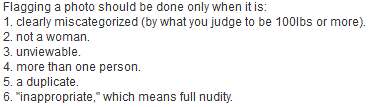
"Flagging a photo should only be done when it is: 1. clearly miscategorized (by which you judge to be 100 lbs. or more) 2. not a woman 3. unviewable 4. more than one person 5. a duplicate 6. "inappropriate," which means full nudity

Are people uploading pictures of dogs?

And then there’s the thing that bothers me most.  This site is for “real women.”  The is an alarming amount of shaming of skinny people within the “body positivity” movement, and plenty of dialogues that replace current beauty standards with other beauty standards- for example, that “real women have curves.”  Worse, the site appears to be only for women, and since whether or not a picture is of a woman is decided by how other members “judge” it, I worry that the site is only for ciswomen.

So, what do you think?  Is this more helpful than harmful?  Do you plan to upload your picture?

Androgyny

Often, we talk about “beauty standards” as a single set of rules, as though they can be internalized and followed the way one might follow the rules of grammar or mathematics.  Beauty standards have very real consequences for those who break them and also those who don’t, and they are so pervasive as to seem universal.  But they aren’t universal.

Take, for example, the context of the fashion industry.  Granted, there are plenty of harmful aspects of consumerism and misogyny in fashion in general.  Still, fashion is, purportedly, an art that pushes boundaries, even if it has inherited the unfortunate boundaries of the society of which it is a part.  This is an essay in itself.  What is interesting for the purposes of this post is how the beauty standards for fashion models differ from those for the average person in a given culture.  The purpose of fashion is to push boundaries, and so it continually shapes the beauty standards and trends for average people and then changes them.

Similarly, models are not held to the same set of standards.  Successful models have a certain set of common characteristics (tall, thin), as well as something that makes them “stand out”: a sharp nose, strong brow, angular jaw line.    At the same time, the desire for models who are tall and thin has necessarily led to an increase in models with androgynous bodies.  Perhaps the most popular androgynous model at the moment is Andrej Pejic, who in one season walked five men’s shows and four women’s shows.

His body seems to be proof that even biology is not dichotomous.  One would expect this to be more threatening, yet Andrej reports a happy, carefree childhood.  His mother is doting, his brother is supportive, and the hardest part of his teenage years, he says, was figuring out who he was.  The freedom that he seems to have felt from pressure to look or act a certain way, the ability to decide for himself who he wanted to be, is remarkable.  The following interview shows him to be level-headed and surprisingly unaffected by his sudden success as a model.

In the context of fashion, androgyny seems more acceptable, relatively speaking.  What do you think makes this the case?  Is this a positive move, or does it just reflect a fetishization of “unusual” bodies?