
As a person who is considered disabled in mainstream American society, video games have become a way for me to escape feelings of marginalization and feel powerful. More specifically, Western role-playing video games that allow the player to design what their character will look like, as well as the specific attributes they will have, are a very effective escape from the marginalization I often feel as a woman of color who is considered disabled. The player character also becomes very physically and politically powerful over the course of the game and has a significant amount of control over the world around them, contributing to my feelings of empowerment.
It is no surprise to anyone that is familiar with video games then, that Bioware games, which are known for their diversity as well as the amount of control the player has over their controlled character and the narrative have become some of my favorite games. Bioware games allow the player to customize the look of their controlled character, with sliders for facial features as well as hair color/style, skin tone, and eye color. Depending on the game, it may be possible to choose the fantasy race that the player character will be (elf, human, dwarf, etc.). For me, this is one of my favorite parts of a Bioware game, because I can make the hero of the story someone who usually would not be considered a protagonist in traditional mainstream media. While I like to replay games and make a different hero each time, I usually end up playing a queer person of color. Bioware games allow for this more than many other games, especially in their Dragon Age series, where the first two games have multiple bisexual love interests and the most recent game, Dragon Age: Inquisition, has multiple gay and bisexual love interests and characters.
Even though the protagonist faces several challenges over the course of the game (including, but not limited to: giant monsters, companion betrayals, and possible world-ending events!), I know that the player character will always be able to triumph somehow. The protagonist will almost always have the power to change the events around them somehow, which is not a feeling I experience often in real life. The protagonist will never experience true fatigue or the constant tiredness that I experience (or at least, it can be cured easily with some sort of magic potion). If they fail and die in battle, it can be solved with a simple reset. Although they can express despair and sadness (and I can imagine that they experience anxiety and depression), they will never be limited to lying in bed by their anxiety the way that I am. The protagonist is an extension of my body and feelings, but they are not limited by the constraints of my body, allowing me to feel empowered, moreso than if I was watching a TV show or reading a book. Even though most of this connection comes from my own interpretations of the character, I still have much more freedom to interpret the protagonist than I do in most other forms of media.
(Spoiler warning!) However, Dragon Age: Inquisition departs from this formula slightly. No matter the race, appearance, or gender of the Dragon Age: Inquisition protagonist, they are defined by the mark on their left arm that allows them fantastical powers. Near the end of the game, they are shown grappling with the pain and fear that their arm is causing them, a rare moment of physical vulnerability usually not illustrated by these invincible video game protagonists. At the very end of the game, regardless of any of their other attributes, they invariably lose their arm, becoming defined by their mortality in comparison to the allegedly immortal and god-like antagonist. Ironically, they then become defined by their lack of an arm in the epilogue of the game as it is the only thing that can be certain about their appearance – which does lead to some complicated implications.
However, their reaction to losing their arm is not defined primarily by devastation and despair as would be typical in many other works of fiction, and the epilogue of the game illustrates them going on a variety of adventures and continuing to change the world for the better. Depending on the choices made during the game, they may be depicted with a prosthetic arm, something that I could relate to as someone who uses an assistive device. Although it is important to note that the game does not actually let you play as the protagonist after they have lost their arm, this turn in the story still felt significant to me as a person who is considered disabled. As representation in video games continues to improve, I hope that explicit representation of people with disabilities will improve as well.
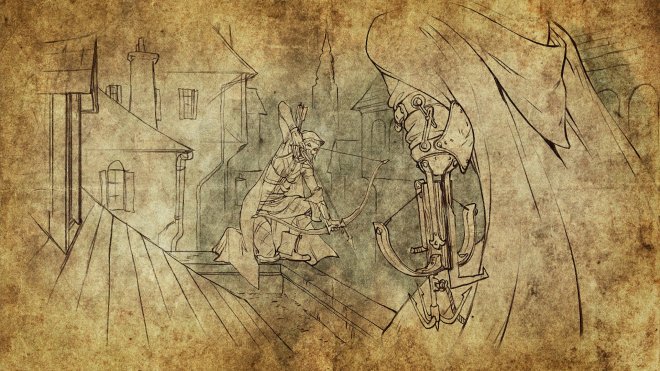


I do too feel a sense of escape when playing video games. With consideration that we do have different circumstances for our surreal sense of escape, but a common ground can be found between you and I. Video games allow us to be characters and people that we potentially don’t have the capability to be in reality thus allowing us to explore a world within our own. Sometimes it adds to our imagination and sometimes it limits it. But for the most part it gives us a sense of enjoyment and relaxation. I think another factor that adds into this is that we know, as you said, that the protagonist always prevails and that gives us a sense of hope that we too will prevail in our obstacles that we face in our own world
I also want for more representations of characters who are disabled in video games, as I feel that video games have become a part of the structure of media power. From there, I think people could experience non-normative lives and understand those lives better.
Of course, I’m worried of a possibility that disabled lives are valorized, removing room for useful discussions.