
Autism: autism spectrum disorder (ASD), is a neurodevelopmental disorder characterized by repetitive, restricted, and inflexible patterns of behavior, interests, and activities and persistent deficits in social communication and interaction.
Neurodivergence: people whose brain differences affect how their brain works
Autism and neurodivergence have always been a part of my family’s life, and navigating these experiences through my sister’s journey has taught my family and I so much about the importance of understanding and acceptance. Growing up, my sister always felt a bit different from her peers. Social interactions were often challenging for her, and she had intense interests that set her apart. It wasn’t until later in her life that she was diagnosed with autism. This revelation was both a relief and a catalyst for self-acceptance. Understanding her neurodivergence allowed her to embrace her unique strengths and acknowledge the areas where she needed support.
As I continue to educate myself on said topics I learned that one of the most significant challenges for autistic individuals, including my sister, is the tendency of society to infantilize them. This concept, extensively discussed by Jennifer L. Stevenson, Bev Harp, and Morton Ann Gernsbacher in their work, highlights how autistic people are often perceived and treated as less capable or childlike. This infantilization can lead to a lack of autonomy and respect, further perpetuating the stigma and misunderstandings surrounding autism. On the contrary Damian Milton and Lyte’s work on the normalization agenda and the psycho-emotional disablement of autistic people sheds light on the harmful effects of trying to “normalize” autistic behavior. The pressure to conform to neurotypical standards can be damaging, leading to feelings of emotional distress. It’s important to recognize that neurodivergent individuals, like my sister, have unique ways of experiencing and interacting with the world, and these differences should be celebrated rather than suppressed.
With that, I think in order to truly support autistic individuals, we must move beyond the stigmatizing narratives that surround autism. Understanding autism as a form of neurodivergence rather than a deficit allows us to appreciate the diverse ways in which people think, feel, and communicate. Education and awareness are crucial in breaking down these barriers. By fostering open dialogues and promoting acceptance, we can create a society where everyone is valued for their unique contributions. It’s crucial to listen to the voices of those who live these experiences every day. Their insights and stories are invaluable in shaping a more inclusive future. Challenging the stereotypes and misconceptions that surround autism and work towards a world where everyone feels seen, heard, and respected.
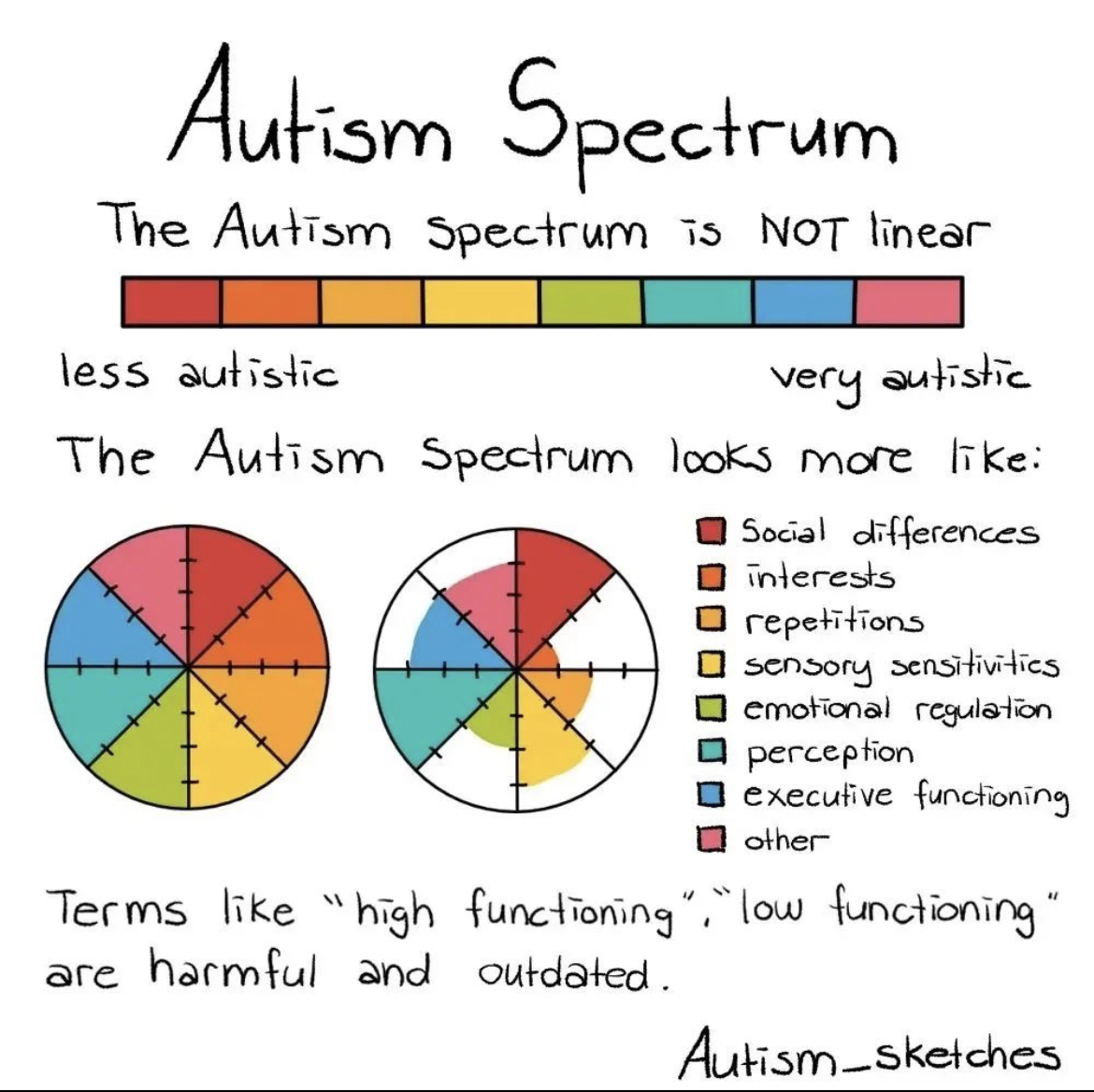
Below is the autism spectrum color wheel designed to help individuals with autism spectrum disorder (ASD) identify, express, and communicate their emotions and needs. It bridges the internal emotional landscape of a person with autism and the external world, providing a common language for understanding and interaction. The color wheel is particularly useful for individuals who are visual learners and process information more effectively through images, colors, and visual representations rather than verbal or written instructions. It can help reduce anxiety by providing clear, predictable information, enhance understanding of abstract concepts, improve independence in daily activities, and facilitate communication between individuals with ASD and their caregivers, educators, or therapists.
-Santana A 😕
 Unruly Bodies
Your post made me think of my little brother and his experiences with neurodivergence. My little brother is 13 years old, and is currently in online learning in his last year of middle school. At first glance, one might question why a boy his age is in online school, possibly missing out on social opportunities. This is a perspective that completely ignores my little brother’s individual needs as a neurodivergent person. How is someone supposed to focus on school, let alone social situations, when persistent bullying is occurring at every turn due to the stigma surrounding autism? Or when a standardized in-person classroom setting renders his individualized needs invisible?
PS: I had never seen the autism spectrum color wheel before, and I thank you for including this. I am thinking of showing your post to my little brother and my mother, as I think discussions like this are so very important in breaking the harmful stigma and infantilization of autism.