Above the village of Chamounix, where mountains touch the sky, I pen these words to you, Victor, with a heavy sigh. In your quest for creation, you sought to defy fate, But in your wake, you left a being to contemplate.
Performing “transgender rag”, I dance to my own tune, In a world that often judges, beneath the silver moon. Like your creation, I seek acceptance, a place to call my own, In the shadows of society, where seeds of doubt are sown.
Victor, do you see the pain you’ve caused, the tears that have been shed? In your pursuit of greatness, you forgot the living dead. Your creation, a reflection of your own inner strife, A mirror to your soul, a testament to life.
I too have felt the sting of isolation, the ache of being alone, In a world that often judges, where compassion is unknown. But unlike your creation, I choose to rise above, To seek out understanding, to find a place of love.
Victor, let this be a lesson, a message from the heart, That in our quest for knowledge, we must not tear apart The bonds that make us human, the ties that bind us near, For in the end, it’s love and kindness that conquer all our fear.
Autism: autism spectrum disorder (ASD), is a neurodevelopmental disorder characterized by repetitive, restricted, and inflexible patterns of behavior, interests, and activities and persistent deficits in social communication and interaction.
Neurodivergence: people whose brain differences affect how their brain works
Autism and neurodivergence have always been a part of my family’s life, and navigating these experiences through my sister’s journey has taught my family and I so much about the importance of understanding and acceptance. Growing up, my sister always felt a bit different from her peers. Social interactions were often challenging for her, and she had intense interests that set her apart. It wasn’t until later in her life that she was diagnosed with autism. This revelation was both a relief and a catalyst for self-acceptance. Understanding her neurodivergence allowed her to embrace her unique strengths and acknowledge the areas where she needed support.
As I continue to educate myself on said topics I learned that one of the most significant challenges for autistic individuals, including my sister, is the tendency of society to infantilize them. This concept, extensively discussed by Jennifer L. Stevenson, Bev Harp, and Morton Ann Gernsbacher in their work, highlights how autistic people are often perceived and treated as less capable or childlike. This infantilization can lead to a lack of autonomy and respect, further perpetuating the stigma and misunderstandings surrounding autism. On the contrary Damian Milton and Lyte’s work on the normalization agenda and the psycho-emotional disablement of autistic people sheds light on the harmful effects of trying to “normalize” autistic behavior. The pressure to conform to neurotypical standards can be damaging, leading to feelings of emotional distress. It’s important to recognize that neurodivergent individuals, like my sister, have unique ways of experiencing and interacting with the world, and these differences should be celebrated rather than suppressed.
With that, I think in order to truly support autistic individuals, we must move beyond the stigmatizing narratives that surround autism. Understanding autism as a form of neurodivergence rather than a deficit allows us to appreciate the diverse ways in which people think, feel, and communicate. Education and awareness are crucial in breaking down these barriers. By fostering open dialogues and promoting acceptance, we can create a society where everyone is valued for their unique contributions. It’s crucial to listen to the voices of those who live these experiences every day. Their insights and stories are invaluable in shaping a more inclusive future. Challenging the stereotypes and misconceptions that surround autism and work towards a world where everyone feels seen, heard, and respected.
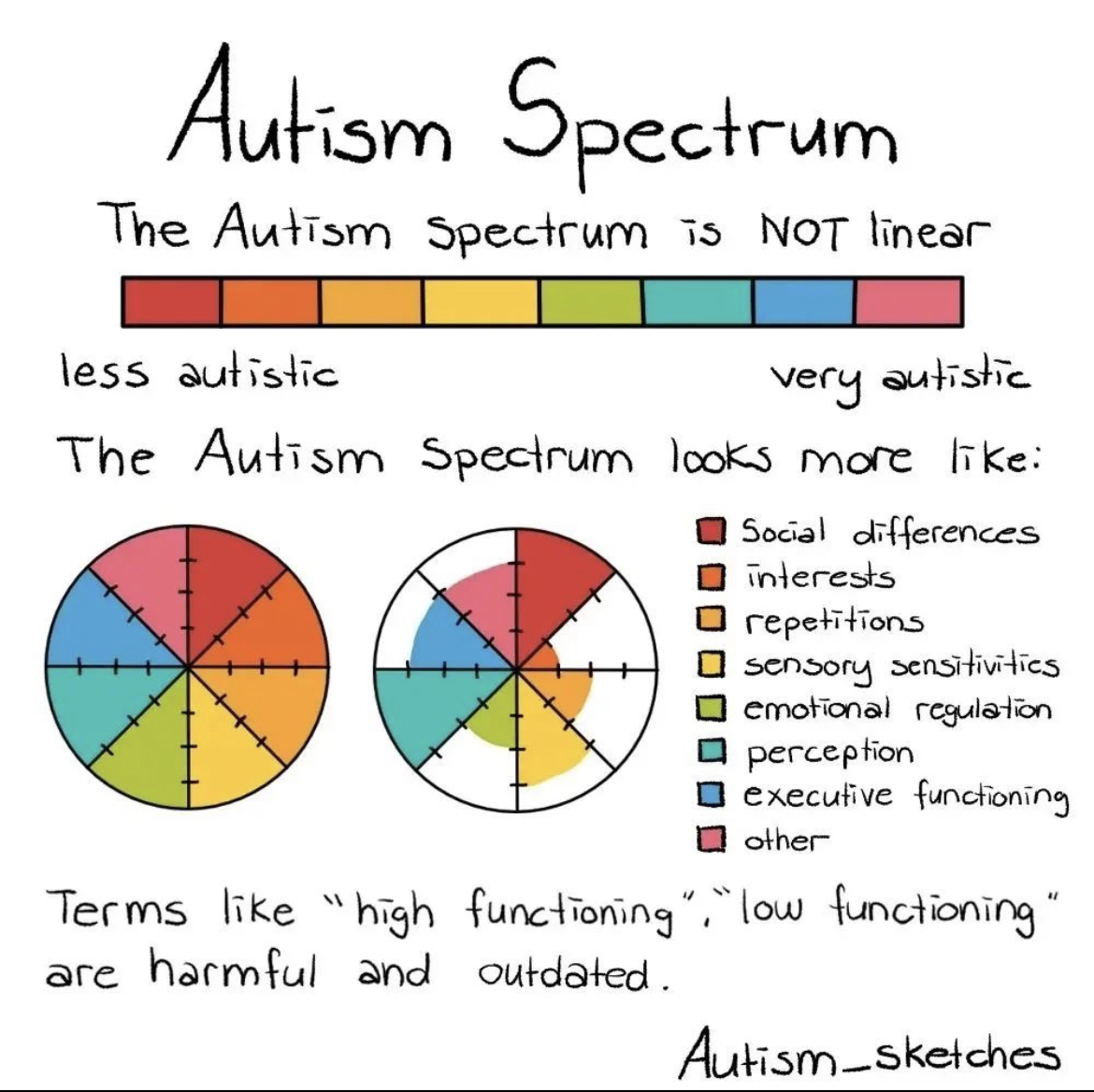
Below is the autism spectrum color wheel designed to help individuals with autism spectrum disorder (ASD) identify, express, and communicate their emotions and needs. It bridges the internal emotional landscape of a person with autism and the external world, providing a common language for understanding and interaction. The color wheel is particularly useful for individuals who are visual learners and process information more effectively through images, colors, and visual representations rather than verbal or written instructions. It can help reduce anxiety by providing clear, predictable information, enhance understanding of abstract concepts, improve independence in daily activities, and facilitate communication between individuals with ASD and their caregivers, educators, or therapists.
Pregnancy and childbirth are profound experiences, deeply influenced by the intersecting ideas of gender and race. These factors can shape how individuals navigate the healthcare system and how they are treated within it. Too often, the voices and experiences of marginalized groups are overlooked, leading to disparities in care and outcomes.When discussing who is “in charge” of the laboring body, we must consider the dynamics of power and autonomy within the healthcare setting. Ideally, the pregnant person should have control over their own body, making informed decisions supported by medical professionals.
However, the reality is that systemic biases and power imbalances can undermine this autonomy. From a young age, I experienced my own form of race based —————————————– experience in a hospital setting. Doctors assumed I had protein in my urine, leading to extensive and costly testing. Instead of taking the time to talk to me and understand my situation, they silenced my voice and provided false information. This not only drained me financially but also left me feeling disempowered. If they would’ve asked I would’ve told them that i’m on my last few days of my menstrual cycle, that could be the reason for the random particles of blood.
My story is just one of many. Women of color, in particular, face significant challenges in the healthcare system, including higher rates of maternal mortality and morbidity. These outcomes are not solely due to biological factors but are aggravated by biases and inequalities in medical care. Addressing these issues requires a fundamental shift in how we view and treat pregnant individuals, ensuring their voices are heard and respected.
So, who should be in charge of the laboring body? The answer is clear: the pregnant person. Medical professionals should act as allies, providing support and expertise without undermining the individual’s autonomy. By fostering an environment of respect and understanding, we can work towards a more equitable and compassionate healthcare system.
Growing up, I never wanted to be seen, quite frankly, I never liked attention but in a society where it is so easy to be forgotten I experienced the battle between the two. My features desire to be mysterious but my consciousness craves to be seen. How can the two even co-exist? The ability to appear and disappear to my liking was my super-power but I made it my job to be-friend everyone that even in my time of isolation I was always pointed out.
This internal conflict, is a rich ground for exploring phenomenology, the study of experience from a first-person point of view. Phenomenology delves into the structures of consciousness, mind, embodiment, identities, and memories, offering a profound lens through which to understand this paradox.
Consciousness and the Desire to Be Seen:
At the heart of phenomenology is the concept of intentionality, the idea that consciousness is always about something. My consciousness, with its craving to be seen, directs itself outward, seeking validation on recognition. This desire is not merely a superficial need for attention but a deeper yearning for acknowledgement of my existence and experiences.
The Mind’s Dual Nature:
The mind, in its complexity, harbors both the desire for visibility and the comfort of invisibility. This duality can be understood through the phenomenological concept of “neoma” and “neosis”– the content of a thought and the act of thinking itself. My neoma, the content of my desire to be seen, is in the constant tension with my neosis, the act of withdrawing into invisibility. This interplays shapes my identity and how I navigate the world.
Memories and Past Experiences:
My past experiences and memories are integral to my sense of self. It informs my present consciousness and influences my future actions. Phenomenology views memories not as static snapshots but as dynamic, lived experiences that continue to evolve. My memories of seeking and avoiding attention are not just recollections but active components of my current identity, influencing how I navigate the tension between visibility and invisibility.
Conclusion:
The paradox of wanting to be seen and unseen is a deeply human experience, one that phenomenology helps me to understand in all its complexity. By examining the structures of consciousness, mind, embodiment, identities, and memories, I can gain insight into this internal conflict and find ways to navigate it more harmoniously. ——————————– In the end, the coexistence of these desires is not a contradiction but a testament to the richness of human experience. It is through this lens that I can appreciate the beauty of my multifaceted self and the intricate dance between visibility and invisibility.