
So earlier I was trying to do this assignment and I was critiquing it constantly and trying to make it sound more deep and professional than necessary so I’m starting over with a new approach. Dr. Kate said that it should be in “our own voice” so I’m going to write in a sort of free-write style. That being said, bear with me.
My idea for the blog comes from the very first reading we were assigned this semester. When I was reading it for the first time, some of it was confusing me quite a bit but there was one particular section that was pretty straight forward to me. Within the first couple of pages, the authors talk about bodies in relation to cyberculture. They particularly mention how, in the 21st century, we are able to have an extension of our bodies in the form of televideo calls and/or avatars. In other words, the body is not just the physical being.
This got me thinking about my own experience with video game avatars. Since I was a child, I would always, without a doubt, choose to play as the male character and not the female character (even though I was AFAB). Like whether it was Mario Kart or Papa’s Hotdogeria, my character had to have the ♂️ selected. Even when I would play board games like Clue with my family, I would always choose Prince Azure over Lady Lavendar. I remember feeling some level of guilt for picking to play as these characters as I started to approach middle school age, but I literally could not force myself to pick the others.
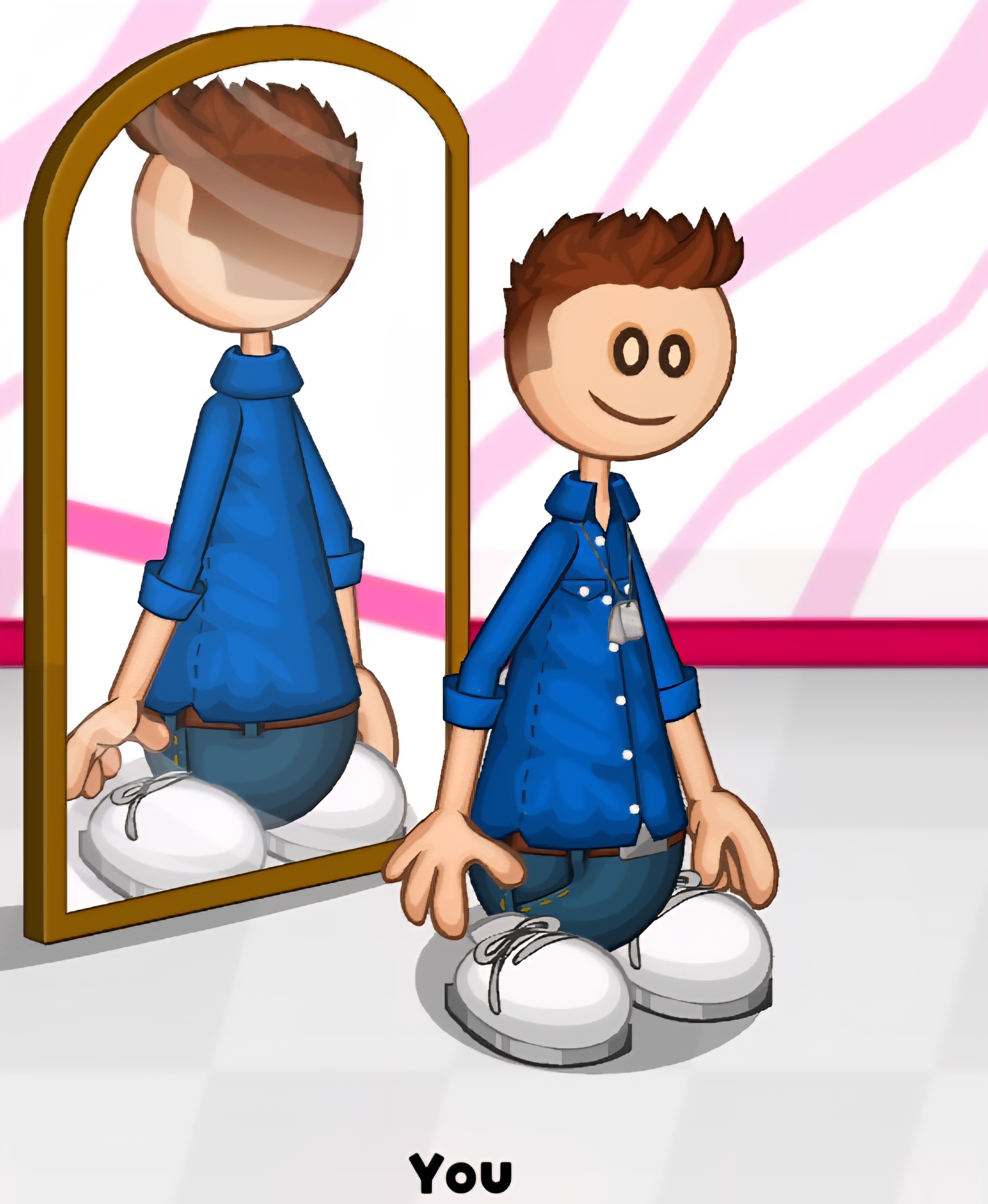
Not to get too vulnerable or personal or anything but I’m going through a bit of a gender journey at the moment and this has actually been something I’ve been reflecting on for the past couple of months. My desire to “be” the boy characters in these games, I’m starting to believe, was likely a projection of what I wanted for myself in real life. This didn’t exactly feel like something I could be capable of when I was 8 so I was confined to doing it from behind a controller or keyboard. However, I think I was actually lucky to be able to somewhat experience worldly interactions (even computer-generated ones) from the perspective of the body I mentally felt comfortable in even though it didn’t match my physical body.
Some people get tattoos and piercings to feel more appropriate within themselves. I, and many others, chose to take it a different route (not that I haven’t also partaken in the former). By accepting virtual avatars as an extension of myself, I allow myself to learn about my own identity and perform it (think “doing gender” in my case”). I think we are all lucky to be able to have this type of outlet for exploration and expression and we shouldn’t take it for granted. I hope we can find even more ways in the future for people to safely/freely form their identities in terms of embodiment.
 Unruly Bodies
I really like how honest your post is, especially the way you connected that reading to something personal like your game avatars. The part about always picking the male characters stood out to me because it shows how these little choices we make as kids can actually be really meaningful when we look back at them later. I think it’s interesting that you framed avatars as an extension of the body, because these connections can be empowering for us in real life. Your point about tattoos and piercings was a nice comparison too, since it shows how people find all kinds of ways to embody who they are. Thank you for sharing!
I loved reading this post. As a trans man myself, I would play a lot of the more “masculine” female characters in video games, always choose the shorter hairstyle options even when my hair was long. I cut my hair for the first time in seventh grade and it was like a weight off my shoulders. It made me feel like less of a “fraud” when I designed my characters that way, because now it was what I actually look like. Even when I identified as non-binary, I started playing male characters in my TTRPG campaigns because I just felt that it fit me more. Before that, I was one of the only AFAB people in my high school theatre troupe who was okay with being cast as a male character. It is really interesting, the way that we put ourselves into the characters we play, even when the traits are things we may not understand about ourselves.
I liked your post a lot. I think that video games are a great outlet of expression and can often reflect the character of the player. I like that video games can often be the first area of gender exploration that children and teens can safely explore without any real life consequences.
I usually made more androgynous-leaning characters in papa’s games. I today identify as nonbinary. However! in Mario Kart I was always Princess Peach because she is my favorite, and I even have 3 little figurines of her in my home.
Hello. I enjoyed your blog post. The part in the first reading about how our presence online is a non-physical extension of our bodies stood out to me as well. I thought about how the aesthetics we curate and information we choose to share about ourselves on online accounts reflect how we perceive ourselves and wish to be perceived without being restrained by our bodies. I thought about it more in terms of social media accounts and character creation, but your blog post made me consider the psychology behind the characters we pick to represent ourselves in video games too. A few weeks ago, someone said to me that they noticed there doesn’t seem to be an overwhelmingly dominant style among our age group, that we’re all presenting ourselves in unique ways. I wonder how growing up with virtual tools of self-expression contributed to that.
I liked how honest and human your post was. I also find it weird how there tends to be a pressure to choose a video game character of the same gender even if one might just inherently be cooler. A game I play that sorta has the same kind of thing is a game called spelunky 2 where while there might be some cool male characters(I am a man), majority of the cooler looking characters are female but it always feels weird to choose them but I think that after reading this, I might as well go with what feels right.
I can really relate to this. As a nonbinary person, I have often struggled to find characters in games to reflect me, especially because the characters are often hypermasculine or hyperfeminine. World of warcraft, my favourite game actually switched from male and female characters to body type one and two, and allowed all customization options to go on both body types. Seeing that change was awesome. When I was younger I was very annoyed I couldn’t have long hair and makeup and earrings on a masculine character, or shorter hair on a feminine character. Little me is very happy seeing myself reflected in videogames.
I had never considered the fact that video game avatars have always allowed us to have a safe(ish) place for our youth to experience gender the way they feel is right to them.
Even thinking back on my own experience, I would always want to be the most girly girly (bonus points if she was wearing pink) as my avatar because that affirmed my gender expression.
Nowadays a lot of childrens MMOs (like club penguin, pixie hallow, or wizards 101) are either defunct or barley hanging on. However these sites really did let us create the person we wanted to be (even if we didn’t realize it). I hope future generations get more online games.
Thank you for sharing your experience 🙂
I really appreciate how you tied the reading on cyberculture to your own experience with avatars. It makes the idea of “the body beyond the physical” much easier to understand. I also related to what you said about guilt when choosing characters, since gender expectations get pushed on us even in small things like games. Your thoughts on avatars as a safe way to “do gender” made me think about how digital spaces can actually give us freedom to experiment with identity in ways our physical environments sometimes don’t.