
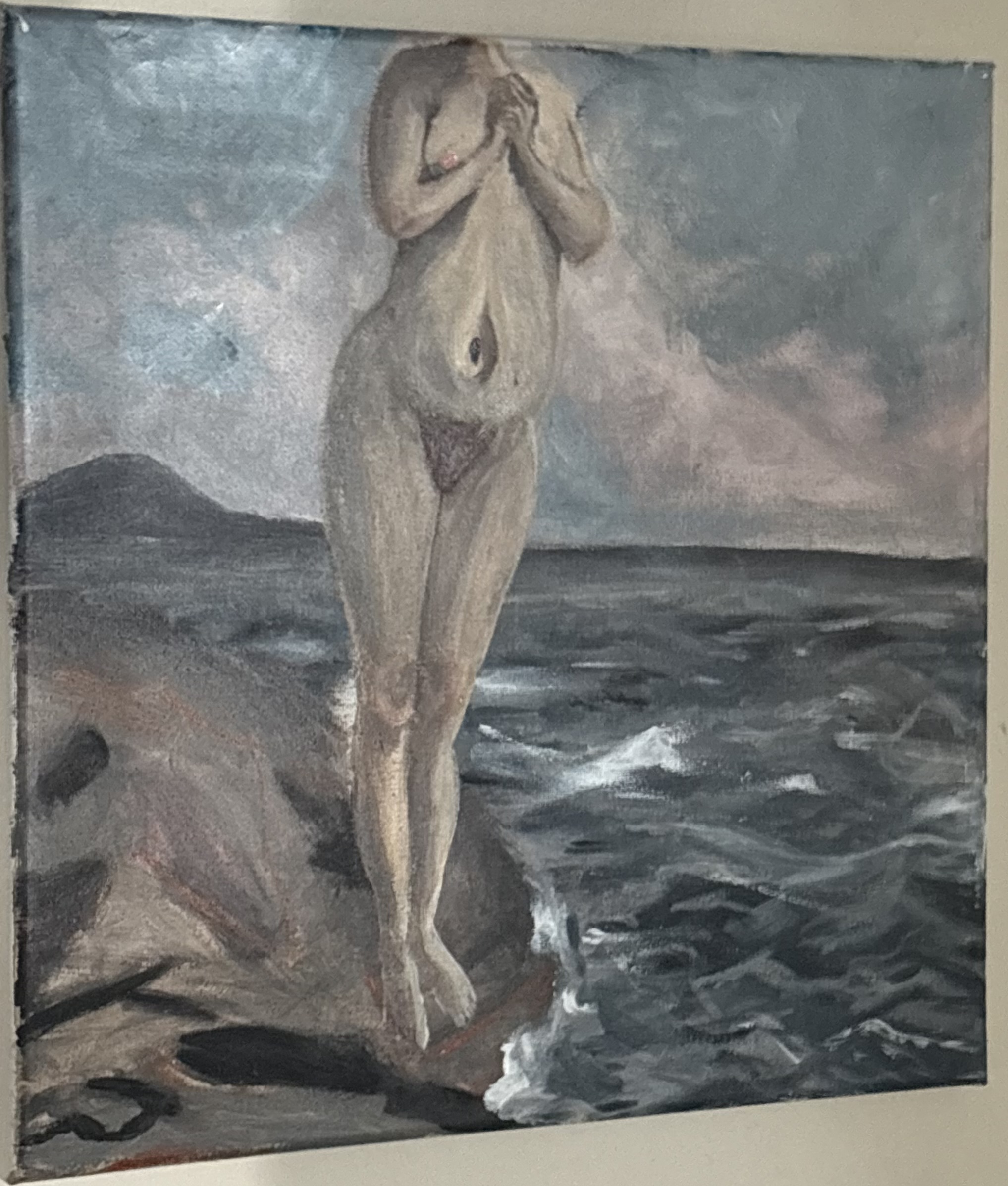
The Muse’s Misfortune
To be a muse is to be worthy. To be a muse is to be beautiful and talented, chosen and seen. To be a muse is to be exhilarated and exhausted, honored and objectified, proud and pornified. There cannot be one state of being without the other, so long as there is one being to perceive and one being to be perceived.
Read more: The Muse’s MisfortuneIn some societies, perhaps, it is possible for a muse to exist without the constant fear and awareness of their own and another’s presence. In patriarchal and sexist cultures, however, the muse faces an internal and external threat of surveillance, and therefore sexualization. “(Patriarchal and sexist) society defines woman as object, as a mere body, and… are in fact frequently regarded by others as objects and mere bodies” (Young, I. “Throwing Like a Girl: A Phenomenology of Feminine Body Comportment Motility and Spatiality,” p. 153-154). For feminine muses, they “learn to live out (their) existence in accordance with the definition that patriarchal culture assigns to (them, and) are physically inhibited, confined, positioned, and objectified” (152). The definition becomes internalized, which then manipulates and forces women into being more feminine- more submissive, docile, small, quiet. “Women often approach a physical engagement with things with timidity, uncertainty, and hesitancy… (They) lack an entire trust in (their) bodies to carry (them to their) aims. There is… a double hesitation here. On the one hand, (women) lack confidence that (they) have the capacity to do what must be done… The other side of this tentativeness is… a fear of getting hurt… (They) often experience (their) bodies as a fragile encumbrance, rather than the medium for the enactment of (their) aims” (143-144). The subordination of feminine beings is at the root of patriarchy, and it grows as more minds and bodies accept the notion that feminine and masculine categories cannot intermingle. The stronger the patriarchy becomes, the more ‘natural’ it seems that feminine bodies are weaker than masculine bodies. In reality, women “have more of a tendency than men to greatly underestimate our bodily capacity,” as well as the relentless pressure of being perceived as a muse, which results in under-performance.
 Unruly Bodies
I feel that because I held this belief as a child that I wasn’t pretty, and that was the reason why I experienced bullying, it largely negatively impacted both my self-esteem and my future decisions. After going through puberty and coming back from lockdown, boys weren’t mean anymore, but they weren’t nice either. Unfortunately, after never having positive experiences and interactions with boys, I misconstrued lust as kindness, desire as intrigue. While the newfound attention was comforting for a while, it quickly turned into shame and caused low self-esteem and self-worth, two issues I still struggle with to this day.
Very well written post. For me, when I read the first paragraph it captured my personal reflection on the stuff we had talked about in class about the internalized objectification, and dis-unity with ones self. Being someone’s muse often requires some kind of disunity since your role as a muse is an object. I think a lot of women relate to this ‘muse’ role in their interactions and relations with men. I think of the manic pixie girl trope and how that mirrors the relation between an ‘artist’ and his ‘muse’.
Your blog post reminded me of a quote by Margaret Atwood in The Robber Bride, “You are a woman with a man inside watching a woman. You are your own voyeur.”
Being a woman sometimes feels like living in 3rd person mode with the way we consciously and subconsciously surveil our own body language and appearances. We are socialized from a young age to always think about other people’s literal view of us (like Dr. Kate’s example about a girl being told to be careful climbing on playground equipment because she had a skirt on). We are taught from a young age that it’s safer to be small and docile as a girl and a woman, but in reality making ourselves meeker has never protected us.
I really like how you framed the idea of the “muse” as both empowering and constraining. It captures that contradiction of being seen as inspiring while also being objectified. Your use of Young’s text makes the connection to bodily inhibition really clear, especially the way confidence gets chipped away by people’s eyes constantly on you. It made me think about how internalized gender norms not only limit movement but also shape identity itself.
I love how you’ve highlighted the contradictions of a woman’s believed point of existence. While we’re expected to be somewhat confident, we also should be careful of how much space we take up to not overstep our predetermined places. Since women have always been burdened by expectations that often overlap, we tend to think a lot about how we present ourselves and if we’re doing do in a way that makes us admirable.