
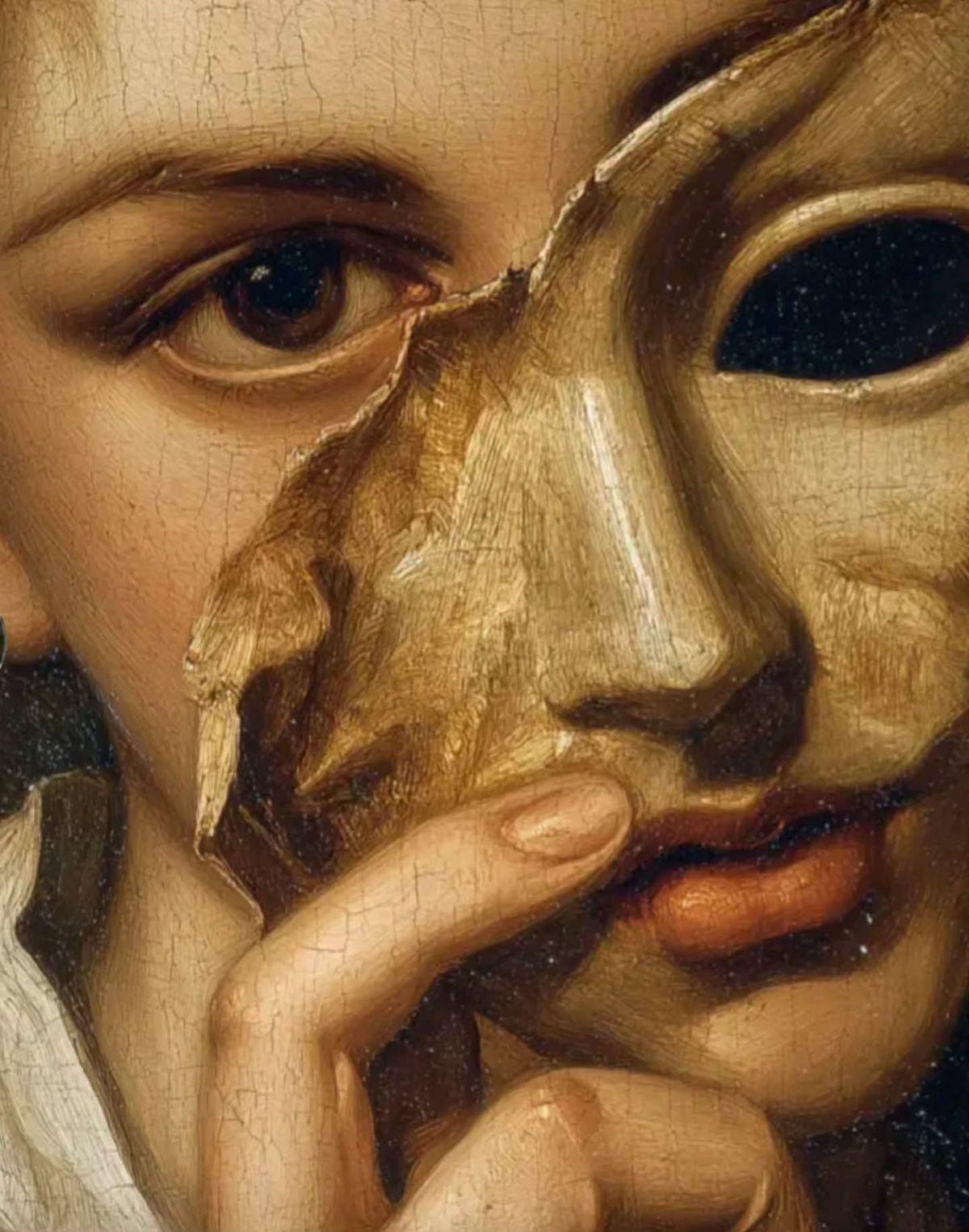
The image portrays an old oil painting displaying a figure holding up a broken mask to their face.
In our earlier lessons within class the question of “are we our bodies?” was discussed. Of course the general response was no, we aren’t. Our bodies are a vessel for our minds, they carry our dreams, fears, beliefs, personalities, and so much more. However, if people are so much more than the body why does it seem like it is such a determining factor in our lives?
The idea that one day society might solely perceive us for our minds, allowing brilliance to always surpass physical aesthetics, is an optimistic idealism but by no means a realistic one. As discussed in class, as humans we have bias. Defined by Merriam-Webster as “a systematic, unreasoned distortion of judgment or mental shortcut that alters how people perceive information, make decisions, and interact with others”. There are a myriad of different types of biases but the idea is that because of bias we at times irrationally flip what we see and take it as fact. If you see an older man with tattered clothing sitting on the curb you might assume that person is homeless. It’s not usually a situation in which you would dwell over it or even think twice about your conclusion. Not because you are careless but because bias is an innate response, ingrained within us to act as a biological survival tool.
By now most people have realized a first glance can deeply affect the way in which someone will view you. With this knowledge we turn our bodies into tools or gateways. We dress ourselves up for important events because that is the invitation in which people get to know us or for how we hope to be perceived. If we want to blend in we dress our bodies in casual wear that wouldn’t stick out or be unusual within the setting. Our bodies are much like a decorated mask that we paint to influence the thoughts of others. Although it is a great power we possess to be able to disguise or to express many don’t get the opportunity to hide what would be seen as a detriment in society and nor should they have to.
Black women have often been deemed promiscuous because of the way in which we at times have more curves than the people who created the physical norms within America. Yet this sort of notion that our predetermined bodies relay us as wanton or loose is absurd, because the policing of a black woman’s body starts within childhood. When I think of this topic I often think of the association of certain colors with being “grown” or “fast” within the black community. When I was young I was told I couldn’t wear red nail polish because it was seen as too adult. I never understood how a color could belong to one demographic, who would reasonably look at a child and perceive them as something to be seen sexually because of their nail color? What makes pink or yellow more acceptable than red?
For some this sort of painting of the metaphorical mask can feel freeing, for some it is done out of obligation, and for others it could be done out of survival. It can be interesting to think about the duality of a body, in one case it’s our way of freedom, it’s how we express ourselves, how we perform, how it’s possible we act out our wants. Yet at the same time it can be constricting to live in a body, especially if it isn’t possible to modify the parts of us that may garner us harm within the world.
 Unruly Bodies