
TW: Child Abuse
In public spaces, activists, dissidents and protestors place their lived bodies directly under the ‘knife-edge of power’. They risk physical safety to force visibility, demand accountability and disrupt existing systemic oppression. We typically apply this framework of body-based resistance to large scale, public political movements. But power doesn’t just exist on the streets or picket lines, it operates everywhere. It made me realize that this battle for control isn’t just something we read about in our coursework or see on the news; it plays out inside the quiet, private architecture of our own lives as well.
For me, resistance did not begin in a crowd or on the street with a sign in hand. Rather, it began within my own family, in the very places that were supposed to keep me safe. As a child enduring abuse, home was never a sanctuary or source of comfort and safety. Instead, it was a danger zone defined by persistent fear and physical vulnerability. The fragile façade of a ‘happy family’ was precariously held together by an authoritarian regime and the mask of co-parenting handoffs. In my situation, and in others like it, the power of my caregivers was absolute, unchecked and often violently enforced. Failure to uphold the lies or an ill-timed slipping of the mask, threatened to bring the entire system crashing down.
Long before I had the intellectual vocabulary to articulate my trauma, or the physical agency to escape, my lived body became both the target of systemic abuse and the sole instrument of my opposition against it.
In an unsafe home, behind locked doors and unwanted touch, defiance didn’t look like an organized march or a loud public revolt. It often took place through small, but intentional acts of resistance. Sometimes, the protest was silence, a purposeful refusal to grant access to my pain. The absence of tears became a quiet boundary drawn on the surface of my skin. Other times my protest was teetering on the edge of recklessness, as I desperately tried to disrupt control and reclaim a sliver of agency. When directly telling anyone about what was happening felt impossible, I found other ways to push back. I would report on smaller, benign transgressions like riding my bike without a helmet, or staying up past my bedtime. I knew they wouldn’t shield me from the violations awaiting at the next visit, but they gave me comfort in that moment. These confessions were intentional flares launched into the dark, a child’s calculated attempts to protest and resist. It was my way to signal danger to outside adults, disrupt my abusers’ authority and to force a broken family system to account for itself.
For me, surviving was never passive. It was an active, relentless refusal to yield. Surviving became a quiet rebellion, carved out of the void, and a stubborn refusal to accept the person they wanted me to be.
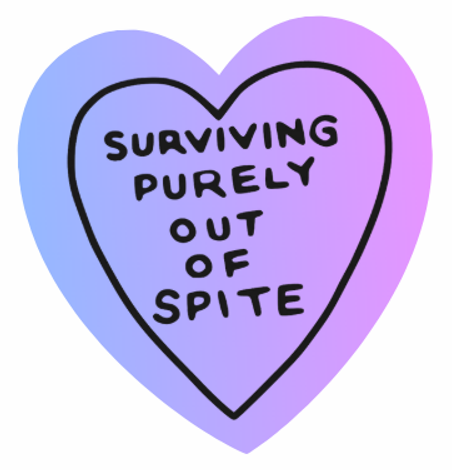
In a basic and raw sense, my resistance was survival powered by spite. However, spite, in this context, is not petty or trite. It was and remains a vital, life-sustaining force that drove me forward. Spite was my uncompromising and weaponized defiance. It was the force behind a persistent refusal to be erased. My abusers demanded total compliance and submission in an attempt to obliterate my sense of self and hope. By continuing to breathe, take up space and mature, I resisted their absolute authority and was eventually able to get away.
Now, my body’s very existence is the ultimate act of defiance. It is an undeniable record and tangible proof that in protest, I survived.
When we study systems of control, it is easy to view protest and resistance solely through historic movements, policy demands and public assemblies. But systemic oppression is also challenged in the quiet, private and often invisible spaces within our lives. For anyone who has had to fight for autonomy over their own existence, survival is not merely the aftermath of violence, but it is the foundation for freedom. As we see each other and ourselves through this lens, we can recognize that every living body carries its own undocumented archive of defiance.

