How I Became a “Failed” Dancer

I’ve always said that if I had had the choice, I would have become a professional dancer. 

I grew up in a sports world – soccer and basketball mostly – and I hated all of it. It was a required activity from when I was young because my dad was a coach and held firm to this grandiose idea that all his kids would grow up to be professional athletes. My older sister really inspired this, as she showed great promise in her athletic ability from a young age. Plus, she was naturally tall. I, as the second child, showed little promise as an athlete, with no indication of being tall, coordinated, or athletic, but was still forced into the activity against my will. 

I hated running and sweating. I hated the competition. I hated trying to coordinate my awkward limbs. I hated all of it. My very first soccer game at the age of 7 or 8 encapsulates perfectly my relationship with sports. During the kick-off – the very first kick of the game – the other team launched the ball square into my face, it toppled me over crying, and I sat out the rest of the game, refusing to play anymore. 

My younger siblings were also naturally gifted as athletes and excelled in both basketball and soccer. In middle school, my older sister, younger sister, and I were all on an intramural team that my dad coached. The team was split into the gold squad and the blue squad, both my sisters being natural stars of the gold squad, and I being the skilled bench warmer of the blue squad. I was content in that role, though, because it meant little play time on the court and I could goof off with the other non-athletic girls relegated to the blue squad, pretending to be cheerleaders instead. 

Dance was never an option for me. Growing up in a conservative religious household, dance was seen as inappropriate in nearly all forms. Most types of music were also forbidden so it wasn’t until I started sneaking around listening to “bad” music in my teens did I realize how much my body enjoyed moving to certain rhythms. Movement felt natural and instinctual, and it allowed me to tap into a confidence about myself that never existed when I played sports. 

As soon as I graduated from high school I left home, got a job, and immediately enrolled myself in jazz dance classes. I loved most everything about it, with one exception: as a late bloomer, I had grown into a decent basketball playing height (ironically) and was taller than every single person there, most of whom had been dancing from a young age. My lack of experience and lanky stature made watching myself dance, in the ceiling to floor mirrors of the dance studio, difficult to bear. As natural as I was, my inability to embody dance technically was frustrating and I did not have the self confidence to persist and give myself the time and consistency needed to improve. So I quit and moved on, swallowing the disappointment that dance was not the pathway I had thought it could be. 

Since then and throughout my adult life, I have enjoyed many different forms of dance, but have had to work through bitter feelings of not being able to dance at the level I wished I could, had I been able to pursue learning from a young age. Really, I think the bitterness stems from being forced into the years of experience I have in a form of movement that I dreaded every moment of, instead of having the opportunity to explore areas of movement where my heart was just as engaged as my body was. 

A friend who knows this story about me likes to joke that I’m a “failed” dancer, a seemingly cruel joke about something so dear to my heart, but one that actually makes me smile and gives solace in framing my experience through; because it implies the potential of what was that failed to be, rather than the potential of something that was never even given a chance to begin with. 

How I wished I could have played soccer:
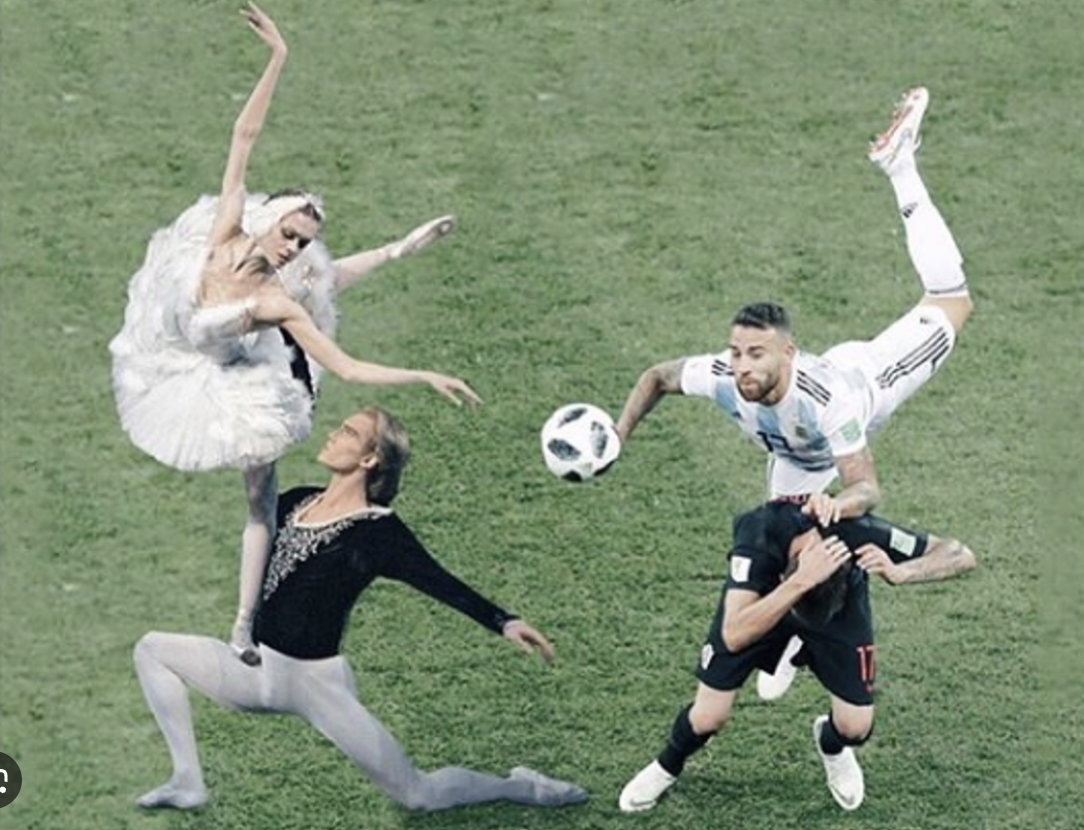
Image: A female ballet dancer dramatically dances atop the bent knee of a kneeling male ballet dancer next to two soccer players diving for a soccer ball in the middle of a soccer field.
More than what it is: a ramble on “neurodivergent”

The subject of neurodivergence is a huge issue, not simply because it reveals the incredible breadth of how the human mind can function, but also because of how that is situated within the intricacies of our very diverse backgrounds and upbringings, infused with social constructions of race, gender, class, and generations. Nature and nurture take on whole new meanings here because they can no longer be perceived as bifurcated aspects of human development. Our neurological configurations are primed and shaped by our environment, and our environments were molded to hold, or not hold, our neurology. In this way, the term “neurodivergent” vastly oversimplifies the entirety of what it means to be something other than neurotypical.  

This is the blessing and the curse of having labels to help us define things. When we give something a name, an amorphous concept can suddenly have grounding and shape through language and become a topic of discourse we can then begin to understand it through. Giving language to an inner experience can be hugely impactful in validating what sometimes feels like isolating events that exist only in our minds. However, that very same label can be a restricting device that limits our ability to truly grasp the enormous landscape that a term like “neurodivergent” encompasses.  What becomes imperative here is how we allow that word to be representative of something that it cannot possibly adequately convey. 

When we think of the Pacific Islands, what does that thought come with? Tropical islands? Palm trees and coconuts? Resorts and vacation getaways? Sunny skies and sandy beaches? Volcanoes? While these are definitely aspects you could find throughout the Pacific, in no way do these elements define what the Pacific Islands actually consist of: nuclear devastation in the Marshall Islands and French Polynesia; phosphate mining in Banaba; military occupation in Hawaiʻi; coup deʻtat in Fiji; island extinction by sea level rise in Kiribati. There is so much history and context and culture to each individual island and atoll, much of which has nothing to do with the greater categorization of these places as a geographic designation. Yet that is often what this region of the world becomes delimited to. 

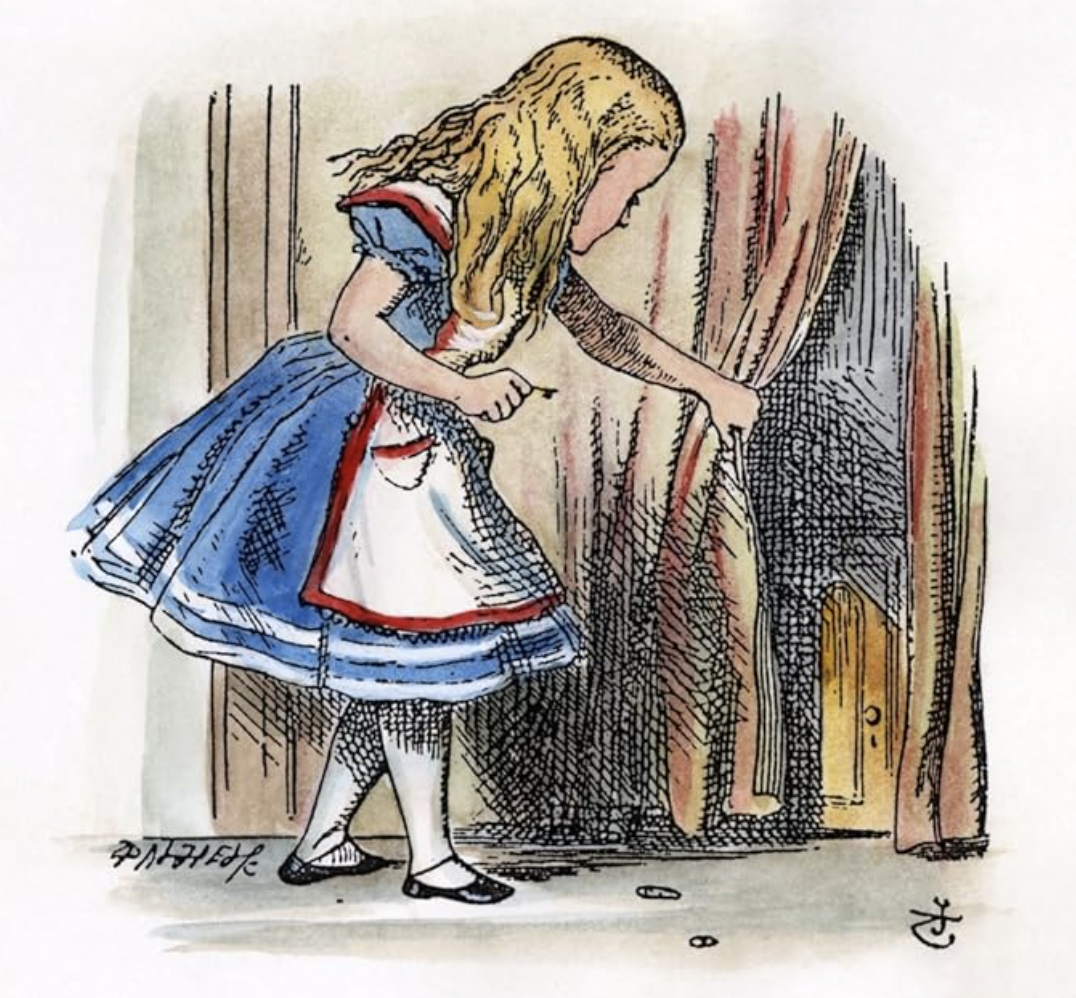
“Neurodivergent” risks having that same delimiting effect. Perhaps what might be helpful is how we view what labels represent. Instead of seeing umbrella terms as something that encompasses many things, maybe we need to understand them as small doorways into whole other realities where new and unfamiliar worlds exist. In this way, the assumption is not that we possess a single word that consists of many elements – an approach to knowledge that suggests what we already know and thus, can simplify – but rather that we can use a single word to help us enter into a space that we must now learn about – an approach to knowledge that centers the possibility of what remains to be known.

What Is My Own

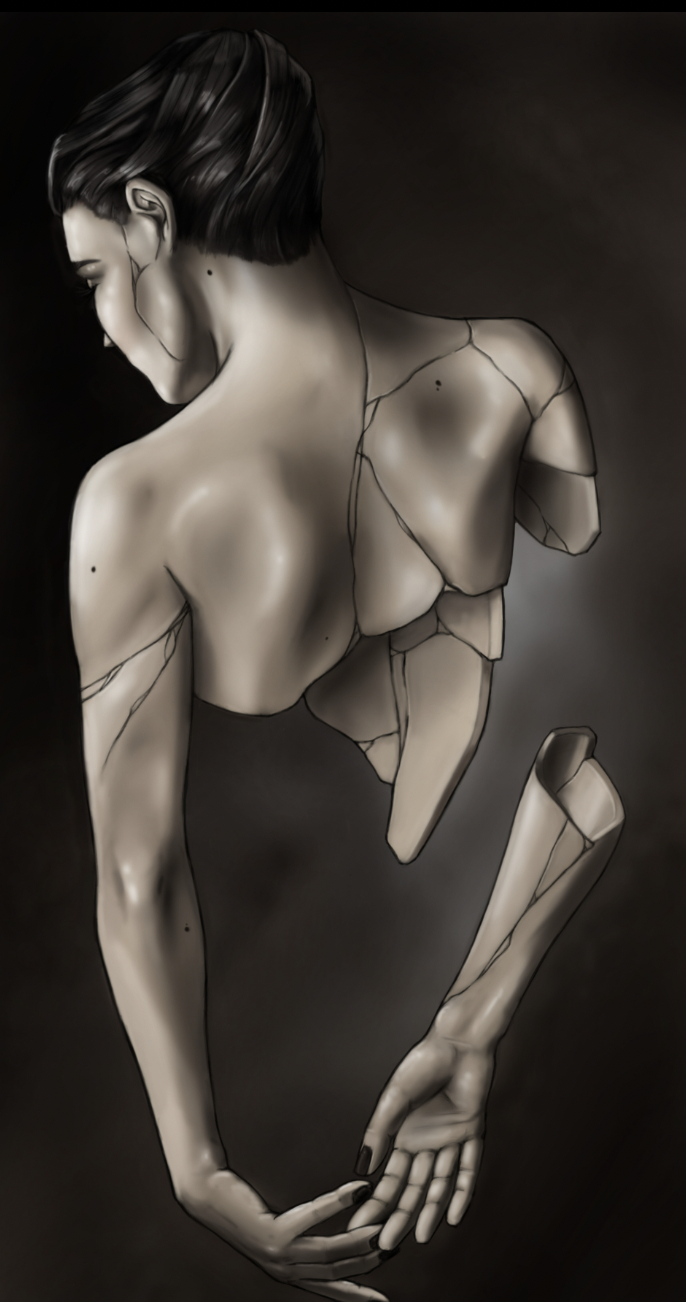
Art illustration of the back torso and slightly turned head of a female with upswept hair. There are large cracks throughout her body and most of her lower body does not exist, as if it has shattered away. One arm is reaching behind to grab the other arm, which has disattached from the body and seems to be falling away.

(artwork by Joel Gehmen)

Is my body broken if its shattered pieces are held together by flesh colored adhesive that is merely my own mental salve?

Do I suffer from pain if the constant ache in my bones is an echo of the violent histories passed down for generations? 

Is it illness if the markers are not physical, the symptoms not visible, and there is no possible diagnosis in western medicine to comprehend this malaise? 

How does one treat such dysfunction? With brave smiles and silent resolve? With quiet tears and chronic despair? Or with hordes of medication that sedate and suppress but fail to inhabit the exact synapse of cellular transmission communicating to the brain that all will be well and that peace can be found?

Where is wholeness to be found if no one can see all the broken pieces? 

Yet I know my pain, I know my illness, I know my suffering. None can take that knowing from me. Because if they could, I would let them.

Excuse me, is this space taken?

Much of my academic day is spent in observation of the environment I am in. While I am capable of diligently taking notes and tuning into the main themes and key points of the class, my brain is also taking notes of the people sitting around me, the mannerisms and postures of the professors in front of me, and the general feeling I get from being in this world. More often than not I wonder: do I belong here? 

Why do I feel this? 

Believing one has the capacity to freely take up whatever space they occupy is a luxury, a privilege, seemingly designated only to those who have not spent their entire lives hearing that they take up too much space. I donʻt even think they were necessarily encouraged to exist in this way as much as there was the absence of actively being discouraged to do so. I marvel at what that must be like to not feel the internal burning shame that revs up my pulse and creates a subtle dizziness in my head anytime I open my mouth in class. My entire childhood surges forward in those moments and my nervous system is immediately dysregulated in anticipation of being made to feel like nothing I have to say ever matters. 

Itʻs silly, I know. 

Of course what I say matters. Of course I have contributions to make to important conversations. Of course Iʻm allowed to take up space, especially in a college classroom where ideas are meant to be exchanged and explored. Iʻm a human being with a beating heart and a curious mind, like most here. But could somebody please tell that to my central nervous system? It always seems to forget this in moments when I need to remember it most. 

This is my reality. It is my phenomenological experience. What are the enabling conditions that allow for this? Well certainly my childhood is a large component – how I was taught to behave as a child, how I was taught to view myself, and how I was taught to move through the world. But beyond the formative programming and environment that laid the foundations for my current configuration, I have found that Academia as a whole, systematically infused with patriarchal and racist ideologies, plays a part. 

There is a competitive expectation here, that if you do not speak fast enough, cleverly enough, articulately enough, then you are exposed for who you are not – intellectually superior. That to showcase intelligence automatically assumes others want to hear what you have to say. That if you are a member of the prioritized categories of social being – in particular, white and male – then the gravitas of what you speak is appreciated before you even speak it. This pressurized environment all the more draws out the deep-seeded fears and insecurities surrounding my internal question of intellectual capacity. Can I take the wellspring of thought and insight contained within and adequately give it voice so as to give myself the appearance of competitive intelligence? Can I do this all the while fighting against the belief that the space I am taking up does not belong to me? 

To this, I have no answer. Only a sense of “I guess weʻll see” and the burning desire to crawl into bed and get lost in the latest reality dating TV series, where I can freely exposit to my laptop why I think everyone is an idiot.