
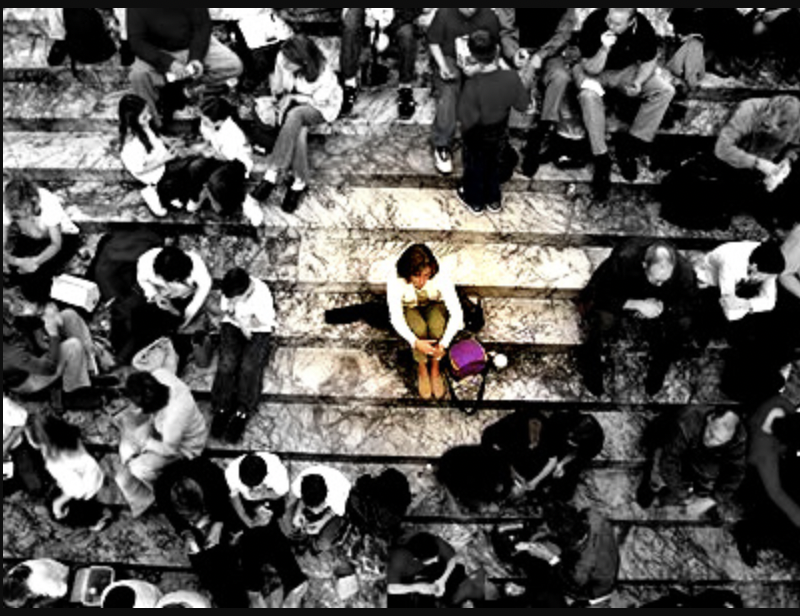
Much of my academic day is spent in observation of the environment I am in. While I am capable of diligently taking notes and tuning into the main themes and key points of the class, my brain is also taking notes of the people sitting around me, the mannerisms and postures of the professors in front of me, and the general feeling I get from being in this world. More often than not I wonder: do I belong here?
Why do I feel this?
Believing one has the capacity to freely take up whatever space they occupy is a luxury, a privilege, seemingly designated only to those who have not spent their entire lives hearing that they take up too much space. I donʻt even think they were necessarily encouraged to exist in this way as much as there was the absence of actively being discouraged to do so. I marvel at what that must be like to not feel the internal burning shame that revs up my pulse and creates a subtle dizziness in my head anytime I open my mouth in class. My entire childhood surges forward in those moments and my nervous system is immediately dysregulated in anticipation of being made to feel like nothing I have to say ever matters.
Itʻs silly, I know.
Of course what I say matters. Of course I have contributions to make to important conversations. Of course Iʻm allowed to take up space, especially in a college classroom where ideas are meant to be exchanged and explored. Iʻm a human being with a beating heart and a curious mind, like most here. But could somebody please tell that to my central nervous system? It always seems to forget this in moments when I need to remember it most.
This is my reality. It is my phenomenological experience. What are the enabling conditions that allow for this? Well certainly my childhood is a large component – how I was taught to behave as a child, how I was taught to view myself, and how I was taught to move through the world. But beyond the formative programming and environment that laid the foundations for my current configuration, I have found that Academia as a whole, systematically infused with patriarchal and racist ideologies, plays a part.
There is a competitive expectation here, that if you do not speak fast enough, cleverly enough, articulately enough, then you are exposed for who you are not – intellectually superior. That to showcase intelligence automatically assumes others want to hear what you have to say. That if you are a member of the prioritized categories of social being – in particular, white and male – then the gravitas of what you speak is appreciated before you even speak it. This pressurized environment all the more draws out the deep-seeded fears and insecurities surrounding my internal question of intellectual capacity. Can I take the wellspring of thought and insight contained within and adequately give it voice so as to give myself the appearance of competitive intelligence? Can I do this all the while fighting against the belief that the space I am taking up does not belong to me?
To this, I have no answer. Only a sense of “I guess weʻll see” and the burning desire to crawl into bed and get lost in the latest reality dating TV series, where I can freely exposit to my laptop why I think everyone is an idiot.

