I Hate Labels

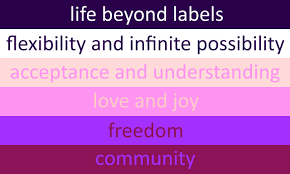
Labels, the reason I was closeted for so long was that I felt a tremendous pressure that I had to be either gay or straight because in-between was not a valid option. Honestly, I prefer the term unlabeled or queer as even the label of Bi feels too constraining to me because I either like someone or I don’t and I don’t feel like I need a title to describe that. I choose to use the label Bisexual purely for other people’s benefit because for some reason everyone needs to know if we find each other attractive or not. If I choose to tell people I am bisexual I do not mind as I chose to let them know that about me and I do fit the criteria for that label. However, when someone I don’t know well or do not wish to tell,  asks me what my sexuality is, I feel uncomfortable. In all honesty, I have no idea if this is relatable to other people or if it’s just a complicated jumbled mess, but the last thing I want is to come across as hostile. I completely understand wanting to know someone else’s preferences, I am a nosy person as well, but I also want to be transparent in saying that I have had instances of being extremely uncomfortable when people I don’t know ask me those questions. I remember this one instance, I believe it was my first shift working with this one girl and we were just talking and getting to know each other a bit while we were in the back of the store working on decorations. This is burned into my memory because I remember the visceral reaction I had to her asking this question as it was so much worse than “what’s your sexuality?” This coworker looked me in the eyes and said “so are you…?” and proceeded to make the hand gesture. (if you know you know.) And you know when you are so uncomfortable that all you can think to do is give the person what they want, so I told her “no” (Lie) I don’t owe this girl an answer let alone a truthful one. So in summary I just want to say that let people tell you on their own terms what they are and never ask a stranger because 9 times out of 10 it makes them uncomfortable. Also that you don’t owe anyone an explanation of who you are and what you like. 
“You’re Autistic”

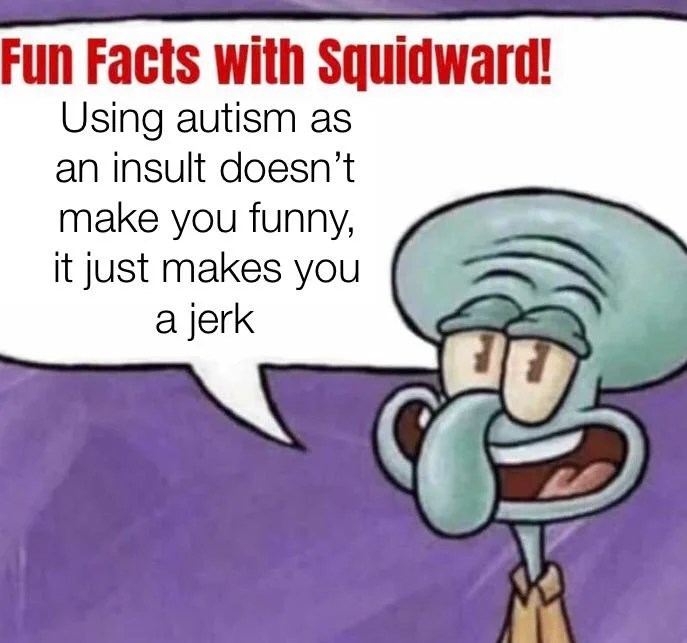
As a person who is chronically online and oftentimes playing online games, I hear many “insults” thrown around. I put quotations around insults as they should not be considered insults but oftentimes are used as such. “Insults” such as “gay” “autistic “retarded” etc. I’m not even going to get into the insults I hear as a woman playing such male-dominated games. 

The use of these words as insults is more prevalent than I’d like to think and I’m sure many of the people reading this if not all of you have heard the word “autistic” used as an insult, especially if you have ever set foot in a middle school. I feel as though the main reason this word gets thrown around so much by people, especially youth is because of desensitization to the word.  Hearing it over and over again and by your friends or even family may make one think that it isn’t that bad to say yourself, and boom ignorance is born. Although I do believe that a percentage of people who call someone autistic don’t actually intend great harm, most kids with autism are targeted by bullies so intention does not matter because these kids are being harmed.  As I said before desensitization to the word makes others believe it is okay to say, so the population of individuals who don’t understand the impact of using that word as an insult only grows larger causing more harm to the kids and adults with autism. 

You never know who you might insult with your words, silence does not equal agreement or acceptance, and oftentimes it means discomfort. You don’t want to contribute to the growing desensitization of using “autistic” as an insult. We need to be more loving, understanding, and accepting of everyone around us, not hurt people who already are having a hard time and quite frankly are just trying their best to fit in.

Continue reading

Design Accommodation

Back in 2019, my healthy active mom started having dizziness attacks that came and went. Eventually, she went to a doctor who misdiagnosed her and sent her home. She contacted her regular doctor when she completely lost hearing in her left ear and couldn’t move because of vertigo and nausea. She was sent to a specialist, had an MRI, and spent months in bed. She gradually recovered, but she had lost all of the hearing in her left ear. While it was scary seeing her so sick, at the time we all thought it was something temporary. She was recovering from an illness, not permanently disabled. As time went on though we realized it was permanent and a disability. She had to stop teaching since the noise made her head ache so badly that she would have to lie down for hours afterward. Going out to loud venues, from restaurants to concerts was too painful. We all learned to stand on her right and to repeat ourselves when needed. 

I also discovered that there are those who just don’t care. One time we walked by a woman at a store who yelled at my mom, “I was next!” When my mother kept on walking, I stopped to explain that there was another register open and that my mom is deaf. The woman’s response was a snort of disgust. I was furious that my mom’s disability could be dismissed with a snort by a person who persisted in believing that she had been wronged. My mother dismissed it as one of the advantages of not always being able to hear. At my brother’s rugby game she couldn’t hear the racist, sexist and homophobic “jokes” made by the people behind us. She has found it freeing in some ways to not always be able to hear. At the same time, she was excited to go to a theater that had headphones available that made it possible for her to understand what the actors were saying. Having a disability often means that people simply accept the difficulties life presents, but there is an amazing feeling of liberty when an accommodation has been made that removes that difficulty. 

My mom’s experience made me realize how much our society is set up based on some undetermined norm of physical ability when in reality our society is made up of people with a wide range of abilities. We tend to only see a disability when it is obvious: someone in a wheelchair or walking with a white cane. While we have the Americans with Disabilities Act, there are many people whose disabilities go unseen or are unsupported, thus making navigating everyday life more difficult. I believe disability can be viewed as a design issue. We can do more to design spaces that accommodate people with varying abilities. For example, at airports and train stations, having announcements displayed on a scrolling screen, would help direct people who are deaf or hard of hearing. Our government, at all levels, needs to require more up-to-date accommodation standards to be incorporated into our public spaces. 

How a Racist Ruined Christmas

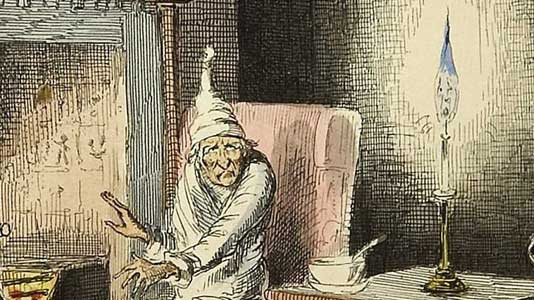
It was Christmas morning in San Francisco, California and my uncle was taking care of my aunt’s pets before coming over to my grandparent’s house to meet up with everyone for Christmas festivities. As my uncle was walking back to his car, one of the neighbors approached him to complain about how he couldn’t see down the hill to get out of his parking space because my uncle’s van was too big. (My uncle drives a large white utility van. It’s for his work and his only means of transportation.) The neighbor, living in an affluent area in San Francisco, immediately assumed my uncle didn’t live there and had no right to park his car there. He didn’t know my uncle was staying with family and that he had just come from the house next door. The neighbor backed up his demands that my uncle moves his car with several rude, racist, and classist comments to my uncle, including the rallying cry of racists everywhere, “go back to where you came from.” The kicker of the story is that my uncle is actually Native American (Navaho). This white man, who is living not only in a state, but a country that was stolen from Native Americans told a Native American man to “go back to where he came from.” This was Christmas morning and my uncle, who has a “let’s all get along temperament, was left feeling pretty down. The whole encounter made him feel like he was just viewed as an unwanted outsider, who could be treated as a lower life form who had no right to park in a particular neighborhood. This wasn’t the first time people have discriminated against him based on his appearance, nor was it the most dramatic and potentially life-threatening occurrence. The thing that really hurt was that it was Christmas morning and the racist Scrooge of the neighborhood had not discovered the true meaning of Christmas. People make assumptions, that’s normal, but feeling justified in acting in a hurtful and hostile manner simply because of these assumptions is wrong. That neighbor didn’t just assume my uncle was Hispanic, he also assumed that because of what my uncle looked like, he didn’t belong in such a wealthy area. The neighbor also assumed that he then had the right to order him to move his car and throw in a racist rant as well. Why? Why did the neighbor feel he belonged there and not my uncle? Why did he feel free to treat someone this way? Because America is a segregated country, not only by skin color but by income and since my uncle didn’t fit the norm of the neighborhood, this man decided to come outside of his multi-million-dollar house on Christmas morning, morph into the love child of Ebenezer Scrooge and the Grinch and feel entitled to dump his racist vitriol on my friendly and kind uncle. The moral of this story is whatever your assumptions are, everyone, deserves to be treated with respect, and don’t be a racist bigot.

Continue reading