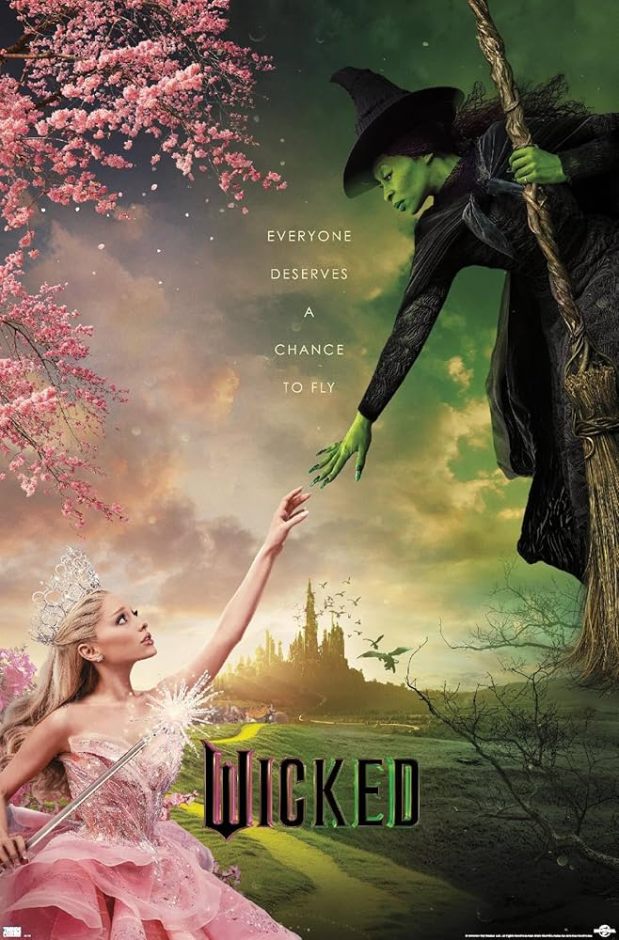
No One Mourns the Sick: The Wicked Myth That the Pandemic Is ‘Over’

No One Mourns the Sick: The Wicked Myth That the Pandemic Is ‘Over’

According to a recent Guardian article, “Both Grande and Cynthia Erivo tested positive for Covid during the filming of the first movie, temporarily delaying production. Erivo reportedly contracted the virus days before shooting the climactic first-act number Defying Gravity, while Grande tested positive before filming the song “Popular.”

There’s something horrifyingly Wicked-like about how illness is framed now. If someone masks, they’re “paranoid.” If they don’t appear for a photoshoot or premiere, fans complain. When someone gets COVID, the conversation is about wasted money on promotion, fan backlash over missed premieres, or travel delays , but  rarely about health, recovery, or the toll illness takes. The framing treats sickness as a hiccup, not as human suffering. It treats the sick body as a burden to the show, not as a person in need of care.

“Grande’s positive test was the latest hiccup for the full-court Wicked press blitz that has seen the cast hop continents by the day. Due to flight delays, Grande was unable to make the premiere in Brazil, triggering fan backlash she also addressed on her Instagram.”

That is exactly the kind of abled entitlement Mingus warns about: a culture that assumes certain bodies can and should be sacrificed for convenience. Under this logic, “the show must go on,” regardless of who gets hurt. The Wicked cast situation isn’t just celebrity news, but it’s a reflection of a larger societal pattern where health, disability, and our shared vulnerability are minimized, ignored, or erased entirely.

What’s even worse is how normalized this erasure has become. COVID has become “another thing,” something to power through so cameras and promotions stay on schedule. Workplaces expect people to show up sick. Students are told to push through fevers. Long-term effects are brushed off as “just fatigue.” Public health infrastructure? Largely forgotten. Masks, ventilation, testing are all optional. People who get sick frequently or live with chronic conditions are expected to adapt or be pushed aside.

Mingus doesn’t just name this as negligence, she instead frames it as violence. When we treat care as optional, when we prioritize productivity over people, when we mourn canceled premieres more than lost lives, we are making a statement about whose lives matter. We’re deciding who gets protection, who gets grief, and who doesn’t.

Me Before You: A Tragic Tale of Romance and Assisted Suicide 

When I first watched Me Before You, I felt like my heart was ripped out of my chest. The story follows Louisa “Lou” Clark who becomes the caregiver of Will Traynor, a man who was adventurous before becoming paralyzed after an accident. Will unfortunately faces many challenges both physically and mentally, leading him to choose assisted suicide despite falling in love, and I haven’t been able to stop thinking about this movie ever since. Recently I started to question, if it was romantic, or was it reinforcing the idea that a disabled life isn’t worth living? After reading Nicole Schroeder’s “Dying a ‘Good’ Death: Disability and the Assisted Suicide Debate” from the Disability Visibility Project, I started to see the story through a completely different lens.

Before I fully dive in, I want to fully paint the picture of this movie. Firstly, Will’s parents hire Lou to care for him after his accident two years in an attempt to raise his spirits. Lou’s unapologetic, positive personality slowly breaks through his bitterness, and they form a deep connection. After finding out he plans to go to Swtizerland for assisted suicide, Lou tries her best to change his mind by trying everything from taking him to concerts and a trip out of the country. But in the end, Will does not change his mind even after falling for Lou. The movie paints his choice as noble as a way of reclaiming control over his life and giving Lou a chance to live hers. The final scene shows Lou reading Will’s farewell letter in Paris, smiling through her tears. It’s meant to be bittersweet, but it also raises difficult questions about what “a good death” really means, and whether society offers disabled people real choices about living.

Nicole Schroeder’s essay completely reframes this debate. She argues that the real issue isn’t about whether people have the right to die, but it’s about why so many disabled people feel they need to. She writes, “those of us protesting do not want people to be in needless pain; instead we want resources other than death to alleviate suffering while people are still alive.” That line stuck with me because it exposes how the conversation around assisted suicide often ignores the failures that lead people to that point: lack of access to care, isolation, and social neglect.

In the film, Will isn’t shown receiving much support beyond Lou’s companionship and his personal caretaker, Nathan. Even with wealth, he seems completely alone in a world not built to include him. Schroeder highlights that in a “hyper-capitalist world,” assisted suicide can become a cheaper alternative to improving care and accessibility. It’s haunting to think about how Will’s decision might have been shaped not by genuine choice, but by a culture that sees disability as tragedy especially after losing the hyper-active life he once had. 

One of Schroeder’s most important points is that assisted suicide is often presented as a form of autonomy, when in reality, many disabled people are making choices under pressure. She shares that in Canada, nearly half of those choosing Medical Assistance in Dying (MAID) cite feeling like a burden or experiencing loneliness. That statistic immediately reminded me of Will telling Lou he didn’t want her to give up her life for him. What sounds selfless in a romantic story becomes more complicated when you realize how society teaches disabled people to internalize guilt for simply existing.

The movie’s emotional framing makes Will’s death feel inevitable, even “beautiful,” but Schroeder challenges that idea. She calls out how assisted suicide has “eugenics-centered roots,” meaning that the very systems allowing it have historically viewed disabled lives as less valuable. When I look back at Me Before You now, I can’t unsee this unfortunate pattern that tangles up love, care, and death into a message that equates disability with hopelessness.

When I first watched Me Before You, I can still remember myself tearing up during the beach scene when Will tells Lou that he is still going to Switzerland after she pours her heart out to him. Me and many fans of this movie are still heartbroken over what could’ve blossomed between Will and Lou. But now, I think the real heartbreak isn’t Will’s death….it’s that the story never gives him another option. Schroeder’s essay reminded me that true dignity doesn’t come from the “freedom” to die; it comes from having the support and resources to live fully. The film romanticizes Will’s choice, but if it reflected the realities Schroeder describes like underfunded care systems, social isolation, and ableist messaging, it might look less like empowerment and more like surrender to a world that failed him.

I still love Me Before You for its intensity and emotional honesty, but I see it differently now. It’s not just a love story; it’s also a mirror of how our society defines whose lives are worth fighting for.

Palestine and what happens to Unruly Bodies under Occupation

TW: murder, violence, genocide, guns and death of children, disabled people, women

I believe it is important as those of us living in the United States to be intentional with how we connect what we learn in our respective courses to what is happening in the world because there is always a link. And in the case of Palestine you do not have to look far to find it. The current genocide in Palestine by Israel is the most important disability justice, reproductive justice, human rights issue for “unruly bodies” of our current moment.

Disability Justice. With the targeting of hospitals, rehabilitation centers, ambulances, medics and other resources for medical and physical assistance by Israeli military bombs represent just one way that disabled people’s lives are directly harmed by this onslaught of violence. Thousands of Gazans have also been permanently disabled as a result of bombings and gunfire while protesting. In fact during the Great March of Return where from March of 2018 to December of 2019 Palestinians gathered and protested at the fenced off Israel-Gaza border for their right to return to the land stolen from them, visibly disabled protesters were intentionally targeted by the IDF. The United Nation’s 2019 report of the massacre during 2018 revealed that of the over 6,000 protesters shot by Israeli snipers, 122 required limb amputations (20 of which were children), 21 became paralyzed, and 9 permanently loss their eyesight. 940 children were shot, 35 were killed, many of whom left with permanent disabilities. This was just in the 8 months of the protest in 2018. Children and disabled people are both protected under international law during instances of armed conflict but instead they were intentionally targeted by Israeli forces and continue to be.

Link to the UN Commission’s 2019 report which I referenced above.

Reproductive Justice. SisterSong Women of Color Reproductive Justice Collective defines reproductive justice as “the human right to maintain personal bodily autonomy, have children, not have children, and parent the children we have in safe and sustainable communities.” Since Israel’s October 13th evacuation order over 1 million Gazans were forced to leave their homes (over 19,000 being pregnant women) and faced death as borders were guarded by IDF soldiers and because of the very limited time given to leave before bombing would begin. Prior to October 7 and the subsequent massacre by Israeli forces, Palestinian women and mothers already lacked access to sexual and reproductive resources from sanitary products to birthing facilities due to travel restrictions. Many hospitals are located where Palestinians cannot travel to without permits which are typically denied. Like the stress and fear caused by the forced evacuation, extreme poverty and food insecurity have resulted in many women experiencing miscarriages. Since the October 7 attack by Hamas resistance forces, over 11,000 Palestinians have been murdered, over 4,000 were children, over 2,000 were women, and thousands are missing. It is impossible to know how many pregnant women have died in the past month. With hospitals and reproductive centers destroyed as a result of the nonstop bombings, hospitals are unable to provide the necessary care and resources for pregnant Palestinian women leaving them with very few safe options for themselves and their unborn children. Reproductive justice cannot exist under occupation.

https://www.aljazeera.com/gallery/2023/11/8/no-end-in-sight-to-plight-of-gaza-children-as-israeli-attacks-intensify

https://www.aljazeera.com/news/2023/10/25/how-will-i-give-birth-dangers-of-a-gaza-pregnancy-amid-israeli-bombing

https://www.sistersong.net/reproductive-justice

Sorry for the lack of proper citations but these are a few links to where I got my numbers from. It’s important to remember that these numbers are growing daily.

Palestinians and the construction of Unruly Bodies. Like in the British/European colonial histories in the Americas, Africa, Asia, and beyond, Israel’s colonial movement required the depiction of Palestinians as barbaric, ignorant, and in need of civilization and modernization. This racist rhetoric was used since Zionism’s beginning in the 19th century solidified in the 1948 Nakba where over half of the Arab population in Palestine were forcefully displaced from their homes first by Zionist militias and then by Israeli armies. Therefore, any Palestinian resistance to Israeli occupation renders Palestinians unruly because their self-determination and autonomy are inherently oppositional to Israel’s colonial project. Labeling such resistance as terrorism justifies Israel’s continued genocide of Palestinian people and such imagery and discourse is used in Israeli and western media to promote the occupation.

To connect it back to class, I believe the social model of disability is an important framework for understanding what is currently happening in Palestine. The Israeli occupation physically, socially, and politically disables Palestinian people daily and denies pregnant women the right to deliver their babies safely and humanely. Also, our conversations about neurodivergence are important to note as neurodivergence can result from traumatic experiences. When discussing people who have become disabled as a result of Israeli violence, mental illnesses are also a part of that. Gazans/Palestinians have lived through decades of trauma meaning the siege is also psychological manifesting as depression, anxiety, post traumatic stress disorder, and more.

Despite this, disabled people are still showing up to protests demanding the right to return to the land of their ancestors. Palestinian women are still giving birth knowing that there is a possibility of their child not being able to grow up. Palestinians continue to yell that Palestine will be free. Regardless of Israel’s attempts to destroy youth-led resistance movements, generations of Palestinians refuse to let the fight for freedom extinguish. It is important that Palestinian modes of survival are acknowledged and that we learn from the resistance movements of Palestinian people and connect them to the liberation struggles of all oppressed people across the world.

HUGE trigger warning for everything I listed at the beginning of this post and more but this film is called Gaza Fights for Freedom and it delves into a lot of what I mentioned above. It is free on Youtube to watch.

Free Palestine!