
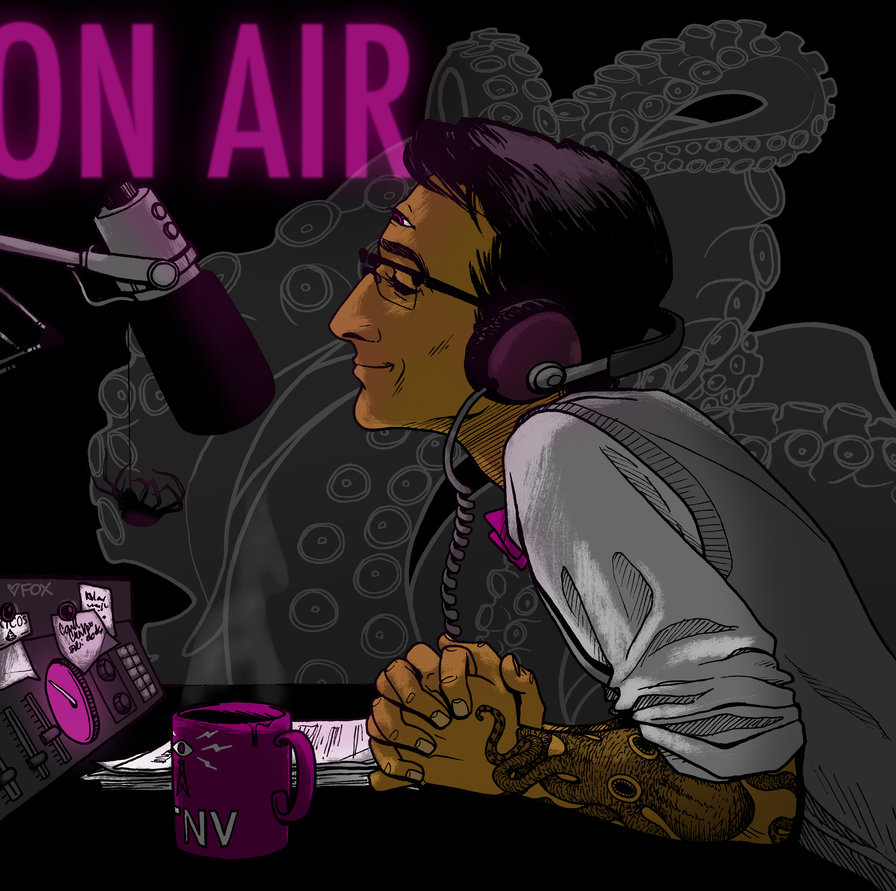
Cecil by lily-fox of deviantart.
Others’ bodies are things we usually experience sensorily — whether visually or through touch, taste, smell, or sound. Lately, though, I’ve been thinking a lot about the bodies we can’t see, and what the assumptions and expectations we impose on the unseen body mean. A few instances of unseen bodies have come to my attention recently in relation to the podcast “Welcome to Night Vale,” produced by Commonplace Books and distributed for free. Welcome to Night Vale is a fictional community radio show that is equal parts creepy, funny, absurd, and somewhat Lovecraftian. It has been airing for over a year but this past summer gained a lot of publicity and fans, and has since blown up in terms of listenership and devoted internet fandom. One of the most interesting things about Night Vale is that it’s entirely an audio program, and while podcasts are certainly a popular medium, visual culture is also certainly dominant. The show makes use of voice acting, sound cues, and music, and the scripts are creatively and sometimes lyrically written.
However, there’s scant description of the show’s characters, especially the show’s host, Cecil, voiced by actor Cecil Baldwin. This has given fans an amazing range of creativity with which to interpret the character’s appearance; searching for “Cecil Baldwin” or “Cecil Night Vale fan art” on Google or Tumblr search yields hundreds of different Cecils. Interestingly, there are a few trends: Cecil almost always has a third eye and is dressed smartly in a (usually purple) suit. Many Cecils have tattoos, which are described as shifting and morphing. What’s important about the way fans have interpreted Cecil is that the podcast’s creators have offered no guidance as to how their character appears. His voice and his character come through in the show, and the fans go from there.
It’s compelling to see the range of skin colors, body types, and facial configurations fans have dreamed up. Of course, much of the fanbase is on tumblr, notorious for advocating inclusivity especially in fan portrayals. This doesn’t just mean that people are making cool fan art: it means when someone is listening to the podcast, the person they imagine speaking is embodied by and for the listener. Despite no real evidence (empirically at least) for a body, listeners are dreaming one up. A body they can’t even see and has no relation to the actor speaking the role, who is a white man and resembles few, if any, of the fan interpretations. What I find so interesting about this is that the unseen body is still very present and important to people, but there’s a huge amount of freedom for what that body means for the individual.


I absolutely love Nightvale (can you tell?), and Cecil fanart is some of the best around. One of the coolest sets I’ve seen recently shows him as many different colors and sizes, depending on the townspeople who are looking at him. I won’t go into huge detail about it, but the part that I love is that the artist is describing a very real thing that happens in society today. Who you are and what people see and think you are are two completely separate entities.