
As long as I’ve been alive, I’ve been some version of overweight. I was my mom’s biggest baby. There was the “baby fat” phase (which I tried to ride to middle school, much to my embarrassment); the “I’m gaining weight because of puberty but it hasn’t decided where to live yet” phase of middle and early high school; the “I may not actually be overweight but I’m so disgusted with that tiny bit of belly fat that I’m pretty sure I’m obese” phase that seems pretty rampant in American high schools; the “shit, now I really AM overweight because I decided to take birth control and I put on 50 pounds in 3 months” phase of panic, terror and depression; the “I’ve stopped trying to stop gaining weight” phase where I saw numbers over 200; the “I had a baby and despite gaining hardly any weight with pregnancy I’ve managed to get even bigger postpartum” phase that’s pretty popular with new moms; and my personal favorite, the “oh my god, this is the biggest I’ve ever been ever in my life and I’m completely freaking out” phase of morbid obesity that has consumed my adult life.
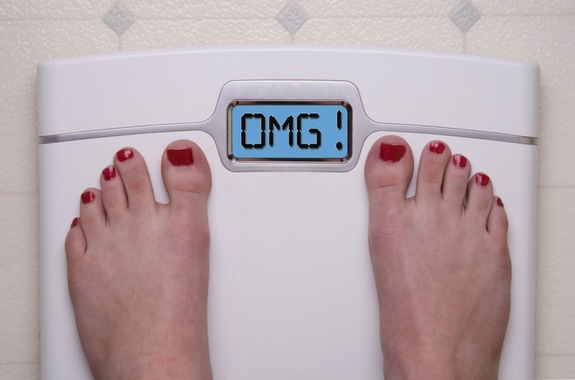
Basically. Though my scale isn’t this clever. And I have better toes.
Sensing a trend? My image, my self-esteem, my worth, my life, has always been wrapped around fat and weight. And don’t think that a comment of “there’s more to life than that” will magically change the way I’ve always thought about myself. Despite my Gender and Women’s studies major that’s been diligently trying to help me see myself as more than “fat”, I regularly struggle with seeing beyond my size. And that’s just how I see myself. We haven’t even begun thinking about how other people see me, how they’ve always seen me. And so, allow me to demonstrate where the idea that my identity is a number came from.
As a toddler, the clothes that didn’t fit were pretty popular topics of conversation; I was the “third-born” that didn’t get hand-me-downs because I wasn’t the same size my sisters had been. By middle school, how I was supposed to look (THIN) and how I looked (immensely curvy by 12) was a constant source of inner turmoil, fueled by the boys that didn’t like me (hello, I looked like a woman, not a kid) and my family who, for whatever reasons, couldn’t help themselves from talking about my weight. There were lots of ways my body showed up in conversations; “you’re fat” from my sisters when they were angry; “do you really need that bowl of ice cream?” from my step-dad who convinced himself that shame was a parenting tool; my personal favorite was the time my dad took me out for ice cream and bought me this monstrous sundae and, half way through, began a lecture about how “concerned” he was that I’d put on MORE weight. I’ve never since consumed ice cream that tasted as badly as that shame-sundae that I finished, teary-eyed, because I’d been taught not to be wasteful.
By high school, there was a lot of self-loathing. Most assuredly my body, that had somehow taken on a life of her own (she showed up in conversations that didn’t mention “Ashley” and she’d somehow gained priority in all of my relationships), was the primary root of my self-hatred. I hated her; not necessarily me- my depression, however intense, never morphed into a desire to have no life, just the desire to have someone else’s. I was sure that she made it to every interaction before me; that my “first” impressions were always snagged by her rolls and chubby cheeks and heavy breasts and voluminous thighs. She was what people knew about me. I was “that fat girl,” “Oh, the one with the big tits,” and “her face is OK.” When I somehow found the logic to see myself beyond “her,” I knew I was smart, I was passionate, I was considerate, I was helpful, I could sing, I could write, and I was funny. But that wasn’t what people saw. Because you really can’t see those things, you see bodies. And I resented being “seen” as nothing more than a body.
We didn’t get along, my body and I. I would cut her when I was consumed by pain or loneliness or hatred. Sometimes (often) I overfed her in sorrow, sometimes I starved her in despair. I hid her in clothes that made me look bigger, and when high school taught me that grown men, at least, saw her as sexy, I subjected her to a lot of physical contact that neither of us liked. And as much as I thought all of those things would make me feel better, they didn’t. We were disconnected.
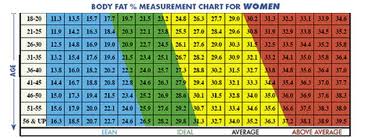
Oh yeah, because that’s the only definition of healthy.
By now, I’m sure I’ve made you sad. Fat stories are, by nature, really really depressing. And I want to console you (because I’m also kind) by telling you that I sporadically found some amazing body acceptance lying around. But I didn’t, not entirely. What happened was harder: I married the first man that convinced me I was beautiful (and to be clear, I love him more than I could ever express, but my self-esteem must be credited for at least part of why I married so soon). I spent a time disconnected from my body, believing that no one could like me if they didn’t like her. And how could I test her likability? By pimping her out to guys that said she was sexy (again, to be clear, my maturation since then has confirmed that that was a really bad idea). I blamed her for my sadness, my pain, and my failures. After all, she was the root of it all. She was all the credit I ever got and I kid you not, year by year she EXPANDED.
As an adult, my family STILL talked about her, but it was different. Adulthood had meant that I could pass the overt criticisms and painful remarks about my size and instead could skip right to passive aggressive “concern for my health” and sarcastic jokes that no one “really meant.” Now my fat-shaming (oh yeah, adulthood taught me that my every interaction could be summed into an experiential phrase) came in forms like moving me to the back of a picture, worry that I’d die by 30, and the time my step-dad’s mom just KNEW I’d have gestational diabetes (hey, I’m obese, how could I not?)
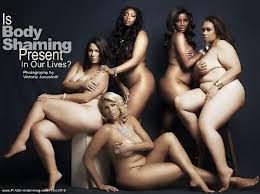
Um… yes.
There was never a moment when something, a conversation with a real friend, an article too logical to ignore, my husband’s insistent adoration, convinced me that I wasn’t my body (or maybe, I wasn’t just my body, I’m still not sure). I just got older. I got smarter. I grew up. I began to think like the adult I’d been posing as for years. And after a while, I began to see things differently. It’s been a slow, oh painfully slow, transition. Most days my body is my body and my body. We are both one thing and separate things. I am her and somehow more than her. And the parts of me that aren’t her, the smart, funny, caring Ashley I mentioned before, they’ve become increasingly more significant to my identity. She’s still important. She is a bigger concern in having another baby than my mental stability, finances or two-bedroom house. She’s sometimes the reason I don’t have the courage to go out. She’s at least 75% of why I don’t like school, when I don’t like school (those tiny desks). She is sometimes the reason I cry.
Our relationship has been slowly progressing; sometimes I love her. Sometimes those rolls (oh my goodness there are so many) and stretch marks are just “character”. Sometimes my now enormous breasts are actually pretty incredible. Sometimes I’m pretty impressed with how well she’s survived the years of abuse, torture and hatred I’ve dumped on her when no one else was there to help me out. Oh yes, part of my maturation has been taking responsibility for what she’s become, the role I’ve played in making her the monster I’ve been afraid of. And my developing love for her has helped me take an interest in self-care that’s healthy. I’m not interested in starving her or leaving her to rot or abusing her anymore. Adulthood has given me the gift of knowing that this body is the only one I get, and if I keep being mean to her, she might quit on me.
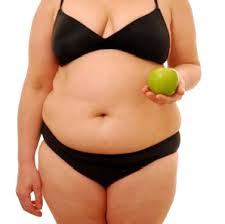
Alright, alright, let’s show some respect. This body is having an apple.
It’s like a marriage, the relationship we have with our bodies. Some people see it as “oneness,” as two halves of a whole; sometimes it’s just two pieces, separate but interdependent. I think of my marriage as arranged; I may not have chosen this body, had I a choice, with a genetic predisposition to obesity, as my “partner for life.” But we’re in this thing. I’ve spent too long hating her, pushing her away, rejecting her; we’ve been in couple’s therapy for a while now. Sometimes I still say mean things to her. Arranged or not, we’re married. For better or worse we’re committed. And I like to think of this “turning of a new leaf” as a kind of vow renewal. I vow to be nicer to you, body, if you vow not to quit on me until I’m treating you with the respect you’ve been missing. And hey, since this is a marriage, give us some gifts. We like cake and pedicures.
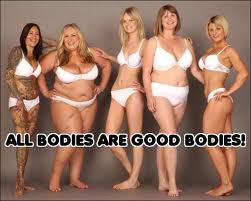
And now I know.


This is such a great entry, and it really gets at how complicated this stuff is, how much it is most assuredly NOT just a matter of “knowing better.” Thank you.
I have never thought about the body and the self as an ‘arranged marriage’, but I think that it fits nicely. We don’t chose our bodies, we just have them. It is a relationship that one has to work at, I don’t think it just comes naturally – especially in our society that tells us that every body is wrong unless it’s photoshopped, and even then, it’s not good because it’s not real. Loving ones body is not easy, but I do think it is possible. Not even to ‘love’ the body one has, I think it can be enough to be neutral with your body. That was always my goal, I didn’t have to be crazy about my body or anything but I wanted to be at a spot where I didn’t look in the mirror and hate everything I saw. It’s been a process, but I think on a good day I like my body, and then me and my body have our fights and disagreements. But like a marriage, you’re together. And like you’re vowing, I would rather try to get along with my body for a long as possible instead of fighting it constantly.
And yes, pedicures and cakes are nice. It’s important to treat your self.
Have you read any of Julie Guthman’s work? I encourage you to check out some of her articles on the neoliberal politics of fat, and also her book ‘Weighing In: Food Justice, Obesity, and the Limits of Capitalism.’ While I didn’t agree with all of her conclusions, she asks really interesting questions that put another lens on the current framing of the obesity ‘epidemic.’
I too sometimes refer to my body as her. When in the midst of my eating disorder, I actually tried to give that other self that consumed me and made me do things I didn’t want to a different name, because I was convinced that wasn’t me.
Growing up gives you a different perspective, and I love the way you finished this blog post–ALL BODIES ARE GOOD BODIES. AMEN.
I really appreciate your honesty and openness in this piece. Viewing our body as an arranged marriage is brilliant and apt. You successfully illustrated the phases we go through with our body acceptance and the consequences that can accompany those times. Your story is not so different from so many of ours and so many of your sentiments are shared amongst all of us.
Ok, now as an aside, I am so angered that anyone, especially family, feels entitled to YOUR body. How you treat it, care for it, dress it, shape it, move it, feed it, is entirely yours for the choosing. You know your body better than anyone else and you are intelligent enough to make your own decisions. How can anyone be so arrogant as to tell you what how much to eat or weigh? I am so angered that the very people in your life who should have been reinforcing you, loving you unconditionally, and empowering you were the very people who were constantly judging you and shaming you. Shame on them! Your body is only a part of you, is not the only part of you. You are so much more than your body and I am glad that you are finally beginning to see the amazing individual that you really are that we all see in you.
I know it’s not easy sharing experiences out in the open and I appreciate this so much because I can relate. After having a child you’re body changes so much and no one ever tells you ‘it’s okay.’ You’re always expected to get back to your “pre-baby” weight in the quickest amount of time. It took me so long to realize that my body is fine the way it is!
Pingback: My Body and Me: The Original Arranged Marriage. A guest post by Ashley Sweet. | Women's Center at UMBC
I never thought of a body in this way before it was a really interesting and unique way of thinking about people’s bodies. I think it is important to remember that everyone struggles with their weight, and learning to treat our bodies right. Thank you so much for sharing your story with us.
Pingback: A woman of size | This is a work in progress