
(tw: racial slurs, street harassment/assault[?])
And so, I’m driving West on Route 40, feeling like I belong in Baltimore. It’s maybe ten on a Friday night, and about two hundred yards before I am to pass them, I see maybe a dozen kids of color on the median strip. Teenagers. My body tensed, as it’d learned to.
Earlier that day, I’d attended some workshop on anti-bullying efforts in Howard County Public Schools. From there, I’d headed over to Hampden to do some birthday present shopping for a friend of mine whose sixtieth birthday was that evening. A couple of white folks were having a super animated conversation as they strolled through the delicious late-summer weather, and when one of them shouted about “some nigger,” loud enough that I could hear it down the street, I figured, Hey, it’s Hampden, right? and barely broke stride on my bee line from the Wine Source to a non-descript Antique store to look for something train-themed. They totally didn’t mean me anyways, or something. I totally did break stride.
So, after a steak and crab cake dinner, and a glass of this stupidly expensive wine (worth it, though?), and a champagne and cherry pie toast on a big Southern porch in Lauraville, I headed home. Harford to North, North to MLK Jr., took the right onto 40, and, with all of my windows open and Julia Holter‘s new album playing loudly through my speakers, I sucked in the night’s air and thought about how good things were. My white friends and I on their Southern porch, my lovely Julia Holter—arguably the musician most emblematic of a liberal-socialized, femme, middle-class, college student—and then, a dozen black kids on the median strip.
And so I tensed. And I heard my mother’s voice, telling me about “another” robbery, or assault, or murder, and how I needed to “be careful.” And not even really doing the thing where you code your language such that you can talk about race without really talking about it.
I felt guilty, ashamed. These were my people. I knew The Village well enough. Hadn’t spent much time there, but I’d driven through it half of a million times. So, I left my windows down, dropped my shoulders, and kind of half-leaned against the inside panel of my door—looking just oh so resigned. So calm. I didn’t look at them as I passed. It was like I didn’t even notice these dozen or so black bodies on the median strip, a couple even darting in front of cars, to the corner, back.
I passed, and when I did, I felt something hit my face and then I couldn’t see anything. But, a second later, I was back, and I was a few hundred feet past them.
It took me a couple blocks for my head to stop spinning, but as it did, it began to pulsate with pain and heat. I gently brushed my face with my fingers before drawing them back to see if they were bloodied red. Was I shot? Was I hit with a rock?
I tasted metal. My head had snapped back hard enough to knock my hat off and into the back. I looked in the passenger seat. A shoe. Actually–a heavy sandal. I still didn’t get it, but I stopped being able to feel anything, so it kind of didn’t matter.
I had to keep realizing, over and again, that I was driving. But I was just kind of going. I idly grabbed the shoe and dropped it lightly out of my car window onto the street.
I passed the carnival lights of a cop car that had just pulled someone over, presumably for breaking a law. I felt something start to rise in me and decided it was anger, and so, I wouldn’t let it. I don’t get angry. I don’t get to get angry. I don’t let myself get angry. I started talking to myself, thankful that I’d not gotten into an accident–the traffic was light, but the speed limit was 40, and so I was going it, and there was a truck next to me when I was hit. I didn’t see the truck anymore. Where had it gone? I didn’t care. I was thankful.
A few miles down, as I got into Woodlawn, passing the old high school where I used to play Edreco basketball when I was a little kid, I realized that I was still talking to myself. I realized Holter was still crooning and so I shut her off. Sorry. I realized I was scared—not that I was hit or that I was hurt, but that what had happened could, and did, happen. What if it hadn’t been me? People call the cops for less and cops certainly beat up kids for less; people shoot at people for less; people get in car accidents trying to send a text message or light a cigarette. But it was me. And it wasn’t someone who would shoot someone, or someone who would call the cops. Shouldn’t I have wanted to call the cops? Shouldn’t I have wanted to turn my car around, wheels screeching and smoking, and tried to fight those horrible black kids? But I wasn’t angry, and I didn’t want to hurt them, and they weren’t horrible. Or I guess I didn’t know if they were.
But so I still couldn’t feel anything when I pulled up alongside the curb at my childhood home where I rarely spent time those days. I tried to laugh and half-jogged up the stairs to the door. When I entered, my incredible dog, Bruno, was perfectly poised to greet me, and he did so, with all of the gusto I’d come to expect after ten years of pure doglove.
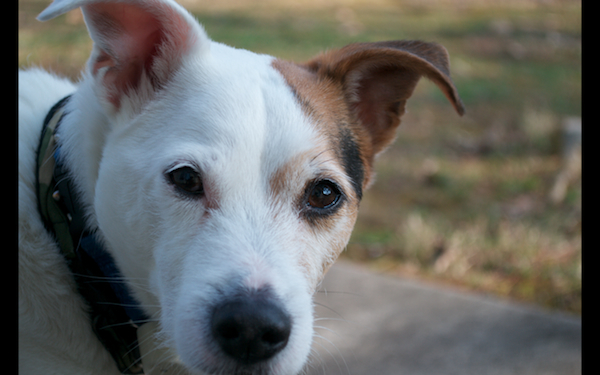
Bruno
But so then I just fell over. And cried and cried. And put my face on his. And realized I hadn’t felt so much grief and confusion in so long—“grief,” like I couldn’t remember it, or like the word had never come to mind to describe my state before that moment. And I realized I hadn’t really cried like that in such a long time. And I couldn’t figure out why I was so upset.
I at once felt I was thinking of everything I’d learned about, everything I’d cared about, all this stuff I had read about race, and gender, and poverty, and violence, and all of it; and nothing. All of the sass that I’d given my mom when she’d talked about “being careful,” and the way I scoffed and smirked at white folks that cross the street when they see me coming to pass; I felt more than conflicted. How was I supposed to feel? What did those kids think I was? What did I represent? Assimilation? Disassociation? Would they be wrong? Privilege, for sure, but something worse even? Or maybe they didn’t care. Maybe they were kids just doing and not caring. And what were they to me? What was I assuming of them? How could I know anything about them, save, maybe hazard a shoe size for one of them? But, I felt like the perfect target. Like I really deserved it. Though I didn’t know why. And the choice of object itself: not even a shoe, but a sandal. How incredibly absurd.
But so it’s a month and a half later now and I still don’t know how to lie at night such that my neck won’t hurt when I wake up; or how to put myself back to bed when I can’t sleep because of it. But I’m sure I’ll figure it out.
But, I still can’t figure out what to make out of this story that the crook in my neck tells me. And I haven’t figured out the story that the tension in my shoulders tells me sometimes when I see people who look–and don’t look–like me. But my shoulders are so sore from it. I just keep trying to relax, keep my windows open, my white music unselfconsciously loud, but I don’t get what I am trying to prove–if I am, indeed, trying to prove something.
I still don’t understand what my body’s telling me or what I’m supposed to learn from it. Or how I’m supposed to unlearn a quite literally embodied fear. Or how to make sense of the fear in the first place. Every time I crack my neck, I realize that I still don’t get it.

