
So much of my identity has been shaped by my body and the way the world around me has treated it that I often find myself wondering, “If I’d had a different body, who would I be now?”
Some of my earliest painful memories are of becoming aware of my weight as an issue—my parents’ noticeable concern for my young and rapidly changing body, being called fat by my peers, the inability to share clothes with friends, the list goes on.
As my fat seemed to be under attack by the world around me, I subconsciously began to fashion armor around it. My attempts at protecting myself began with denial, not letting myself believe I was a “fat kid.” At eight years old, I still had the sense that I was fantastic and beautiful and I wasn’t ready to give that up. However, as people grew meaner and more eager to inform me that I wasn’t as beautiful as I thought I was, I came to a sort of sad acceptance.
But because I was a rambunctious and attention-seeking kid, I decided that maybe I could use being fat to my advantage. I realized fat could be funny and began to use my belly in my comedy routines in the schoolyard and at home. I would rather be fat and funny than just fat. As I got older, however, my loud and unselfconscious comedy act transformed into a show of quiet and self-deprecating jokes about my body, and I seemed to be the sole audience member. As a matter of fact, much of the negative feedback I’d been given about my body became internalized as the years went on.
I remember starting to acknowledge my body as unacceptable when I went to middle school. Girls were transforming into young women and their bodies were becoming desirable to boys. My body, however, was still the fat body I’d established in elementary school. While I continued to use humor as a shield, turning into a class-clown and joining the drama club where I felt at home with fellow weirdos, I yearned to be to like the skinny or “normal” girls who seemed to gain acceptance without trying. While I was fortunate enough to get cast in lead roles in school plays, mostly as the comic relief, I secretly longed to play “the girl”—the ingénue character who is simple, pretty, and gets the guy and the last bow at the end of the play. I quickly learned that the fat girl never gets this part, and she never gets the last bow.
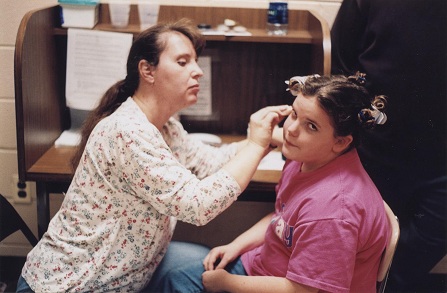
Getting my makeup done for a play in 6th grade.
Thinkin’, “Had enough of your shit, ‘the girl!'”
During the summer between middle and high school, I rapidly lost weight. I had spent much of middle school “growing into my body” and as my summer after eighth grade was spent compulsively biking (since I was now allowed to bike outside of my neighborhood—woohoo!), the rest of my fat began to melt off of me. Upon entering high school, I was struck with the strange realization that I was now considered attractive. Boys approached me in the hallways and pretty girls, who in previous years would not have spoken to me unless we were paired up for a school project, began to act friendly towards me. Despite suddenly gaining the acceptance that I had desperately longed for, I felt extremely uncomfortable in my skin. I hadn’t actively decided to lose weight—it just happened. And people telling me that I looked “so good” or “so pretty” made me painfully aware of a change that I had hardly recognized myself. Inside I was still the funny fat girl, but outside I had become “the girl.”
I can only describe my freshman year of high school as an intense identity crisis. Ever the actress, I decided I needed to play the new role I’d been unwittingly cast in. I traded in my punky middle school attire for polo shirts and hair ribbons and obsessed about serving sizes and riding my bike every day after school. This, however, only made me more unhappy and uncomfortable with my body. I plunged myself back into drama club, hoping for an outlet for my frustration and for that sense of belonging it had given me in middle school. Wouldn’t you know it? I was cast as “the girl” in my first high school play… and it turns out, being “the girl” was pretty lame.
As high school went on, my confusion dwindled. Drama did indeed introduce me to people who were like me—strange and funny people who were protective of their fragile hearts. The friends I made there were able to bring out the qualities that my thin body made me feel I had to hide. I could be that rambunctious kid again without feeling that I had to wear any armor. I grew more comfortable with myself each passing year, and my body became full of knowledge and experiences and I started to become aware of it as just a body.
My body continues to change, my weight fluctuates, and people still want to tell me what it is and what I need to do with it. I can’t say that I feel comfortable with it every day of my life as it has spent many years as a site of shame and confusion for me. However, I would not trade the bodies I’ve had for anything. My fat made me who I am. For better or worse, it has made me funny, clever, and protective of myself. My loss of fat, in turn, brought me to a path of self-discovery that I would be lost without.
Is it a positive thing that my selfhood is tied so closely to my body? I really don’t know. On one hand, I would like to be able to say that I went through my adolescence at various sizes and was unfazed by people’s opinions of my body. On the other hand, I do like the person I am today, and I have my body to thank for that.


This is really wonderfully written and honest. I can relate to it a lot. Your thoughts about the way others transformed how you viewed your body was especially really intriguing. Thanks for sharing something so personal and tackling this really complex subject with some keen insights.