
Thinking about mental health, part 1:
I begin this post with a question: How can we tell if someone has a mental disorder? According to the National Alliance for Mental Health, “a mental illness is a disease that causes mild to severe disturbances in thought and/or behavior, resulting in an inability to cope with life’s ordinary demands and routines.” According to Wikipedia, it is “is a diagnosis, most often by a psychiatrist, of a behavioral or mental pattern that may cause suffering or a poor ability to function in life.”
What’s most interesting to me is that there are two parts to the definition- “A disturbance in mental thought/pattern”, and “Affects the individuals’ ability to function in life.” Taken at face values, these make perfect sense, if someone has abnormal mental thoughts and it makes them unable to function normally, then they have a mental disorder. Now, what are we comparing “abnormal” to? The “normal” identity, which has been crafted by society.
With that in mind, we can see that the concept of “mental disorder” can be considered a societal construct. Of course, this means that the concept of “mental normality” can also be considered a societal construct. A cute example that shows this that the shifting views of transsexualism as illness. Currently, DSM states that transsexuals suffer from Gender Dysphoria. I remember before that transsexuals used to be considered an illness altogether.
Of course, the fact that mental normality does not exist is a terrifying concept for some, as seen by the decisions some parents make to sacrifice their children’s body health in exchange for better mental health. I know it’s unnerving to me to see another individual who acts in ways that are not placed into the “correct methods of acting”, as that reminds me of the eternal fact that without outside intervention, my actions could also fall into “incorrect methods of acting.” (Note, I may have a diagnosis of being mentally abnormal and have gone thorough intense mental corrections so I can pass as mentally normal. I also understand that there is some level of prejudice in my actions.)
The emotional aspect of that anecdote aside, something that strikes me is the fact that I am judging other by their day-to-day actions in society. On the other hand, if I did not see any “incorrect methods of acting”, then I could say they are “normal.” Of course that’s not the case all of the time, as there as those who can pass as normal in a social setting. Thus, what I consider “mentally ill” consists of “those who act abnormally enough.” I am unsure of how others operate to categorizes identities in terms of mental health.
On the other hand, I know that individuals who suffer from mental illness are distinctly sure of their own problems. There are anecdotes describing their own pained experience. (One of mine is that when I was young, I remember periodic meetings with a psychiatrist. This comes to a head where I placed myself in a dangerous situation, and one of the psychiatrist had to break trust in me for societal safety. Since then, I developed some sort of distrust, an unnatural level of fear and aversion, towards psychiatrists. It requires professional aid to resolve.)
From this, we can say that mental illness is both a personal and societal identity. However, if “mental normality” is a social construct, then “mental abnormality” can be considered also a social construct. But if mental illness is a personal effect, then that means that it is a “real concept.” There lies the absurdity- mental illness, according to society, is a state of mind. According to the individual, it is a fact of being. According to society, one can just get normality. To the individual, they cannot by themselves. This comic explains more than my words ever can:
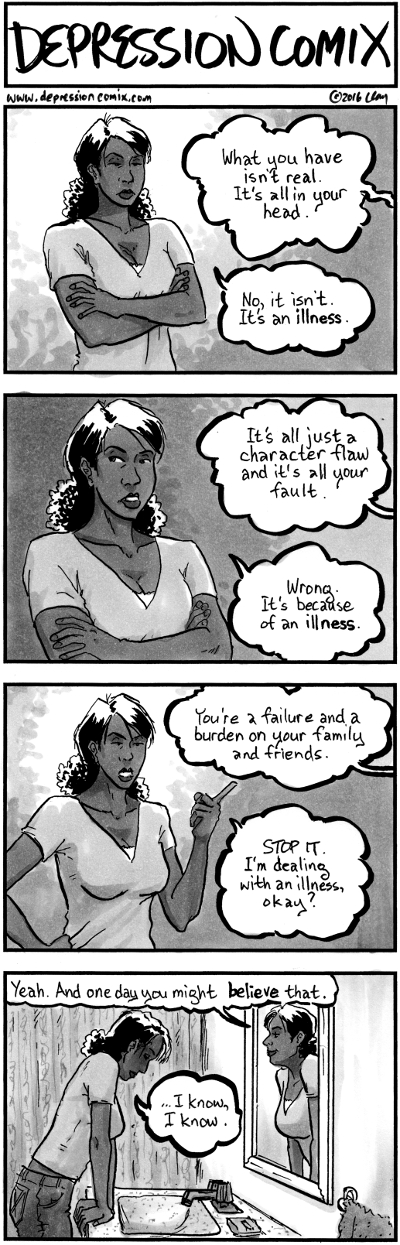
http://www.depressioncomix.com/posts/305/
To me, that understanding dramatically changes the meaning of what it means to have a mental illness. It’s both personal and societal, but because society has slipped away from consciousness into normality, all that can be seen is the personal effects. So the first steps towards better mental consciousness is understanding that self is linked to the society, and the society links towards individuals. So, those who have mental illnesses are people, sometimes patients.


Mental disorders have always been present in humans throughout our history on this planet. I feel that as a society we haven’t come to a concrete definition for mental disorders, because it is an enormous topic with finite details which in themselves are extremely complex. It would be inappropriate to attempt to define Mental Disorders at this current time in medicine, because even though we have studied and learned a great amount, we still may not have sufficient evidence to clearly and appropriately create a definition that suits it. I agree with your perspective that mental illness is both a personal and societal identity. One who is diagnosed with a mental disorder instantly becomes an outlier to society. Really interesting points and perspectives on a difficult subject.
I think it’s interesting (and by interesting I mean terrifying) the extent to which society obsesses over “normalizing” mentally ill people. I personally have a variety of complex brain stuff and am constantly told to ‘just get help’. Since I, too, have had a mental health professional violate my trust (with the result of an involuntary imprisonment in a mental ward) that is literally the last thing I want to do. The fact is I ~am~ normal in that my mental state is the same as it’s always been.
Pingback: Mental Illness, an existence defined by potential futures and progress | Unruly Bodies