
The way that body dysmorphia can actually change the way you see and think about yourself should almost be illegal.
I’m a very average build, and when I am thinking rationally, I know this about myself. But, when body dysmorphia takes hold, I do not picture myself the way I am actually presenting to the rest of the world. This is so strange to realize, it’s a daily mind game I have to play with myself. When I’m not thinking clearly, and I go to think about how my body might look to those around me, I picture myself taking up so much more space than what is real. I picture myself almost a foot taller; I feel as though I am towering over everyone around me. I picture myself 100 pounds heavier; I feel as though I am way bigger and wider than what is true.
Body dysmorphia takes a hold of everyone’s lives differently. For me, it led to some unhealthy eating and exercising habits, such as skipping meals and overworking my weak physique. It led to ideas that food is bad and that I must work off every calorie I consume. During this time, I avoided mirrors and refused to be in pictures. I never wanted to see myself and felt bad for those who had to see me, so I even isolated from friends. But I realized no matter how I changed my eating habits, how many times I went to the gym, how long I stayed away from my friends, I was not becoming any happier.
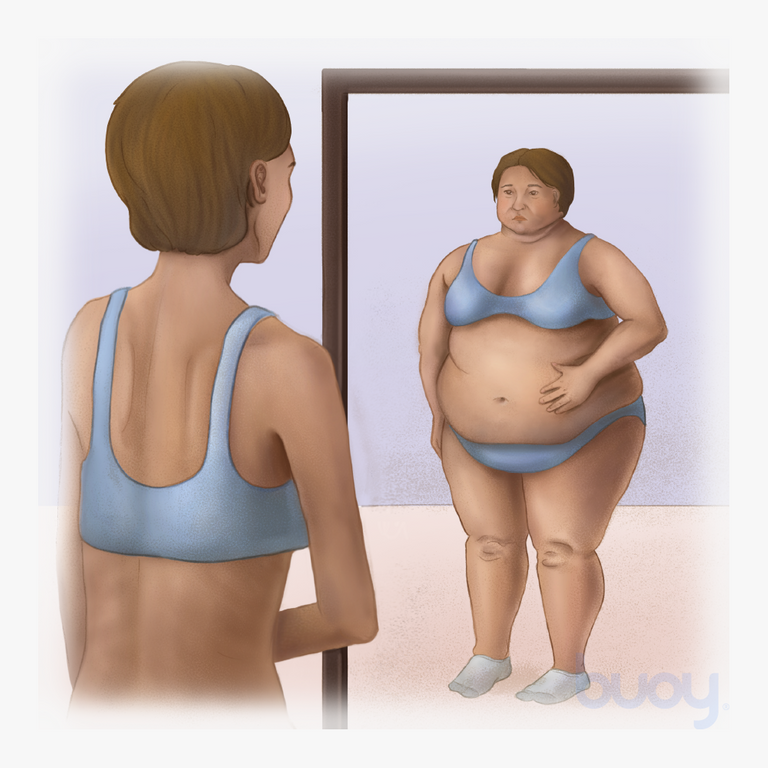
Through researching what was going on in my head, learning what it meant to have feelings of body dysmorphia, learning how to create realistic goals for myself and my body, and learning healthier habits to achieve those goals, I made progress. I learned that food is fuel, and it will always be impossible to preform well during workouts without eating. I learned that workouts are not supposed to be punishments, they are supposed to be a celebration of what our bodies can do for us. However, all of this does not mean I do not still have feelings that I am larger than what is real.
Now, the mirror has become my friend. A quick glance at myself became a reminder that, “Hey, you’re actually a normal size, you’re not a giant”. This can go a long way for me on days that I am struggling to remember what I really present to the world. I can look in the mirror and see that I am not towering over everyone else and I am not a giant as I saw myself in my head. So, very frequently, almost every chance I get, I glance at myself in a mirror or another reflective surface. This causes comments from friends and family, ironically, they see me as someone who is just full of themselves. I’m not sure I’ll ever find the words to properly explain to them this concept that so detrimentally effects my brain.
Maybe this will be something I work through for the rest of my life, maybe one day I will wake up and these feelings will be gone. Either way, it is important to understand the way that our bodies are presenting to the world will always have some effect on us in one way or another. It’s just important to not solely focus on the way we are being perceived; there is so much more to life.


I think you make some very good points here and your story is powerful. I would push back on some of the language you use to describe fatness, though. Specifically the use of the word “normal” and the stigmatizing implications of “you’re normal, you’re not a giant.” First of all, having a BMI outside the “average” range is actually more common and normal. Second of all, it is not a bad thing to be fat — you personally may not wish to look that way, but framing it as a universally bad thing can shame fat people for just existing in their bodies, which reinforces pretty harmful rhetoric. I myself have dealt with body dysmorphia for a few years, and I think it’s useful and important to separate the discomfort of having a distorted perception of your own body from the supposed discomfort of simply being fat, which is not an inherently negative thing.