
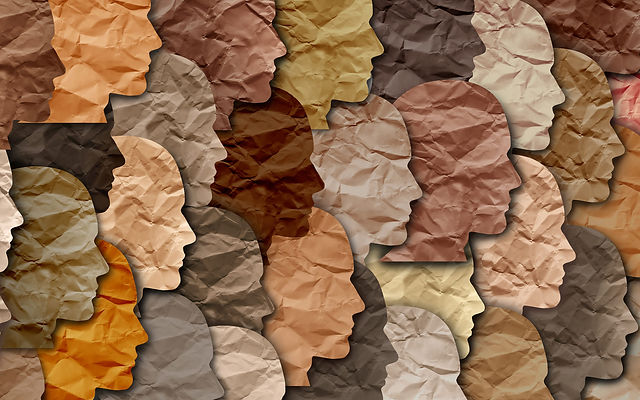
this is a typical response to racism, made with good intentions and in good faith. even in alcoff’s “Towards a Phenomenology of Racial Embodiment”, it is highlighted that the liberalism concepts of universalism purport that differentiating between race through color impedes equality, essentially saying that acknowledging color is unseemly. despite that good, this statement can be seen as ignoring the privileges certain people have over others and can invalidate the struggles some experience because of race. i’ve found myself trying to explain this to people in the past, and it is (not surprisingly) very difficult. when having discussions about race with someone who is not the same race as you, the conversation can become very defensive, very quickly. as a black person, i try to have these open discussions with friends and peers so we can all learn from each other. for some reason though, i never feel like i get much out of the conversation. since we aren’t used to having these tricky conversations, they continuously feel like uphill battles. talking about race with other black people is different, and easier: because our experience with race is similar.
it is extremely important in this day and age to educate ourselves on the experiences of everyone. but it just can’t be denied that it is typically easier, and maybe more comfortable, to surround yourself with people who have similar experiences to you. there is a lesser chance of a cultural barrier, and it can be easier to form connections because of this. at my high school during a school-wide assembly, my principal said that while he walked through the cafeteria, he noticed that most tables were primarily filled with people of the same race. he was perfectly correct: whether it happened intentionally or unintentionally the people of my school typically were friends with others that looked like them. originally when he stated this i thought “what’s the problem with that?” and in my opinion its not a problem: it makes sense that we as humans choose to be around people like us. but we can’t truly learn about the experiences of others if we don’t allow ourselves to.
the main reason why the “i don’t see color” saying confuses me is because i see color. a lot. i notice it in every new environment i’m in, especially in the workplace or at school. as a black person in the STEM field, it is very obvious to me when i am sometimes the only black person in the room. or as a black person working in an IT department, it is very apparent to me that i am one of the only persons of color in the office. or even just moving about my daily life, acknowledging the fact that because i am black, i will be perceived in certain stereotypical ways in public. my main point is, that having the privilege to “not see color” means you are desensitized to the experiences that people of color experience every day. we all, as humans, need to develop a better understanding of our shared and individual experiences. we also need to learn empathy for each other, and compassion. there is still a very long way to go for racial equality, but acknowledging one another, and our color, is the first step.


I just referenced the “I don’t see color” phrase in my latest weekly response! I really enjoyed this post. Well put.
Love your photo at the beginning of the blog and this post helped in constructing my view on my own blog. “the main reason why the “i don’t see color” saying confuses me is because i see color. a lot. i notice it in every new environment I’m in, especially in the workplace or at school.”
Lets be real, who doesn’t VISUALLY see color? Its easy to become offended and defensive, but in order to get to a better understanding of who we are and become a more well-rounded person, we gotta get comfortable with the uncomfortable. I’m grateful that you see color and advise for others to do the same!
I love your post. I know exactly what you mean that conversations can feel like you get nothing out of them when race is the topic. In high school English talks we held Socratic seminars and they were usually very informative for everyone. However, when race or any big social issue came up, everyone basically took a defensive stance and took all of the substance out of their words. They made short statements which added nothing to the conversations and caused everyone to go in circles repeating each other.
I feel that “I don’t see color” is only used by Caucasians that have lived a sheltered life. Like you mentioned, they usually use the phrase in good faith, but are simply too ignorant. The majority of people of color have obviously had a different life experience than themselves, and pretending like that isn’t the case is racism in itself.
Hello! I really appreciate that you wrote about this because the statement “I don’t see color” makes me very annoyed. I feel as though it is literally impossible to not see color. It is one of the first things that people notice about each other. It also sweeps under the rug all the atrocities that have happened because of color. Ignoring the reality of things doesn’t make it not exist, it just pulls a hood over your eyes and causes you to not acknowledge the realities of life.
Hello, I really enjoyed reading your blog and I personally resonate with it as a black woman in America. Colorblindness is a form of racial denial. For me, their skin color matters very much because i experience racism on a daily basis. To say “I don’t see color,” is to say we don’t see the racism people face. Ignoring skin color will only helps to maintain inequities and systemic racism.