
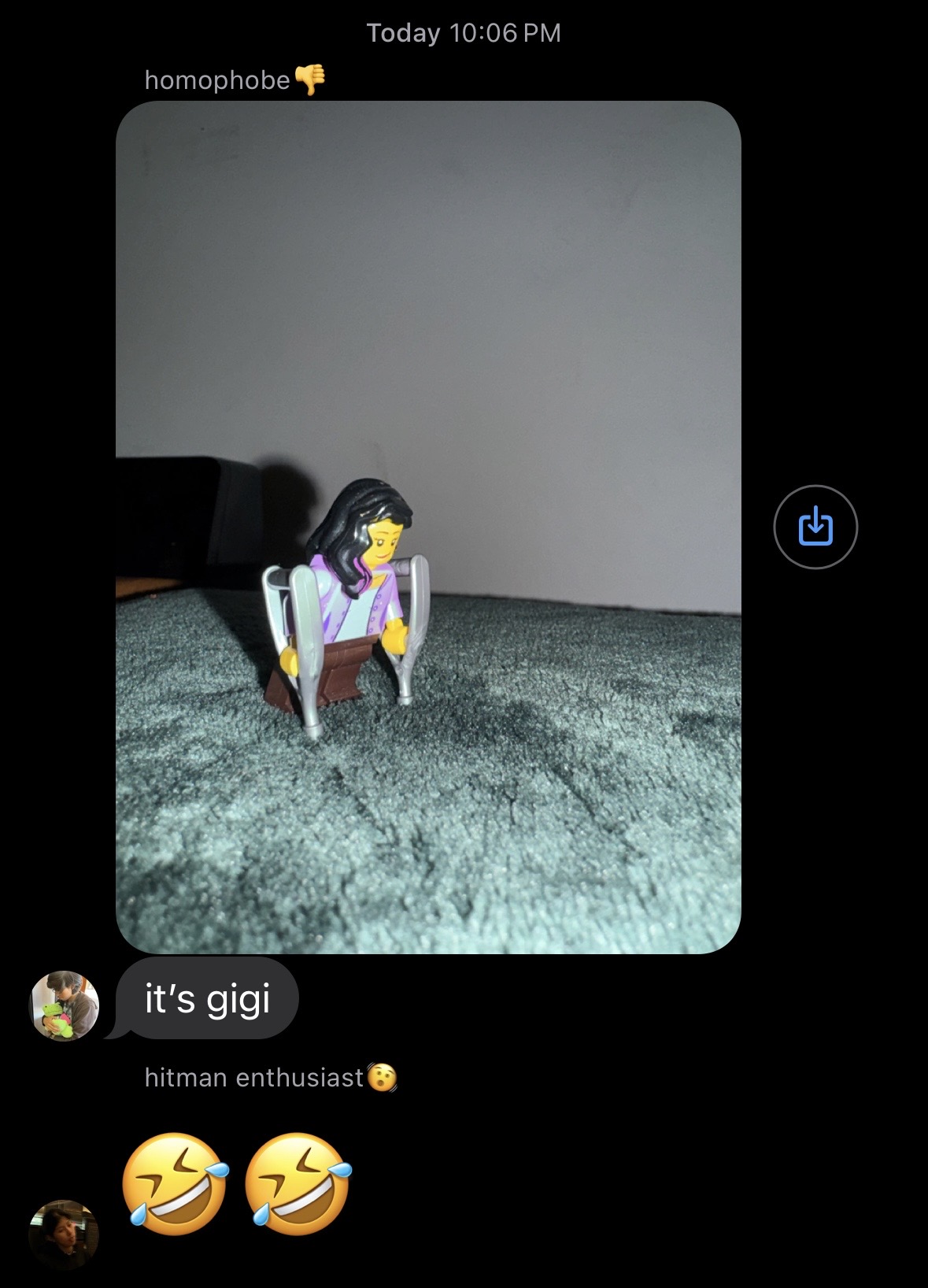
I was on crutches for three-ish weeks and wrote a couple of entries on my experience!:
…
Everyone’s been so accommodating, and I appreciate it immensely but it also sort of makes me want to eat my insides. When my friends go out of their way to pay for my drinks or bring me snacks, or when a teacher runs to grab the door for me and brings the paper to my seat, I know they’re being kind and I would likely want to do the same if roles were reversed but I can’t help being overcome with guilt. The fomo too, absolutely excruciation. Normally, I’m perfectly content staying behind if I don’t feel like leaving my dorm and my friends go out and study or grab lunch, but now it feels different, this time it feels out of my control. I’m not staying behind because I chose to, but because my body is sore and limited and forcing me to stay behind. On the other hand, when I do push myself to go, I slow the group down with my slow steps and while logically, I know no one’s holding it against me, i feel the constant need to apologize and regret leaving in the first place.
Also, sometimes I take just one crutch instead of two. My best friend was quick to express her disapproval but I insisted that I felt less silly looking when I just used the one. That, and I’ve found that people ask less questions. Maybe its because they could less easily see it, or maybe they thought it couldn’t be that bad if I was just using one so they didn’t ask, but i appreciated every time it was left unvoiced, everytime I didn’t have to think about what kind of assumptions people were making.
…
I felt so sore waking up. I did some youtube research two days ago and have since corrected the way I was previously using the crutches but i presume just the fact that I use them at all is going to be a workout for my arms and abs as they have to bare quite a bit of weight to keep me balanced. I was also internally snappy but externally did my best to politely tell my roommate to please stop asking me how I was feeling after the three times i dodged the question over text. Because truthfully, I felt bad, I was in pain, and I didn’t want to talk about it.
…
People are too nice, as in, I can state semi-confidently that we do not treat those with actual disabilities with this much out-of-the-way kindness. Is it because we assume they don’t need/ want the help? That’s my general mindset, if someone asks for assistance, I will gladly help them, but I don’t want to infantilize them by assuming they can’t accomplish things themselves. But now people are holding the door for me while I’m still two hallway lengths away, offering to grab me lunch and bring it to my dorm, one girl turned around at the bottom of the staircase and asked if she could hold my backpack, multiple have told told me they’ll pray for my health. And maybe I just have a very warped perception of acts of kindness but this is the most back to back interaction I’ve had with strangers possibly ever and it feels so strange. Of course, I take pride in being very polite, but I’m so used to keeping to myself in public, seeing how many social rules are changed when someone is “hurt” is interesting.
…
The embarrassment is the worst part. Which is pretty dumb because there’s some mornings where I wake up after a long day of walking and the pain is so bad I can’t get up for hours, and yet, the embarrassment is what I still cite as the worst part of using crutches.
They’re just so loud and people never fail to turn their heads. And even if it’s just a passing thought, i know they’re wondering what caused it. The knowledge that i’m being perceived at all, that I’m more than just a passing person in a crowded pathway, makes my skin crawl. But I was dumb and got hurt and this is my penance.
Also, taking 25 mins on average to get to class is not ideal. We’ve spoken in class how inaccessible this campus is, but to experience it, even if just a bit, has definitely made me understand it in a different way. Swinging on the crutches allows me to go much faster, but takes up so much energy I can’t do it for long without loosing my breath and needing a break. So what would normally be a quick shortcut through Erickson field and walk down to Dunkin’ for a morning egg sandwich now requires three elevator rides (dorm, middle of commons, commuters lounge) and 15 minutes of agonizingly noisy walking. And truly I can complain for however long I desire, in blog world nothing can stop me, but I am so so privileged to feel secure in the knowledge that this is temporary. Urgent care said 4-6 weeks and I’ll feel better. Millions of people use mobility aids for life, with varying conditions that some alternative routes are compatible with and others are not. I want this experience to mean something, I hope I never fail to offer aid, to amplify voices demanding basic necessities that able-bodies neglect are not a given, and most of all, respect an individuals agency.


This is a thought I have had before: I wonder if tearing an ACL or having a bad sports injury has ‘radicalized’ a sports jock type hypermasculine cisgender guy before. And by radicalize know that I actually mean ’caused empathy and solidarity to someone outside of themselves’.
While I am sure that you, like other (temporarily or chronically) disabled people, are tired of hearing this ‘classic’ line, I do hope that you are feeling better! As Eli Clare illustrated in Brilliant Imperfection, many people are very quick to comment, stare, or outwardly perform acts of kindness when they see a visibly disabled person. The tense discomfort of being noticed and catered to, along with the appreciation of being accommodated, are viewpoints that often coincide. Even though it may feel as though these should be dichotomous, nonconcurrent thoughts, one should not have to limit oneself to solely feeling grateful or even having gratitude at all. There is a great emotional complexity to being seen as disabled, even if temporarily, and one should not have to hold any guilt for acknowledging that. As you mention, very few seem to notice the ways in which our environment is blatantly inaccessible unless one is put in a situation where such barriers are directly experienced.
I find this so interesting to read as a disabled person that does use crutches sometimes. All these things are likely issues you have heard about, but never experienced, and first of all I would like to say I am glad you are feeling better and able to ditch the crutches. Secondly, it is nice to see learning and compassion come from such a shitty situation, your perspective on inaccessibility is one few take on in a state of temporary disability. I have experienced many of the feelings you described, and it makes me feel less alone knowing there are some able-bodied people out there that actually take the lessons of the universe to heart. Something that I see with temporarily and permanently disabled alike is a lack of education on how to adjust and use mobility aids properly- it is something that can truly be detrimental and actually was a contributor to disability worsening. So uh, medical system, do better.