
TW: Discussion of Eating Disorders
I have struggled with body image for most of my life. I can vividly remember the negative comments my mom would say about her body when I was about 5 years old, such as “I have too much flab here”, “This is sagging”, “Look at my C-section scar, so huge”, and “I am so huge”. I can’t think of a time when the topic of appearance came up, and she wouldn’t call herself fat. And when my mom called herself fat, she was really calling herself disgusting and undeserving of love.
A lot of these conversations would lead to my mom saying, “God, I wish I had your body”. “Enjoy it while you can”, like her scars and flab were the cost for me, and I must be skinny to make all of this change worth it. “It’s fleeting!” The societal definition of my happiness is fleeting, and she was trying to live vicariously through my skinniest. I was maybe 10 years old. This is the age when my mom stopped packing my lunches, and I pretended to pack my own. This was the beginning of my eating disorder.
My dad and brother also struggled with their weights for most of my childhood. Everyone in my immediate family felt the spotlight whenever they ate, moved, or just existed. Like how the Roxanne Gay said, “Fat, much like skin color, is something you cannot hide, no matter how dark the clothing you wear, or how diligently you avoid horizontal stripes”. And I could see that everywhere me and my family went together.
Whenever we went to my Granny and Poppop’s house, my Poppop made snarky comments about them eating too fast, too much, or too early. I remember being about 8 when my dad had an intervention with his father, while we kids were in the basement, about how he needed to stop commenting on my mom’s and brother’s weights. I kept imagining how I never wanted to feel a glaring look or hear a comment like that directed at me from my Poppop. I can’t gain weight, or I will be miserable like my family is, or even worthless in the eyes of them. I don’t want to live life always being confronted with the trap of everyone seeing me only by this one aspect. I could feel how soul-draining it was for them, and I drained my soul to avoid it.
I was also seen as the example for my family. “Gosh, I wish I could eat as slow as you, Megan”, my dad would say when he finished his plate before me. The eyes were also on me, but my family didn’t know that I never felt like I could get seconds, even when I was STARVING. My stomach got so bad that I couldn’t hold anything down if I ate before noon. It was so used to starving it couldn’t handle when food entered my body. I would eventually repress hunger so badly that I just forgot to eat unintentionally. The beautiful skinny daughter or granddaughter was the ultimate accomplishment for my family. And I was always on edge if anyone saw me slipping.
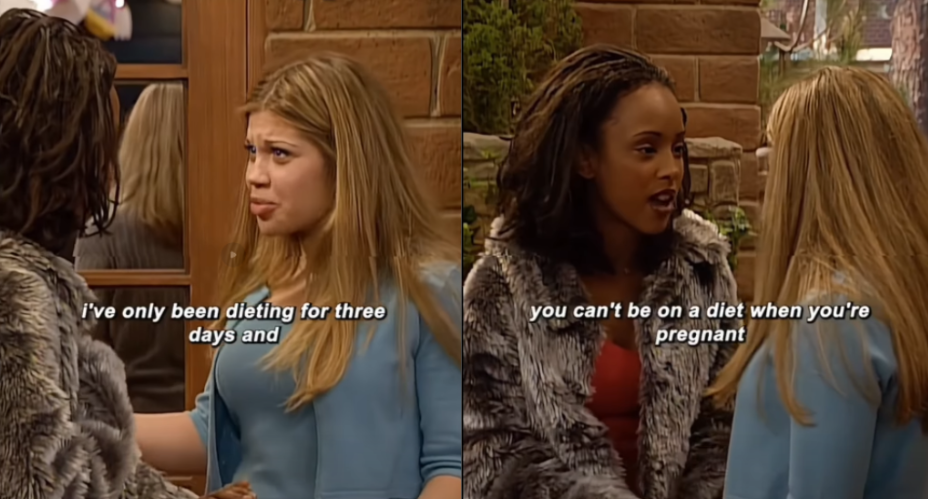
I know this isn’t something my mom ingrained in herself. Or my dad. Or brother. Or Poppop. It’s been created and fed by societal pressure to be skinny, or be undesirable. And this pressure is even more extreme and socially acceptable for women. Systemically, women are seen as reaching their full potential when providing the most pleasure for men, and that includes fitting into the traditional female beauty standards. I am not saying that this pressure isn’t present for men, but men often received more grace for wearing looser clothes or not looking perfect all of the time. One really specific example I can think of is if a woman gains some weight, it is an automatic assumption that she is pregnant. The one example in media that came to my mind was in Boy Meets World, where the female lead, Topanga, has gained some weight and her friends and husband assumed that she is pregnant. It’s as if the only justifiable reason for a woman to gain weight is through pregnancy and sometimes not even then. When looking up images for this blog post, I learned that this specific episode was called “She’s Having My Baby Back Ribs”, which made me want to throw up. Unless a woman is bringing life into this world, if she does not fit the traditional skinny box, she’s unattractive and less desirable in all aspects of life, not just romantic ones.
Additionally, plus-size leads weren’t really a thing in the shows I grew up watching. They were usually the butt of the joke or the comedic sidekick, like Soos in Gravity Falls or Willow in Liv and Maddie, where they were portrayed as unappealing in ways not because of their weight, but because of society’s perception of their attractiveness due to their weight.
All of this to say, these were the emotions I felt when reading the Roxane Gay articles. Reading her work did bring up difficult emotions about my body image that I thought I had long buried. But I guess that’s the point, this pressure never truly leaves you. No matter if you’re viewed as skinny or fat, the way society pushes labels and worth from weight can be detrimental to people of all body types, impacting how we treat one another, view if someone is doing well or poorly, and interact with food, exercise, and health.
The societal pressure around attaining and/or maintaining the perfect weight really does cause “my body to be a cage of my own making”, but its not just of my own making. Most of the blame is society, our culture, and the repercussions ever person experiences and carries with them due to our unacceptance of weight. It’s similar to the Social Model of Disability. What’s more debilitating isn’t our weight, but how society has preconceived notions about our weight and makes life less accessible for thicker body types.
Society has forged this cage.


It’s hard to describe the shock I felt as I read through this post. Societal weight pressures are one thing, but family pressure is a whole other ball game. I vividly remember having to run to the bathroom and cry my eyes out at a Red Lobster after my grandmother commented on how much I was eating (mind you, I only had 2 biscuits). That memory is deeply ingrained in my mind, but it’s also one of the only examples I have of my family really shaming my size in a direct, unabashed way. I couldn’t imagine hearing, let alone receiving, those kinds of comments from my family 24/7. It’s heartbreaking, really, because while you know that it was terrible for your relatives to be making comments on everyone’s weight (to the point of an intervention, WOW), there’s no easy way to “blame” them because they’re a product of the extremely toxic and fatphobic society they were raised in. I truly pray that your family has become less weight-obsessive, because it’s genuienly such a dangerous mindset and environment to be in. You are so strong, bestie, and I’m so proud of you for overcoming and continuing to recover from your disorder.
I liked how you talked about how body image issues can start at a young age, especially from the people around us. It’s interesting how even small comments about someone’s weight can affect the way they see themselves for so long. I agree that society puts a lot of pressure on women to look a certain way. I also liked how you connected your life to Roxane Gay’s writing. It shows that our insecurities aren’t always created by ourselves but also by the expectations of others.
I had some of the same experiences as you and how my mother always constantly brought up weight. I know a lot of people who are just now uncomfortable with eating in front of people for fear of judgement and just being ridiculed for maybe eating too much, too fast, too slow or not at all. It’s all mostly a trick because a lot of the time you will never be right and it’s exhausting. It makes me feel a bit better that I’m not alone but also sad that this is happening to so many people.